


Impact of organised cervical screening on cervical cancer incidence and mortality in migrant women in Australia
- PMID: 23092207
- PMCID: PMC3573959
- DOI: 10.1186/1471-2407-12-491
Impact of organised cervical screening on cervical cancer incidence and mortality in migrant women in Australia
Abstract
Background: Organised cervical screening, introduced in 1991, appears to have reduced rates of cervical cancer incidence and mortality in women in Australia. This study aimed to assess whether cervical cancer rates in migrant women in the state of New South Wales (NSW) showed a similar pattern of change to that in Australian-born women after 1991.
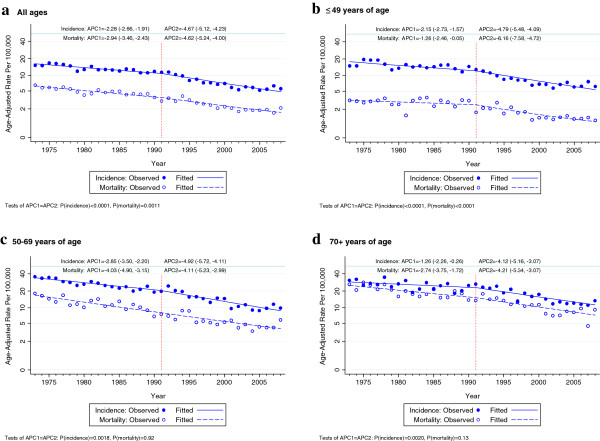
Methods: Data from the NSW Central Cancer Registry were obtained for females 15+ years diagnosed with invasive cervical cancer from 1973 to 2008 (N=11,485). We used joinpoint regression to assess annual percent changes (APC) in cervical cancer incidence and mortality before and after the introduction of organised cervical screening in 1991.
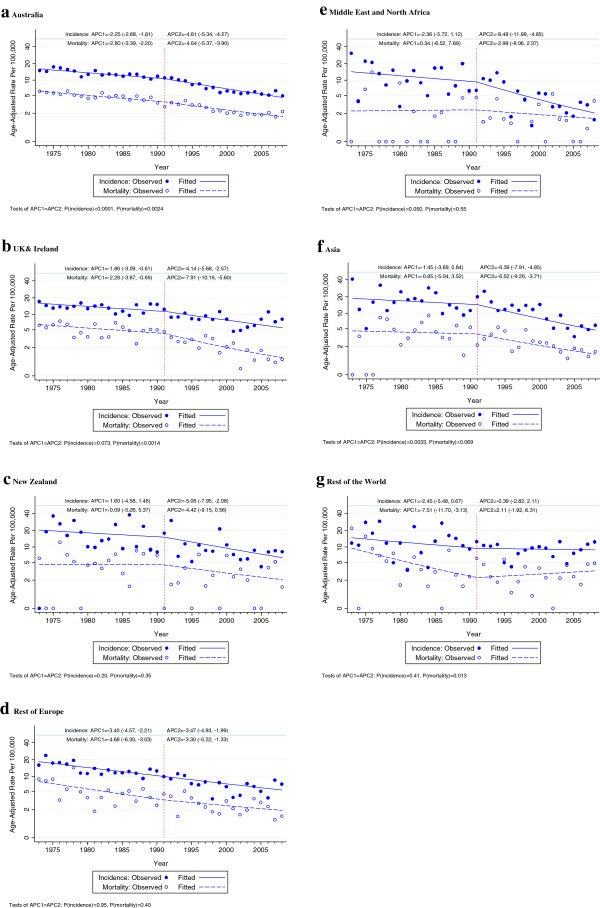
Results: APC in incidence fell more rapidly after than before 1991 (p<0.001) amongst women from seven groups defined by country of birth (including Australia). There was only weak evidence that the magnitude of this incidence change varied by country-of-birth (p=0.088). The change in APC in mortality after 1991, however, was heterogeneous by country of birth (p=0.004). For Australian and UK or Ireland-born women the mortality APC fell more rapidly after 1991 than before (p=0.002 and p=0.001 respectively), as it did for New Zealand, Middle East, North Africa and Asian-born (p≥0.05), but in other European-born and women from the 'Rest of the World' it appeared to rise (p=0.40 and p=0.013 respectively).
Conclusions: Like Australian-born women, most, but not all, groups of migrant women experienced an increased rate of fall in incidence of cervical cancer following introduction of organised cervical screening in 1991. An apparent rise in mortality in women in a 'Rest of the World' category might be explained by a recent rise in migration from countries with high cervical cancer incidence and mortality rates.
Figures
References
-
- IARC. Handbook of Cancer Prevention, Cervix Cancer Screening. The International Agency for Research on Cancer. 2005;10:201–212.
-
- Canfell K, Sitas F, Beral V. Cervical cancer in Australia and the United Kingdom: comparison of screening policy and uptake, and cancer incidence and mortality. Med J Aust. 2006;185(9):482–486. - PubMed
-
- Australian Institute of Health and Welfare. Australian Cancer Incidence and Mortality (ACIM) books. Canberra: Australian Institute of Health and Welfare; 2011.
