


doi: 10.3201/eid1811.120607.
Fatal respiratory infections associated with rhinovirus outbreak, Vietnam
Affiliations
- PMID: 23092635
- PMCID: PMC3559162
- DOI: 10.3201/eid1811.120607
Item in Clipboard
Fatal respiratory infections associated with rhinovirus outbreak, Vietnam
Emerg Infect Dis.
2012 Nov.
Abstract
During an outbreak of severe acute respiratory infections in 2 orphanages, Vietnam, 7/12 hospitalized children died. All hospitalized children and 26/43 children from outbreak orphanages tested positive for rhinovirus versus 9/40 control children (p = 0.0005). Outbreak rhinoviruses formed a distinct genetic cluster. Human rhinovirus is an underappreciated cause of severe pneumonia in vulnerable groups.
Figures
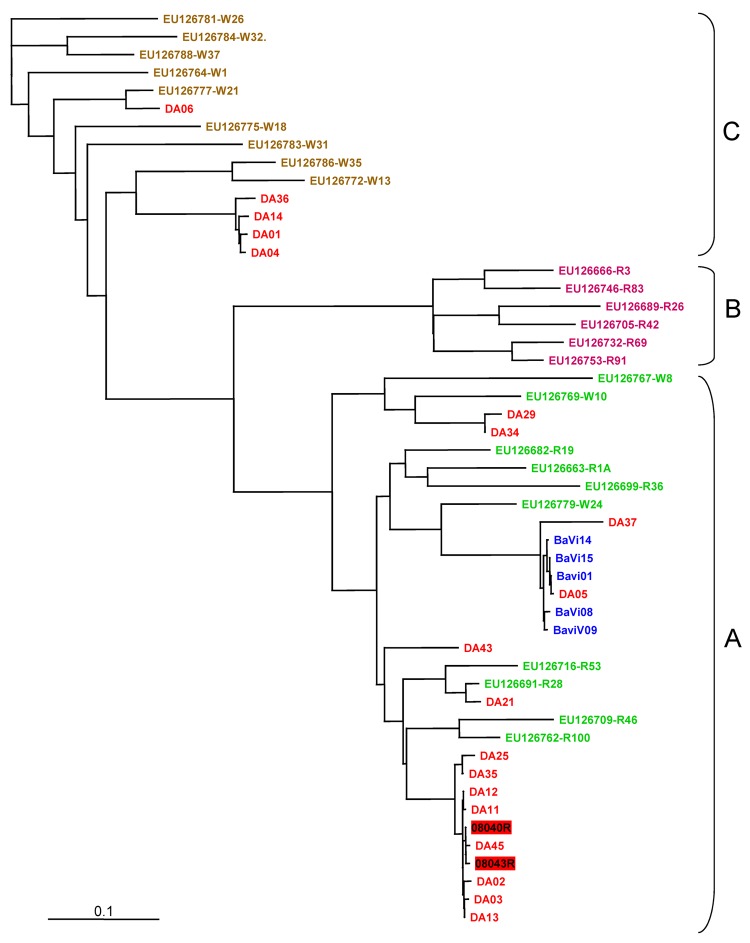
Genotyping of human rhinovirus (HRV) from outbreak and control specimens by P1–P2 sequence analysis. We compared 19 HRVs from the outbreak orphanage (red), 5 HRVs from control orphanage blue), and the following P1-P2 sequences in GenBank, according to Lee et al. (3). HRV-A group (green): EU126769, EU126779, EU126767, EU126699, EU126682, EU126663, EU126716, EU126691, EU126709, EU126762; HRVB group (orange): EU126732, EU126689, EU126666, EU126753, EU126705, EU126746, HRV-C group (brown): EU126786, EU126772, EU126775, EU126777, EU126783, EU126788, EU126784, EU126781, EU126764. Two HRV sequences from hospitalized patients were included (HRV number in red box). Multiple sequence alignment was performed by using the BioEdit program package (Ibis Biosciences, Carlsbad, CA, USA). Nucleotide distances were analyzed with DNAdist, the neighbor-joining tree of BioEdit package. The consensus tree was visualized by TREEVIEW v1.6.6 (Institute of Biomedical and Life Sciences, University of Glasgow, Glasgow, UK). Scale bar indicates nucleotide substitutions per site.
References
-
- World Health Organization. Children: reducing mortality. World Health Organization Factsheet no. 178. 2012. [cited 2012 Aug 29]. http://www.who.int/mediacentre/factsheets/fs178/en/index.html
Publication types
MeSH terms
Substances
Grants and funding
LinkOut - more resources
Full Text Sources