


ENU-induced phenovariance in mice: inferences from 587 mutations
- PMID: 23095377
- PMCID: PMC3532239
- DOI: 10.1186/1756-0500-5-577
ENU-induced phenovariance in mice: inferences from 587 mutations
Abstract
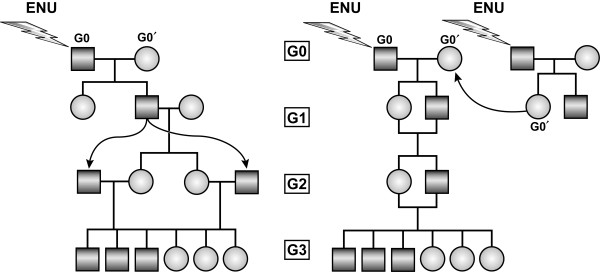
Background: We present a compendium of N-ethyl-N-nitrosourea (ENU)-induced mouse mutations, identified in our laboratory over a period of 10 years either on the basis of phenotype or whole genome and/or whole exome sequencing, and archived in the Mutagenetix database. Our purpose is threefold: 1) to formally describe many point mutations, including those that were not previously disclosed in peer-reviewed publications; 2) to assess the characteristics of these mutations; and 3) to estimate the likelihood that a missense mutation induced by ENU will create a detectable phenotype.
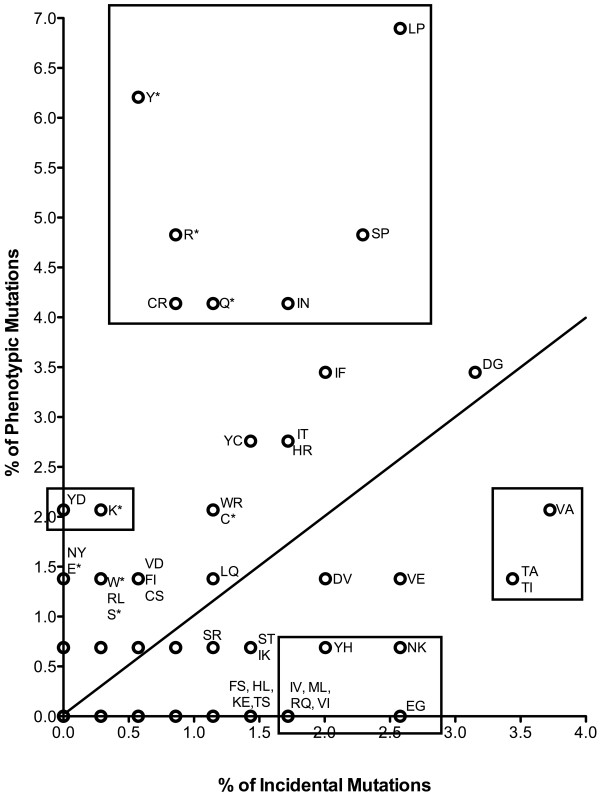
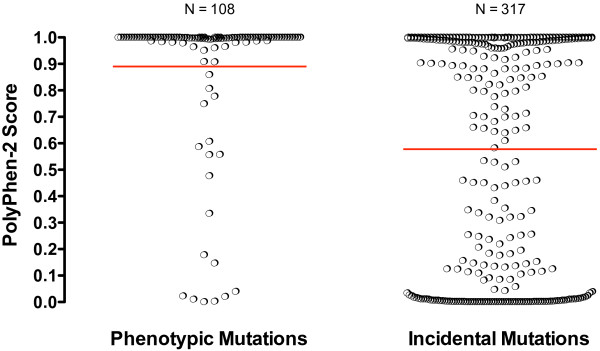
Findings: In the context of an ENU mutagenesis program for C57BL/6J mice, a total of 185 phenotypes were tracked to mutations in 129 genes. In addition, 402 incidental mutations were identified and predicted to affect 390 genes. As previously reported, ENU shows strand asymmetry in its induction of mutations, particularly favoring T to A rather than A to T in the sense strand of coding regions and splice junctions. Some amino acid substitutions are far more likely to be damaging than others, and some are far more likely to be observed. Indeed, from among a total of 494 non-synonymous coding mutations, ENU was observed to create only 114 of the 182 possible amino acid substitutions that single base changes can achieve. Based on differences in overt null allele frequencies observed in phenotypic vs. non-phenotypic mutation sets, we infer that ENU-induced missense mutations create detectable phenotype only about 1 in 4.7 times. While the remaining mutations may not be functionally neutral, they are, on average, beneath the limits of detection of the phenotypic assays we applied.
Conclusions: Collectively, these mutations add to our understanding of the chemical specificity of ENU, the types of amino acid substitutions it creates, and its efficiency in causing phenovariance. Our data support the validity of computational algorithms for the prediction of damage caused by amino acid substitutions, and may lead to refined predictions as to whether specific amino acid changes are responsible for observed phenotypes. These data form the basis for closer in silico estimations of the number of genes mutated to a state of phenovariance by ENU within a population of G3 mice.
Figures
Comment in
-
Functional annotation and ENU.BMC Res Notes. 2012 Oct 24;5:580. doi: 10.1186/1756-0500-5-580. BMC Res Notes. 2012. PMID: 23095518 Free PMC article.
References
Publication types
MeSH terms
Substances
Grants and funding
LinkOut - more resources
Full Text Sources
Molecular Biology Databases
Research Materials
