


Novel soybean oils differing in fatty acid composition alter immune functions of moderately hypercholesterolemic older adults
- PMID: 23096013
- PMCID: PMC3497965
- DOI: 10.3945/jn.112.164335
Novel soybean oils differing in fatty acid composition alter immune functions of moderately hypercholesterolemic older adults
Abstract
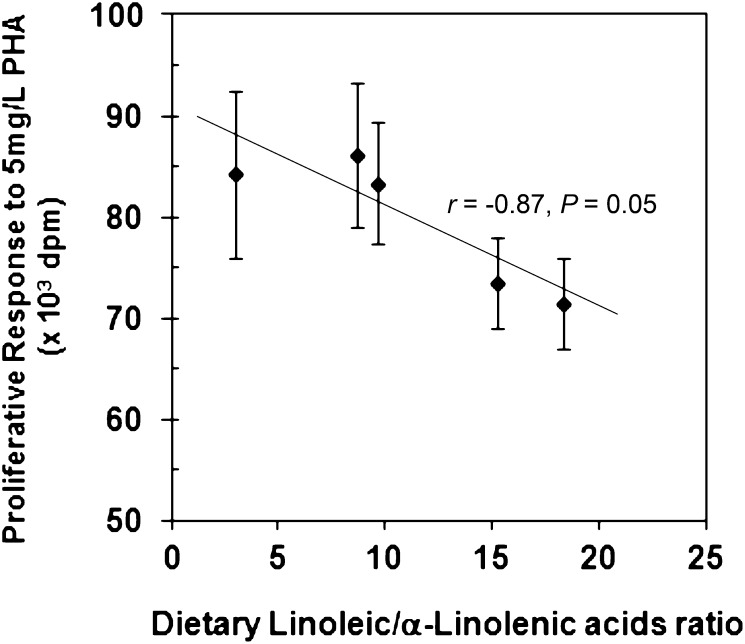
Linoleic acid (LA) and α-linolenic acid (ALA) are essential fatty acids that play an important role in modulation of T cell proliferation. The effects of consuming novel soybean oils varying in LA:ALA ratios on T cell proliferation and inflammatory responses were assessed in older adults. Eighteen participants (>50 y old) with elevated cholesterol concentrations (3.37-4.14 mmol/L LDL cholesterol) consumed 5 experimental diets in random order for periods of 35 d. Each diet contained 30% of energy as fat, two-thirds of which was high-oleic acid soybean oil (HiOleic-SO), soybean oil (SO), low-SFA soybean oil (LoSFA-SO), hydrogenated soybean oil (Hydrog-SO), or low-ALA soybean oil (LoALA-SO), resulting in LA:ALA ratios of 2.98, 8.70, 9.69, 15.2, and 18.3, respectively. Participants had higher proliferative responses to phytohemagglutinin (PHA) compared with baseline following consumption of SO (26%; P < 0.05), LoSFA-SO (22%; P < 0.05), or HiOleic-SO (24%; P < 0.05) diets. Proliferative response was similar to the baseline after participants consumed diets with an LA:ALA ratio >10 (Hydrog-SO and LoALA-SO). Post-diet intervention, LA:ALA ratios correlated with proliferative responses to PHA (r = -0.87; P = 0.05). An optimal proliferative response was observed at an LA:ALA ratio of 8.70, with an inverse correlation between proliferative response and LA:ALA ratios >8.70. These effects were independent of changes in the production of PGE(2), inflammatory cytokines, or cytokines involved in growth of lymphocytes. These data suggest that the LA:ALA ratio modulates the proliferative ability of T lymphocytes, which may be due to subtle changes in fatty acid composition of the phospholipids in immune cells.
Conflict of interest statement
Author disclosures: S. N. Han, A. H. Lichtenstein, L. M. Ausman, and S. N. Meydani, no conflicts of interest.
Figures
References
-
- Kris-Etherton PM, Taylor DS, Yu-Poth S, Huth P, Moriarty K, Fishell V, Hargrove RL, Zhao G, Etherton TD. Polyunsaturated fatty acids in the food chain in the United States. Am J Clin Nutr. 2000;71:S179–88 - PubMed
-
- Wijendran V, Hayes KC. Dietary n-6 and n-3 fatty acid balance and cardiovascular health. Annu Rev Nutr. 2004;24:597–615 - PubMed
-
- Weiss LA, Barrett-Connor E, von Muhlen D. Ratio of n-6 to n-3 fatty acids and bone mineral density in older adults: the Rancho Bernardo Study. Am J Clin Nutr. 2005;81:934–8 - PubMed
-
- Williams CD, Whitley BM, Hoyo C, Grant DJ, Iraggi JD, Newman KA, Gerber L, Taylor LA, McKeever MG, Freedland SJ. A high ratio of dietary n-6/n-3 polyunsaturated fatty acids is associated with increased risk of prostate cancer. Nutr Res. 2011;31:1–8 - PubMed
-
- FAO. Fats and fatty acids in human nutrition. Report of an expert consultation. Rome: FAO; 2010. - PubMed
Publication types
MeSH terms
Substances
Grants and funding
LinkOut - more resources
Full Text Sources
Medical
