. 2013 Feb;27(2):769-81.
doi: 10.1096/fj.12-212118. Epub 2012 Oct 24.

Identification of brain-targeted bioactive dietary quercetin-3-O-glucuronide as a novel intervention for Alzheimer's disease

Affiliations

Identification of brain-targeted bioactive dietary quercetin-3-O-glucuronide as a novel intervention for Alzheimer's disease

Lap Ho et al. FASEB J. 2013 Feb.

Abstract

Epidemiological and preclinical studies indicate that polyphenol intake from moderate consumption of red wines may lower the relative risk for developing Alzheimer's disease (AD) dementia. There is limited information regarding the specific biological activities and cellular and molecular mechanisms by which wine polyphenolic components might modulate AD. We assessed accumulations of polyphenols in the rat brain following oral dosage with a Cabernet Sauvignon red wine and tested brain-targeted polyphenols for potential beneficial AD disease-modifying activities. We identified accumulations of select polyphenolic metabolites in the brain. We demonstrated that, in comparison to vehicle-control treatment, one of the brain-targeted polyphenol metabolites, quercetin-3-O-glucuronide, significantly reduced the generation of β-amyloid (Aβ) peptides by primary neuron cultures generated from the Tg2576 AD mouse model. Another brain-targeted metabolite, malvidin-3-O-glucoside, had no detectable effect on Aβ generation. Moreover, in an in vitro analysis using the photo-induced cross-linking of unmodified proteins (PICUP) technique, we found that quercetin-3-O-glucuronide is also capable of interfering with the initial protein-protein interaction of Aβ(1-40) and Aβ(1-42) that is necessary for the formation of neurotoxic oligomeric Aβ species. Lastly, we found that quercetin-3-O-glucuronide treatment, compared to vehicle-control treatment, significantly improved AD-type deficits in hippocampal formation basal synaptic transmission and long-term potentiation, possibly through mechanisms involving the activation of the c-Jun N-terminal kinases and the mitogen-activated protein kinase signaling pathways. Brain-targeted quercetin-3-O-glucuronide may simultaneously modulate multiple independent AD disease-modifying mechanisms and, as such, may contribute to the benefits of dietary supplementation with red wines as an effective intervention for AD.


Figures
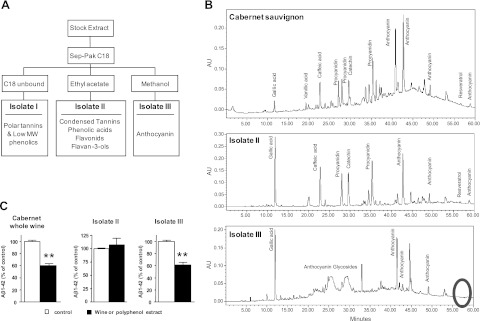
Figure 1.
Figure 1.
Selective polyphenolic preparation from Cabernet Sauvignon exerts Aβ-lowering activity in vitro in Tg2576 corticohippocampal primary neuron cultures. Polyphenolic contents in Cabernet Sauvignon were fractionated using a solid-phase extraction procedure and Aβ-lowering activity of recovered isolates were assessed in vitro, using primary corticohippocampal neuron cultures from Tg2576 AD mice. A) Schematics of the extraction procedure. Ethanol was removed from the red wine under reduced pressure at 35°C. Polyphenols from the dealcoholated stock extract was absorbed onto a C18 column. Unbound components were recovered as isolate I, which comprises polar tannins and low-molecular-weight phenolics. Thereafter, the column was eluted in series with ethyl acetate to recover the majority of nonanthocyanin polyphenolics (e.g., phenolic acids, flavonols, and flavanols; isolate II), followed by elution with methanol to recover anthocyanin and other polyphenolics on the column (isolate III). B) Polyphenol component analysis by HPLC using a binary water/acidified methanol solvent gradient system. Compounds were detected using a Waters 996 photodiode array detector. Top panel: Cabernet Sauvignon wine. Middle panel: isolate II. Bottom panel: isolate III. Circle indicates the position where resveratrol should be detected. C) Assessments of intact Cabernet Sauvignon, isolate II, and isolate III for Aβ-lowering activity in primary cortico-hippocampal neuron cultures. Bar graphs represents mean ± se; n = 3 cultures/treatment group. **P < 0.001.
Figure 2.
Figure 2.
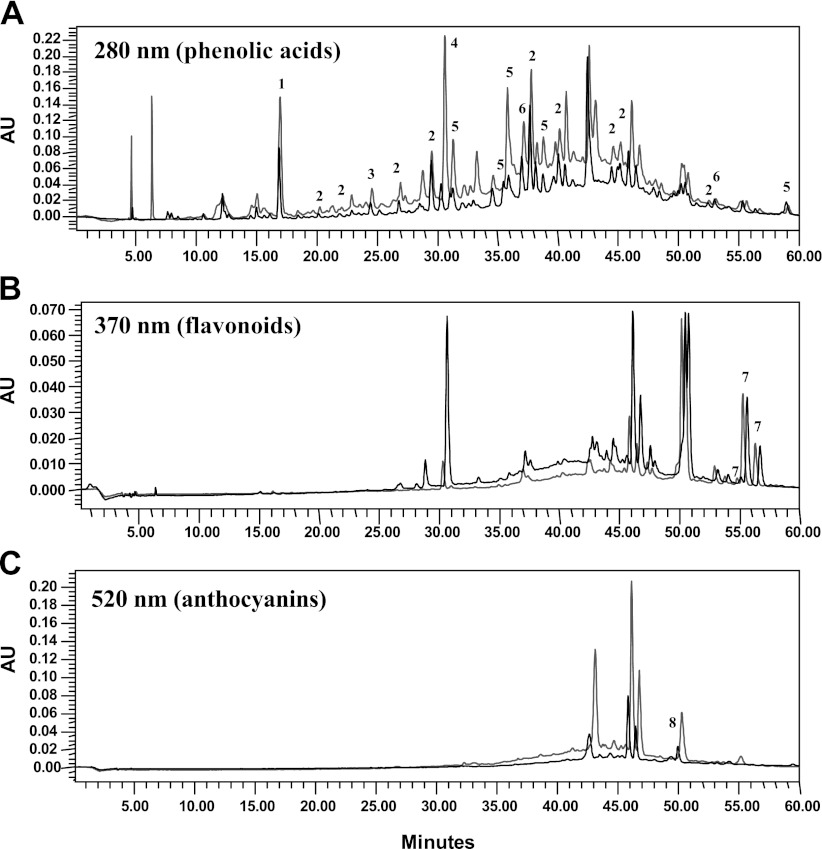
Chemical analysis of Cabernet Sauvignon polyphenol extract. Polyphenolic component compositions of the Cabernet Sauvignon wine and the Cabernet Sauvignon total polyphenolic extract preparation were analyzed by HPLC using a binary water/acidified methanol solvent gradient system. Compounds were detected using a Waters 996 photodiode array detector. Spectrograms resulted from analysis of Cabernet Sauvignon (gray spectra) and the total polyphenol extract (black spectra). A) Detection of phenolic acid compounds at 280 nm. B) Detection of flavonoids at 370 nm. C) Detection of anthocyanins at 520 mm. Some of the peaks (indicated by numbers above selected peaks) in each of the three spectra were identified based on photodioarray spectroscopic interpretations from 200 to 600 nm; the names of the corresponding compounds and their glycosidic derivatives are listed below. Most of the flavonoids and anthocyanins are in a glycosidic form. We note that the maximal absorbance of resveratrol is 510 mm and is, therefore, detected in the 520 mm spectra (peak 8 in panel C), which, in general, is optimal for detection of anthocyanins. Peak ID: 1, gallic acid (280 nm); 2, procyanidin (280 nm); 3, protocatachuic acid (280 nm); 4, caffeic acid (280 nm); 5, p-coumaric acid (280 nm); 6, ferulic acid (280 nm); 7 flavonol (370 nm); 8, resveratrol (520 nm).
Figure 3.
Figure 3.
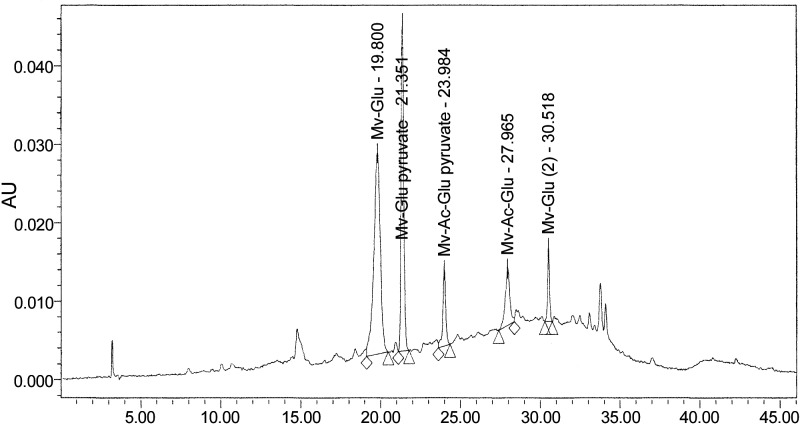
Analysis of malvidin derivatives in Cabernet Sauvignon. Polyphenolic component compositions of the Cabernet Sauvignon total polyphenolic extract preparation were analyzed by HPLC using a binary water/acidified methanol solvent gradient system. Malvidin derivatives were detected by UV (520 nm). Mv-glu, malvidin-glucoside; Mv-glu-pyruvate, malvidin-glucoside-pyruvate; Mv-Ac-glu-pyruvate; malvidin-acetyl-glucoside-pyruvate; Mv-Ac-glu; malvidin-acetyl-glucoside.
Figure 4.
Figure 4.
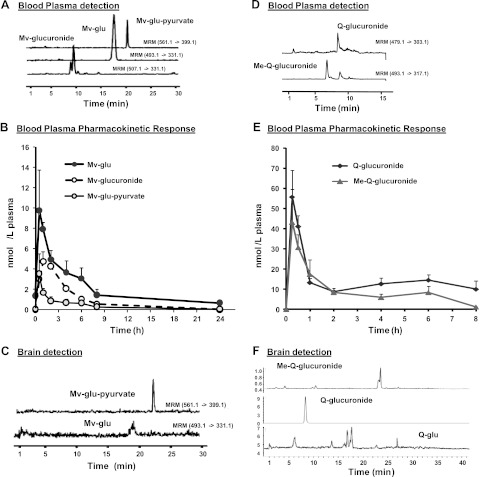
Plasma pharmacokinetics and brain levels of malvidin and quercetin derivatives. Contents of malvidin and quercetin derivatives in plasma and in the brain were assessed following repeated oral treatment of rats with the total polyphenolic extract prepared from the Cabernet Sauvignon wine. Tissue contents of anthocyanin and quercetin derivatives were monitored by LC-UV-MS methodologies. A, D) Detection of malvidin derivatives (A) and quercetin derivatives (D) in the plasma by LC-MS/MS. B, E) Plasma pharmacokinetic profile of major malvidin (B) and quercetin (F) components over time. C, F) Concentrations of malvidin (C) and quercetin (F) derivatives in brain tissue following 10 d of treatment. Mv-glu, malvidin-glucoside; Mv-glucuronide, malvidin-glucuronide; Mv-glu-pyruvate, malvidin-glucoside-pyruvate; Q-glu, quercetin-glucoside; Q-glucuronide, quercetin-glucuronide; Me-Q-glucuronide, methyl-quercetin-glucuronide.
Figure 5.
Figure 5.
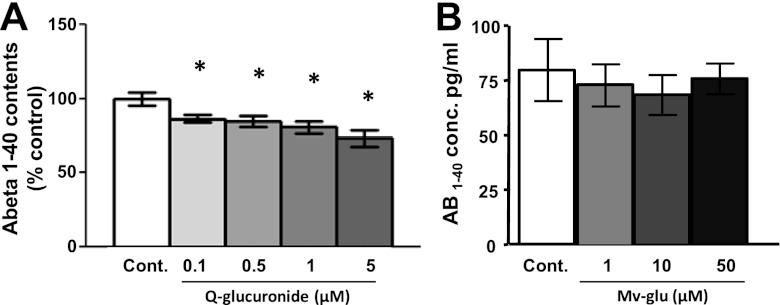
Brain-targeted quercetin-3-O-glucuronide significantly inhibits generation of Aβ1–40 peptides from Tg2576 primary neuron cultures. The potential efficacy of brain-targeted quercetin-3-O-glucuronide (A) or malvidin-3-O-glucoside (B) in modulating the generation of Aβ1–40 peptides were assessed using primary Tg2576 neuron cultures. Cells were treated with varying doses of the polyphenols as indicated; control cells were treated with the vehicle. Aβ (A) and Aβ1–42 (B) contents in the conditioned medium. Q-glucuronide, quercetin-glucuronide; Mv-glu, malvidin-glucoside. Bar graphs represent mean ± se; n = 3 cultures/treatment group; values are expressed as percentage of control. *P < 0.05.
Figure 6.
Figure 6.
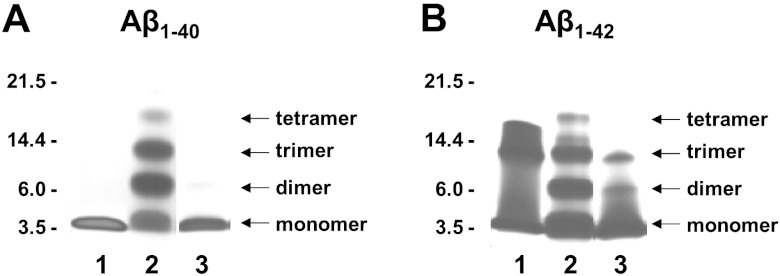
Brain-targeting quercetin-3-O-glucuronide potently interferes with aggregations of Aβ peptides, in vitro. We used the PICUP assay to explore initial protein-protein interactions necessary for the assembly of monomeric Aβ peptides into neurotoxic oligomeric Aβ species. Aβ1–40 (25 μM; A) or Aβ1–42 (25 μM; B) was cross-linked in the presence or absence of an equal molar concentration (25 μM) of quercetin-3-O-glucuronide. PICUP products were resolved by SDS-PAGE and visualized using silver staining. Lane 1, control non-cross-linked Aβ peptides; lanes 2 and 3, cross-linked Aβ peptide in the absence (lane 2) or presence (lane 3) of quercetin-3-O-glucuronide. Aβ1–42 trimers and tetramer bands under non-cross-linking conditions (B, lane 1) are known SDS-PAGE-induced artifacts (49, 50).
Figure 7.
Figure 7.
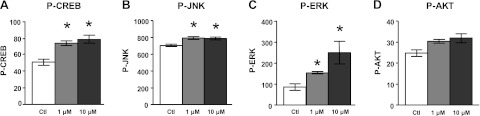
Brain-targeting quercetin-3-O-glucuronide promotes P-CREB in primary cortico-hippocampal neurons. Activated P-CREB (A), as well as P-JNK (B), P-Erk (C), and P-AKT (D), which are important for modulating P-CREB signaling, were assayed by a multiplex assay. Bar graphs represent means ± se; n = 3 cultures/treatment group; values are expressed as percentage of control. *P < 0.05.
Figure 8.
Figure 8.
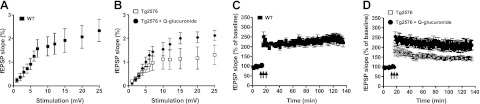
Brain-targeted quercetin-3-O-glucuronide promotes basal transmission and LTP. Assessment of basal synaptic transmission and LTP from ex vivo hippocampal slices. A, B) Treatment with quercetin-glucuronide-rescued basal synaptic transmission deficits in hippocampal slices from 12-mo-old Tg2576 AD mice. A) Basal synaptic transmission recordings from age-matched WT mice. B) Basal synaptic transmission recordings from Tg2576 mice in the absence or presence of treatment with 400 nM quercetin-3-O-glucuronide. Two-way ANOVA; P < 0.01 for WT vs. Tg2576 or Tg2576 vs. Tg2576+quercetin-3-O-glucuronide; no statistical difference observed for WT vs. Tg2576 + quercetin-3-O-glucuronide. C, D) Treatment with quercetin-3-O-glucuronide rescued LTP deficits in hippocampal slices from 12 mo-old Tg2576 AD mice. C) LTP recordings from age-matched WT mice. D) LTP recordings from Tg2576 mice in the absence or presence of treatment with 400 nM quercetin-3-O-glucuronide. Arrows indicate the beginning of tetanus used to induce LTP. Two-way ANOVA; P < 0.01 for WT vs. Tg2576 or Tg2576 vs. Tg2576+quercetin 3-glucuronide; no statistical difference was observed for WT vs. Tg2576+quercetin-3-O-glucuronide. Q-glucuronide, quercetin-3-O-glucuronide.

References

    1. Alzheimer's Association (2012) 2012 Alzheimer's disease facts and figures. Alzheimers Dement. 8, 131–168 - PubMed
    1. Thies W., Bleiler L. (2011) 2011 Alzheimer's disease facts and figures. Alzheimers Dement. 7, 208–244 - PubMed
    1. Germain S., Adam S., Olivier C., Cash H., Ousset P. J., Andrieu S., Vellas B., Meulemans T., Reynish E., Salmon E. (2009) Does cognitive impairment influence burden in caregivers of patients with Alzheimer's disease? J. Alzheimers Dis. 17, 105–114 - PubMed
    1. Gonzalez E. W., Polansky M., Lippa C. F., Walker D., Feng D. (2011) Family caregivers at risk: who are they? Issues Ment. Health Nurs. 32, 528–536 - PubMed
    1. Mausbach B. T., Chattillion E. A., Roepke S. K., Patterson T., Grant I. (2012) A comparison of psychosocial outcomes in elderly Alzheimer caregivers and noncaregivers. [E-pub ahead of print] Am. J. Geriatr. Psychiatry doi: 10.1097/JGP.0b013e31824472d5 - DOI - PMC - PubMed

Publication types

MeSH terms