


Continent-wide tracking to determine migratory connectivity and tropical habitat associations of a declining aerial insectivore
- PMID: 23097508
- PMCID: PMC3497251
- DOI: 10.1098/rspb.2012.2207
Continent-wide tracking to determine migratory connectivity and tropical habitat associations of a declining aerial insectivore
Abstract
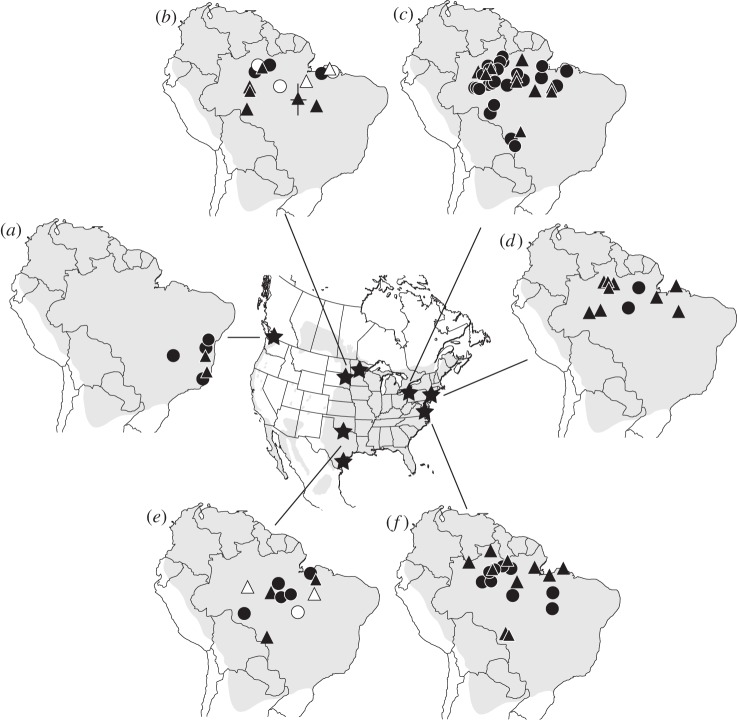
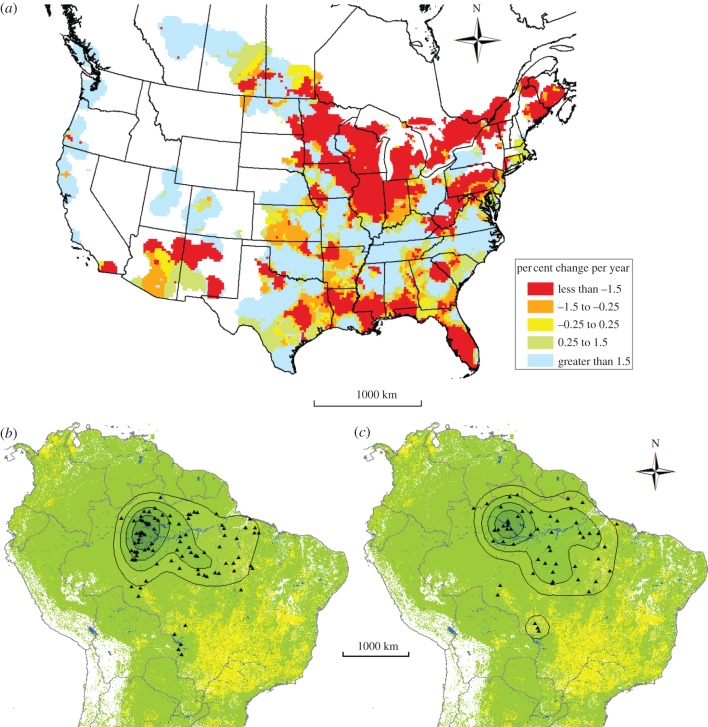
North American birds that feed on flying insects are experiencing steep population declines, particularly long-distance migratory populations in the northern breeding range. We determine, for the first time, the level of migratory connectivity across the range of a songbird using direct tracking of individuals, and test whether declining northern populations have higher exposure to agricultural landscapes at their non-breeding grounds in South America. We used light-level geolocators to track purple martins, Progne subis, originating from North American breeding populations, coast-to-coast (n = 95 individuals). We show that breeding populations of the eastern subspecies, P. s. subis, that are separated by ca. 2000 km, nevertheless have almost completely overlapping non-breeding ranges in Brazil. Most (76%) P. s. subis overwintered in northern Brazil near the Amazon River, not in the agricultural landscape of southern Brazil. Individual non-breeding sites had an average of 91 per cent forest and only 4 per cent agricultural ground cover within a 50 km radius, and birds originating from declining northern breeding populations were not more exposed to agricultural landscapes than stable southern breeding populations. Our results show that differences in wintering location and habitat do not explain recent trends in breeding population declines in this species, and instead northern populations may be constrained in their ability to respond to climate change.
Figures
References
-
- Sillett T. S., Holmes R. T. 2002. Variation in survivorship of a migratory songbird throughout its annual cycle. J. Anim. Ecol. 71, 296–308 10.1046/j.1365-2656.2002.00599.x (doi:10.1046/j.1365-2656.2002.00599.x) - DOI
-
- Faaborg J., et al. 2010. Conserving migratory land birds in the New World: do we know enough? Ecol. Appl. 20, 398–418 10.1890/09-0397.1 (doi:10.1890/09-0397.1) - DOI - PubMed
-
- Sherry T. W., Holmes R. T. 1995. Summer versus winter limitation of populations: conceptual issues and evidence. In Ecology and management of Neotropical migratory birds: a synthesis and review of critical issues (eds Martin T., Finch D.). New York: Oxford University Press
-
- Sheehy J., Taylor C. M., McCann K. S., Norris D. R. 2010. Optimal conservation planning for migratory animals: integrating demographic information across seasons. Conserv. Lett. 3, 192–202 10.1111/j.1755-263x.2010.00100.x (doi:10.1111/j.1755-263x.2010.00100.x) - DOI
-
- Marra P. P., Norris D. R., Haig S. M., Webster M. S., Royle J. A. 2006. Migratory connectivity. In Connectivity conservation (eds Crooks K. R., Sanjayan M.), pp. 157–183 New York: Cambridge University Press
Publication types
MeSH terms
LinkOut - more resources
Full Text Sources
