Comparative Study
. 2012 Oct;14(10):986-93.
doi: 10.1593/neo.121218.

Functional analysis of in-frame indel ARID1A mutations reveals new regulatory mechanisms of its tumor suppressor functions

Affiliations
Comparative Study

Functional analysis of in-frame indel ARID1A mutations reveals new regulatory mechanisms of its tumor suppressor functions

Bin Guan et al. Neoplasia. 2012 Oct.

Abstract

AT-rich interactive domain 1A (ARID1A) has emerged as a new tumor suppressor in which frequent somatic mutations have been identified in several types of human cancers. Although most ARID1A somatic mutations are frame-shift or nonsense mutations that contribute to mRNA decay and loss of protein expression, 5% of ARID1A mutations are in-frame insertions or deletions (indels) that involve only a small stretch of peptides. Naturally occurring in-frame indel mutations provide unique and useful models to explore the biology and regulatory role of ARID1A. In this study, we analyzed indel mutations identified in gynecological cancers to determine how these mutations affect the tumor suppressor function of ARID1A. Our results demonstrate that all in-frame mutants analyzed lost their ability to inhibit cellular proliferation or activate transcription of CDKN1A, which encodes p21, a downstream effector of ARID1A. We also showed that ARID1A is a nucleocytoplasmic protein whose stability depends on its subcellular localization. Nuclear ARID1A is less stable than cytoplasmic ARID1A because ARID1A is rapidly degraded by the ubiquitin-proteasome system in the nucleus. In-frame deletions affecting the consensus nuclear export signal reduce steady-state protein levels of ARID1A. This defect in nuclear exportation leads to nuclear retention and subsequent degradation. Our findings delineate a mechanism underlying the regulation of ARID1A subcellular distribution and protein stability and suggest that targeting the nuclear ubiquitin-proteasome system can increase the amount of the ARID1A protein in the nucleus and restore its tumor suppressor functions.


Figures
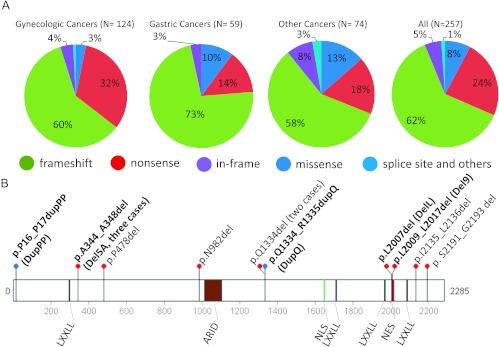
Figure 1
Figure 1
The spectrum of ARID1A mutations in human cancer. (A) Types of ARID1A mutations found in endometrium-related gynecologic cancer, gastric cancer, and other cancer types. Different mutation types are indicated by different colors. (B) Diagram of in-frame indel mutations. The five in-frame mutations identified in ovarian clear cell and endometrioid carcinomas are shown in bold font. The p.A344_A348del mutation was detected in three independent tumors, and the p.Q1334del mutation was detected in two tumors. LXXLL, leucine-rich steroid receptor binding motif; ARID, AT-rich interactive domain; NLS, nuclear localization signal; NES, nuclear export signal.
Figure 2
Figure 2
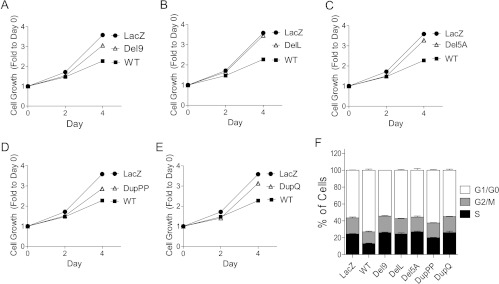
Loss of tumor suppressor function of ARID1A in-frame mutations. (A–E) OVISE cells, which do not express detectable levels of endogenous ARID1A protein, were infected with lentiviral vectors expressing wild-type or mutant ARID1A. Relative cell numbers were determined at different days after lentiviral transduction. (F) Cell cycle progression was analyzed by flow cytometry after EdU incorporation and DNA staining. The percentages of cells in different phases of cell cycle were determined.
Figure 3
Figure 3
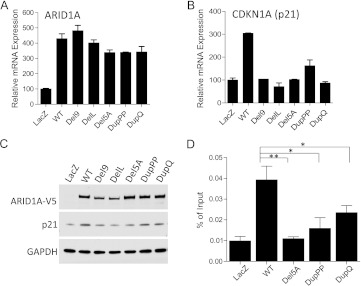
ARID1A mutants lose the ability to induce CDKN1A (p21) transcription. (A) Levels of ARID1A mRNA in cells expressing wild-type ARID1A or in-frame indel mutants. Vector expressing lacZ was used as a negative control. (B) Levels of CDKN1A (p21) mRNA in cells expressing wild-type ARID1A or in-frame mutants. Vector expressing lacZ was used as a negative control. (C) Western blot analysis shows protein levels of ARID1A and p21 in cells expressing wild-type ARID1A and in-frame indel mutants. GAPDH was used as a protein loading control. (D) Chromatin immunoprecipitation-qPCR analysis demonstrates the binding activity of wild-type ARID1A and in-frame indel mutants Del 5A, Dup2P, and DupQ to the CDKN1A promoter. One-way t test, *P < 0.05; **P < 0.01.
Figure 4
Figure 4
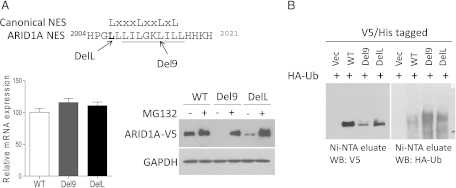
Degradation of ARID1A by the ubiquitin-proteasome pathway. (A) Proteasome inhibition increases Del9 and DelL protein levels. The residue deleted in the DelL mutant is indicated in bold, and residues deleted in the Del9 mutant are underlined. ARID1A constructs with V5/His dual tags at the C terminus were introduced into HEK293FT cells. Twenty-four hours after transfection, cells were treated with MG132 (proteasome inhibitor) or DMSO (vehicle control) for an additional 16 hours. ARID1A protein levels were determined by Western blot analysis using an anti-V5 antibody (right), and ARID1A mRNA levels (left) were determined by qPCR analysis. (B) Enhanced ubiquitination of Del9 and DelL mutants as compared with the wild-type protein. HEK293FT cells were transfected with constructs expressing HA-tagged ubiquitin (HA-Ub) and ARID1A-V5/His. ARID1A proteins were enriched using Ni-NTA agarose beads. The eluates were subjected to Western blot analysis using anti-V5 and anti-HA antibodies.
Figure 5
Figure 5
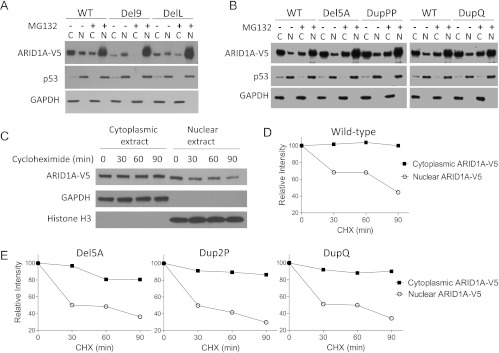
Localization of ARID1A protein in the nucleus and cytoplasm. (A) Steady-state levels of wild-type ARDI1A protein and the Del9 and DelL mutants in nuclear (N) and cytoplasmic (C) fractions. OSE4 cells were transfected with ARID1A constructs and treated with MG132 (proteasome inhibitor) or DMSO (vehicle control). Ectopic ARID1A levels were determined by Western blot analysis using an anti-V5 antibody. GAPDH and p53 served as loading controls for cytoplasmic and nuclear protein fractions, respectively. (B) Subcellular distribution of the three ARID1A in-frame indel mutants in which the NES was not affected. (C, D) The half-life of cytoplasmic and nuclear ARID1A was determined after inhibiting protein synthesis with cycloheximide (CHX). Histone H3 served as a nuclear protein loading control. (E) Assessment of the half-life of ARID1A mutant proteins in cytosolic and nuclear compartments.
Figure 6
Figure 6
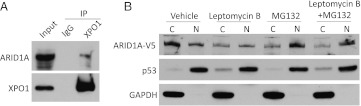
XPO1-dependent ARID1A nuclear export. (A) ES2 cell lysate was immunoprecipitated using a rabbit anti-XPO1 antibody or normal rabbit IgG. Total cell extracts (input) and immunoprecipitates were then probed using antibodies against XPO1 or ARID1A followed by a mouse anti-rabbit conformation-specific antibody. (B) Nuclear and cytoplasmic levels of ARID1A were determined in OSE4 cells transfected with wild-type ARID1A. Sixteen hours after transfection, cells were treated with leptomycin B (LMB) for an additional 24 hours; during the last 6 hours of incubation, MG132 was added to some of the cells as indicated. Protein levels of ARID1A-V5 were detected by Western blot analysis with an anti-V5 antibody. GAPDH and p53 served as loading controls for cytoplasmic and nuclear protein fractions, respectively.

References

    1. Jones S, Wang TL, Shih Ie M, Mao TL, Nakayama K, Roden R, Glas R, Slamon D, Diaz LA, Jr, Vogelstein B, et al. Frequent mutations of chromatin remodeling gene ARID1A in ovarian clear cell carcinoma. Science. 2010;330:228–231. - PMC - PubMed
    1. Wiegand KC, Shah SP, Al-Agha OM, Zhao Y, Tse K, Zeng T, Senz J, McConechy MK, Anglesio MS, Kalloger SE, et al. ARID1A mutations in endometriosis-associated ovarian carcinomas. N Engl J Med. 2010;363:1532–1543. - PMC - PubMed
    1. Guan B, Mao TL, Panuganti PK, Kuhn E, Kurman RJ, Maeda D, Chen E, Jeng YM, Wang TL, Shih Ie M. Mutation and loss of expression of ARID1A in uterine low-grade endometrioid carcinoma. Am J Surg Pathol. 2011;35:625–632. - PMC - PubMed
    1. Jones S, Li M, Parsons DW, Zhang X, Wesseling J, Kristel P, Schmidt MK, Markowitz S, Yan H, Bigner D, et al. Somatic mutations in the chromatin remodeling gene ARID1A occur in several tumor types. Hum Mutat. 2012;33:100–103. - PMC - PubMed
    1. Gui Y, Guo G, Huang Y, Hu X, Tang A, Gao S, Wu R, Chen C, Li X, Zhou L, et al. Frequent mutations of chromatin remodeling genes in transitional cell carcinoma of the bladder. Nat Genet. 2011;43:875–878. - PMC - PubMed

Publication types

MeSH terms