. 2012:2012:738590.
doi: 10.1155/2012/738590. Epub 2012 Oct 14.

Understanding Viral Transmission Behavior via Protein Intrinsic Disorder Prediction: Coronaviruses

Affiliations

Understanding Viral Transmission Behavior via Protein Intrinsic Disorder Prediction: Coronaviruses

Gerard Kian-Meng Goh et al. J Pathog. 2012.

Abstract

Besides being a common threat to farm animals and poultry, coronavirus (CoV) was responsible for the human severe acute respiratory syndrome (SARS) epidemic in 2002-4. However, many aspects of CoV behavior, including modes of its transmission, are yet to be fully understood. We show that the amount and the peculiarities of distribution of the protein intrinsic disorder in the viral shell can be used for the efficient analysis of the behavior and transmission modes of CoV. The proposed model allows categorization of the various CoVs by the peculiarities of disorder distribution in their membrane (M) and nucleocapsid (N). This categorization enables quick identification of viruses with similar behaviors in transmission, regardless of genetic proximity. Based on this analysis, an empirical model for predicting the viral transmission behavior is developed. This model is able to explain some behavioral aspects of important coronaviruses that previously were not fully understood. The new predictor can be a useful tool for better epidemiological, clinical, and structural understanding of behavior of both newly emerging viruses and viruses that have been known for a long time. A potentially new vaccine strategy could involve searches for viral strains that are characterized by the evolutionary misfit between the peculiarities of the disorder distribution in their shells and their behavior.


Figures
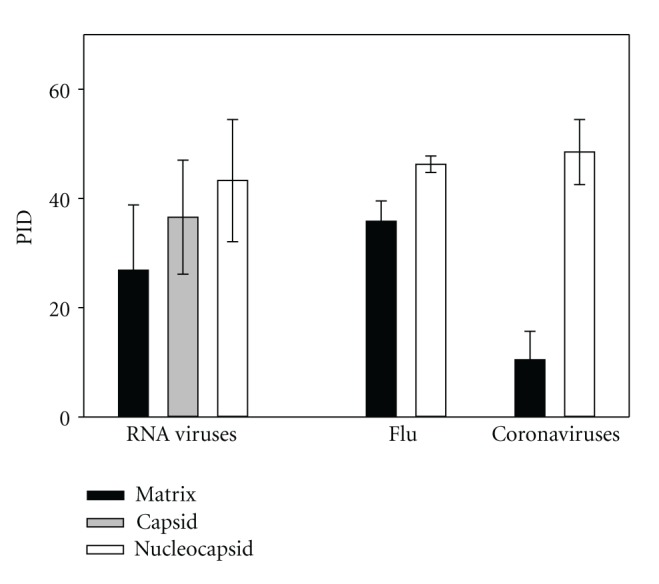
Figure 1
Figure 1
A comparison of the mean PID of membrane (matrix glycoprotein, M) and nucleocapsid (N) proteins of coronavisruses with those of the influenza A virus and RNA viruses in general. Similarities and dissimilarities can be observed.
Figure 2
Figure 2
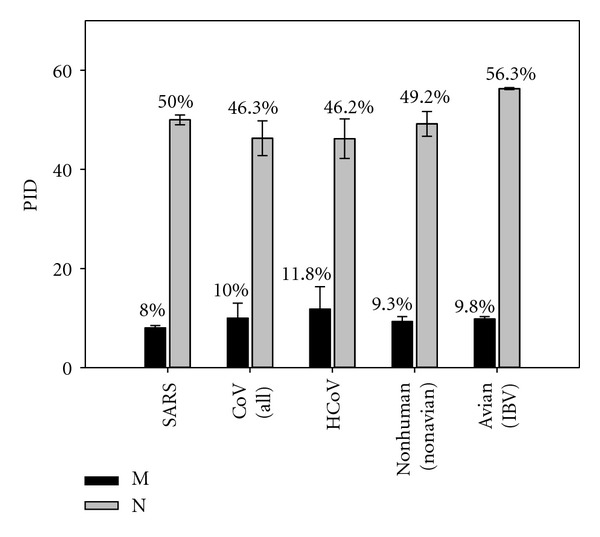
Comparison of the mean PID of membrane (matrix glycoprotein, M) and nucleocapsid (N) proteins of human and nonhuman coronaviruses. Mean PIDs in the N- and M-proteins of avian coronavirus are shown for comparison.
Figure 3
Figure 3
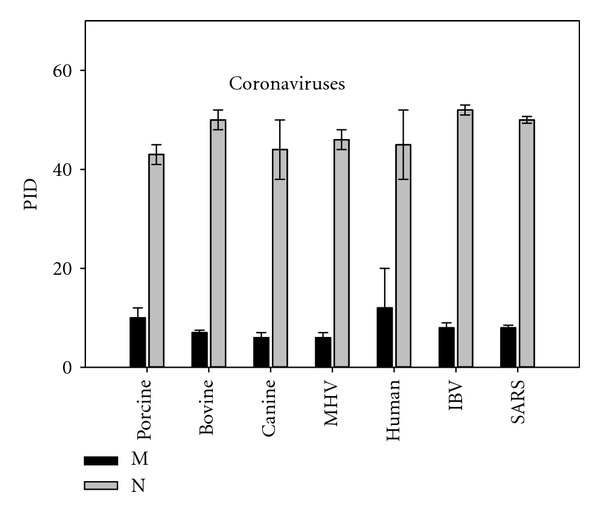
The mean PIDs of the M- and N-proteins of human coronaviruses (HCoV) and the various animal coronaviruses including avian coronavirus.
Figure 4
Figure 4
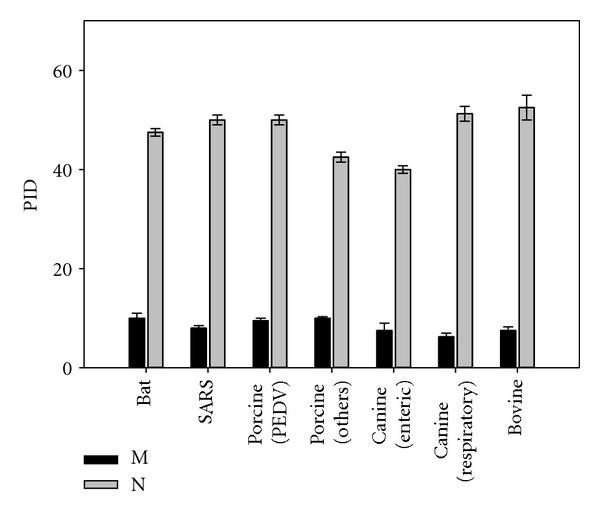
The mean PIDs of the M- and N-proteins of the various animal coronaviruses. Strains of porcine and canine coronaviruses are shown. Differences are seen between the strains of porcine and canine coronaviruses.
Figure 5
Figure 5
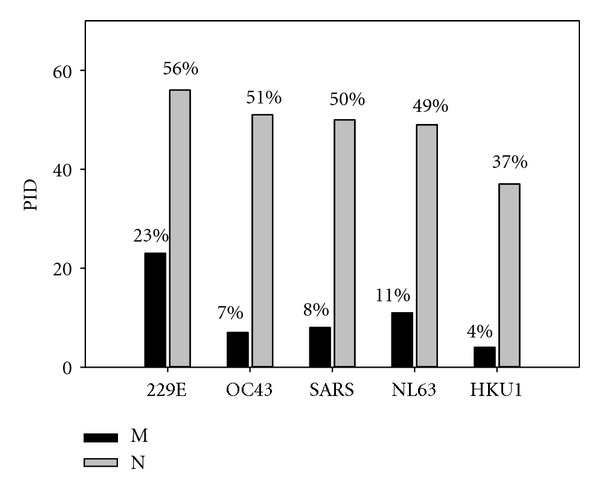
The mean PIDs in different strains of human coronavirus (HCoV) as compared to the SARS-CoV.
Figure 6
Figure 6
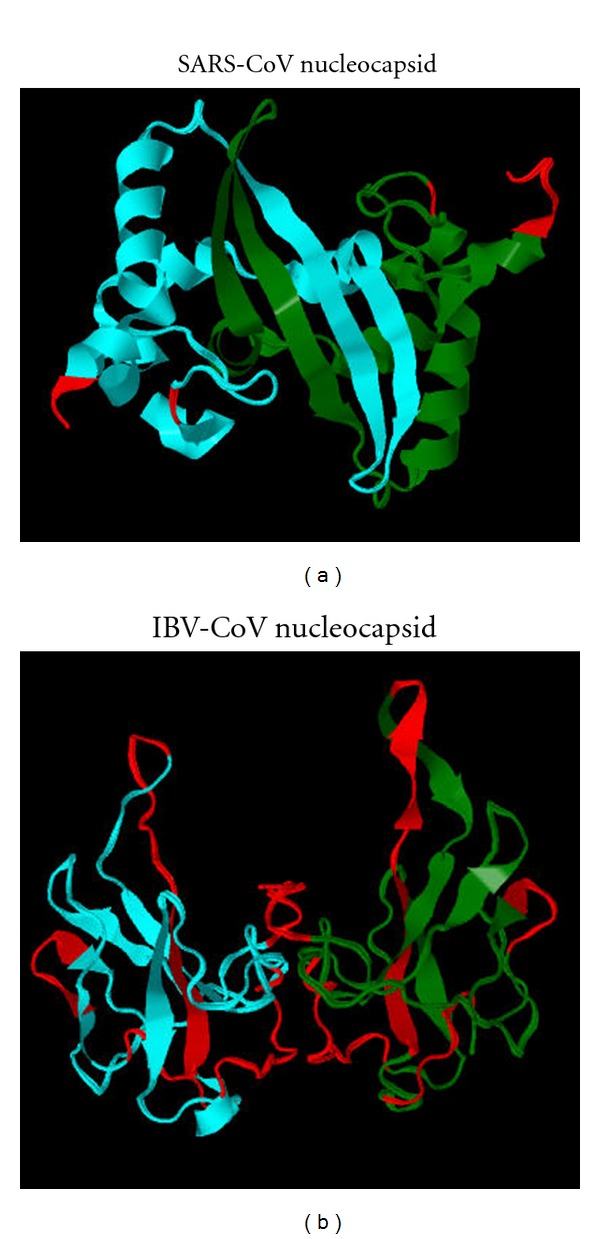
3D representation with predicted disorder annotation of the parts of the nucleocapsid proteins of IBV and SARS-CoV [7, 8]. (a) SARS-CoV (PDB ID: 2gib); (b) IBV (PDB ID: 2c86) Avian infectious bronchitis virus (IBV). The red color denotes residues predicted to be disordered by PONDR VLXT, while cyan and green represent regions that are predicted to be ordered with the two colors used to distinguish between separate subunits. The mean PID of the IBV N-protein is 56%, whereas the corresponding PID of SARS-CoV N-protein is only 50% (see Table 3). The N-protein of HCoV-299E is more similar to the IBV N-protein in this respect.

References

    1. Goh GKM, Uversky VN, Dunker AK. A comparative analysis of viral matrix proteins using disorder predictors. Virology Journal. 2008;5, article 126 - PMC - PubMed
    1. Goh GKM, Dunker AK, Uversky VN. Protein intrinsic disorder toolbox for comparative analysis of viral proteins. BMC Genomics. 2008;9(2, article S4) - PMC - PubMed
    1. Xue B, Williams RW, Oldfield CJ, Goh GKM, Dunker AK, Uversky VN. Viral disorder or disordered viruses: Do viral proteins possess unique features? Protein and Peptide Letters. 2010;17(8):932–951. - PubMed
    1. Holmes KV. SARS coronavirus: a new challenge for prevention and therapy. Journal of Clinical Investigation. 2003;111(11):1605–1609. - PMC - PubMed
    1. Stadler K, Masignani V, Eickmann M, et al. SARS—beginning to understand a new virus. Nature Reviews Microbiology. 2003;1(3):209–218. - PMC - PubMed

LinkOut - more resources