


Open-label, randomized, parallel-group controlled clinical trial of massage for treatment of depression in HIV-infected subjects
- PMID: 23098696
- PMCID: PMC3627430
- DOI: 10.1089/acm.2012.0058
Open-label, randomized, parallel-group controlled clinical trial of massage for treatment of depression in HIV-infected subjects
Abstract
Objectives: The study objectives were to determine whether massage therapy reduces symptoms of depression in subjects with human immunodeficiency virus (HIV) disease.
Design: Subjects were randomized non-blinded into one of three parallel groups to receive Swedish massage or to one of two control groups, touch or no intervention for eight weeks.
Settings/location: The study was conducted at the Department of Psychiatry and Behavioral Neurosciences at Cedars-Sinai Medical Center in Los Angeles, California, which provided primary clinical care in an institutional setting.
Subjects: Study inclusion required being at least 16 years of age, HIV-seropositive, with a diagnosis of major depressive disorder. Subjects had to be on a stable neuropsychiatric, analgesic, and antiretroviral regimen for >30 days with no plans to modify therapy for the duration of the study. Approximately 40% of the subjects were currently taking antidepressants. All subjects were medically stable. Fifty-four (54) subjects were randomized, 50 completed at least 1 week (intent-to-treat; ITT), and 37 completed the study (completers).
Interventions: Swedish massage and touch subjects visited the massage therapist for 1 hour twice per week. The touch group had a massage therapist place both hands on the subject with slight pressure, but no massage, in a uniform distribution in the same pattern used for the massage subjects.
Outcome measures: The primary outcome measure was the Hamilton Rating Scale for Depression score, with the secondary outcome measure being the Beck Depression Inventory.
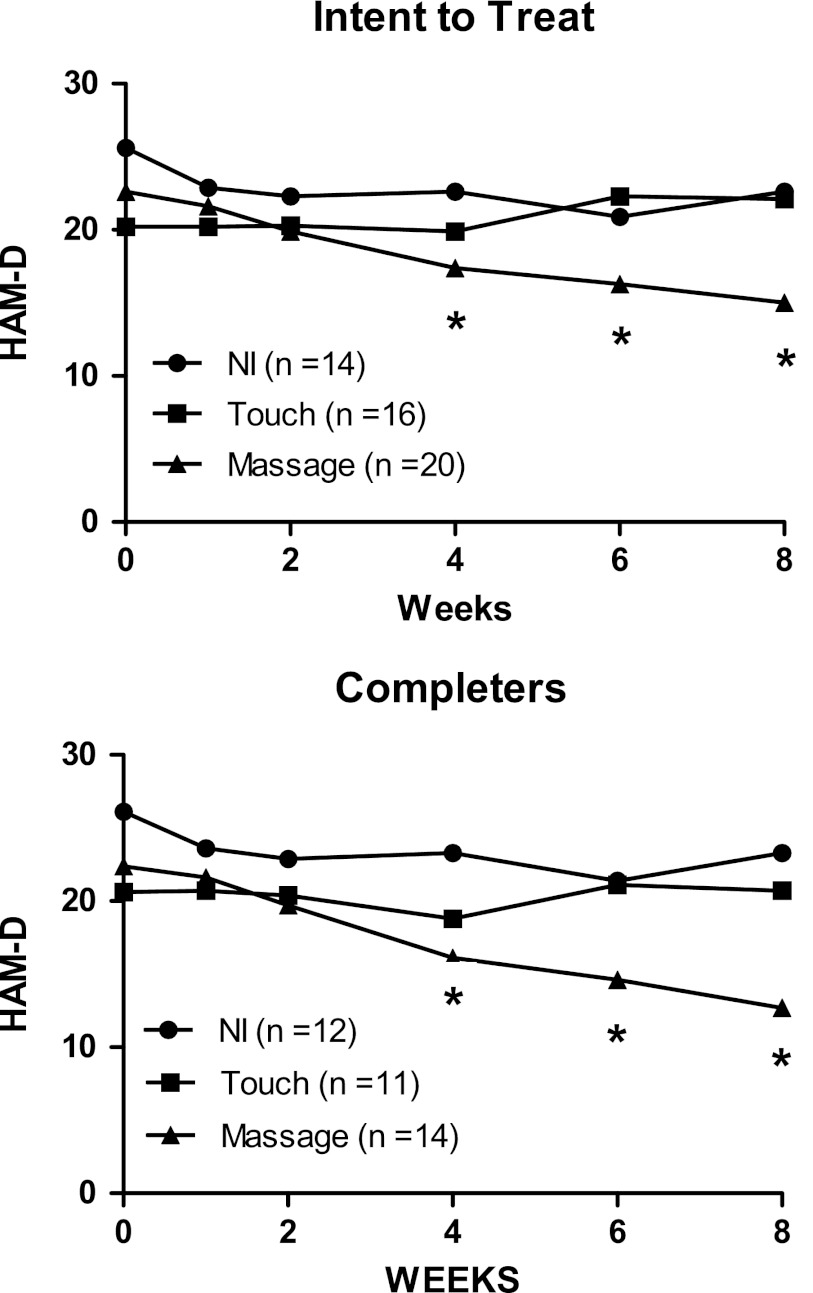
Results: For both the ITT and completers analyses, massage significantly reduced the severity of depression beginning at week 4 (p ≤ 0.04) and continuing at weeks 6 (p ≤ 0.03) and 8 (p ≤ 0.005) compared to no intervention and/or touch.
Conclusions: The results indicate that massage therapy can reduce symptoms of depression in subjects with HIV disease. The durability of the response, optimal "dose" of massage, and mechanisms by which massage exerts its antidepressant effects remain to be determined.
Figures
References
-
- Taylor CB. Youngblood ME. Catellier D, et al. Effects of antidepressant medication on morbidity and mortality in depressed patients after myocardial infarction. Arch Gen Psychiatry. 2005;62:792–798. - PubMed
-
- Lustman PJ. Clouse RE. Treatment of depression in diabetes: Impact on mood and medical outcome. J Psychosom Res. 2002;53:917–924. - PubMed
-
- Grant BF. Stinson FS. Dawson DA, et al. Prevalence and co-occurrence of substance use disorders and independent mood and anxiety disorders: Results from the National Epidemiology Survey on Alcohol and Related Conditions. Arch Gen Psychiatry. 2004;61:807–816. - PubMed
-
- Perkins DO. Stern RA. Golden RN, et al. Mood disorders in HIV infection: Prevalence and risk factors in a nonepicenter of the AIDS epidemic. Am J Psychiatry. 1994;151:233–236. - PubMed
-
- McDaniel JS. Fowlie E. Summerville MB, et al. An assessment of rates of psychiatric morbidity and functioning in HIV disease. Gen Hosp Psychiatry. 1995;17:346–352. - PubMed
Publication types
MeSH terms
Substances
Grants and funding
- G12 MD007586/MD/NIMHD NIH HHS/United States
- KL2 RR024977/RR/NCRR NIH HHS/United States
- UL1 TR000124/TR/NCATS NIH HHS/United States
- R01 DA017805/DA/NIDA NIH HHS/United States
- AT001047/AT/NCCIH NIH HHS/United States
- UL1 RR024975/RR/NCRR NIH HHS/United States
- U54 RR026140/RR/NCRR NIH HHS/United States
- UL1 TR000445/TR/NCATS NIH HHS/United States
- RR000425/RR/NCRR NIH HHS/United States
- G12 RR003032/RR/NCRR NIH HHS/United States
- TL1 RR024978/RR/NCRR NIH HHS/United States
- U54 MD007593/MD/NIMHD NIH HHS/United States
- R01 MH068391/MH/NIMH NIH HHS/United States
LinkOut - more resources
Full Text Sources
Other Literature Sources
Medical
