


Stiffness-controlled three-dimensional extracellular matrices for high-resolution imaging of cell behavior
- PMID: 23099487
- PMCID: PMC3845971
- DOI: 10.1038/nprot.2012.127
Stiffness-controlled three-dimensional extracellular matrices for high-resolution imaging of cell behavior
Abstract
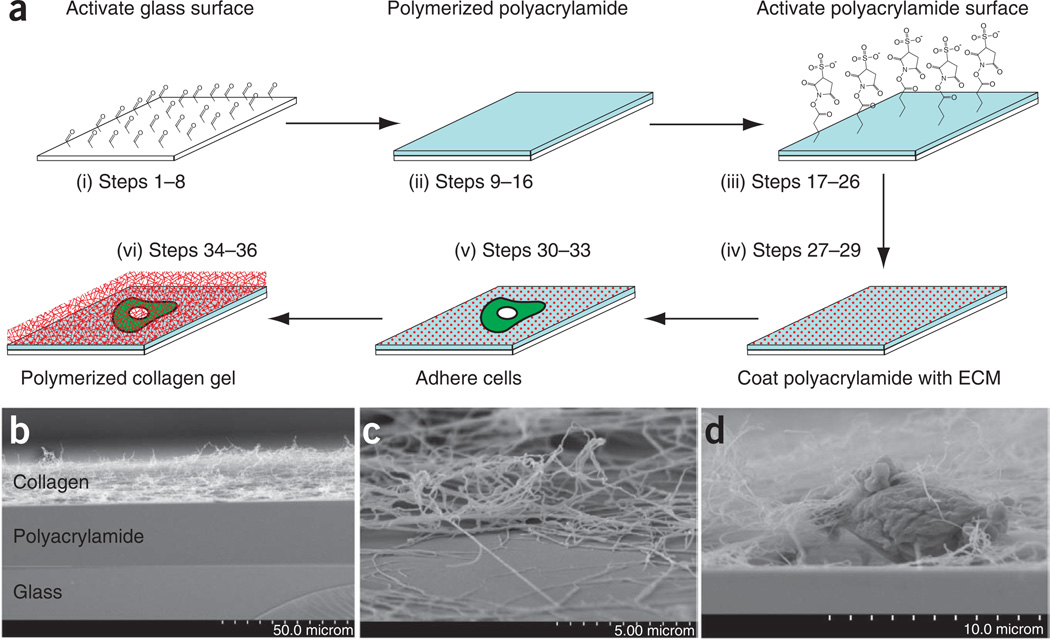
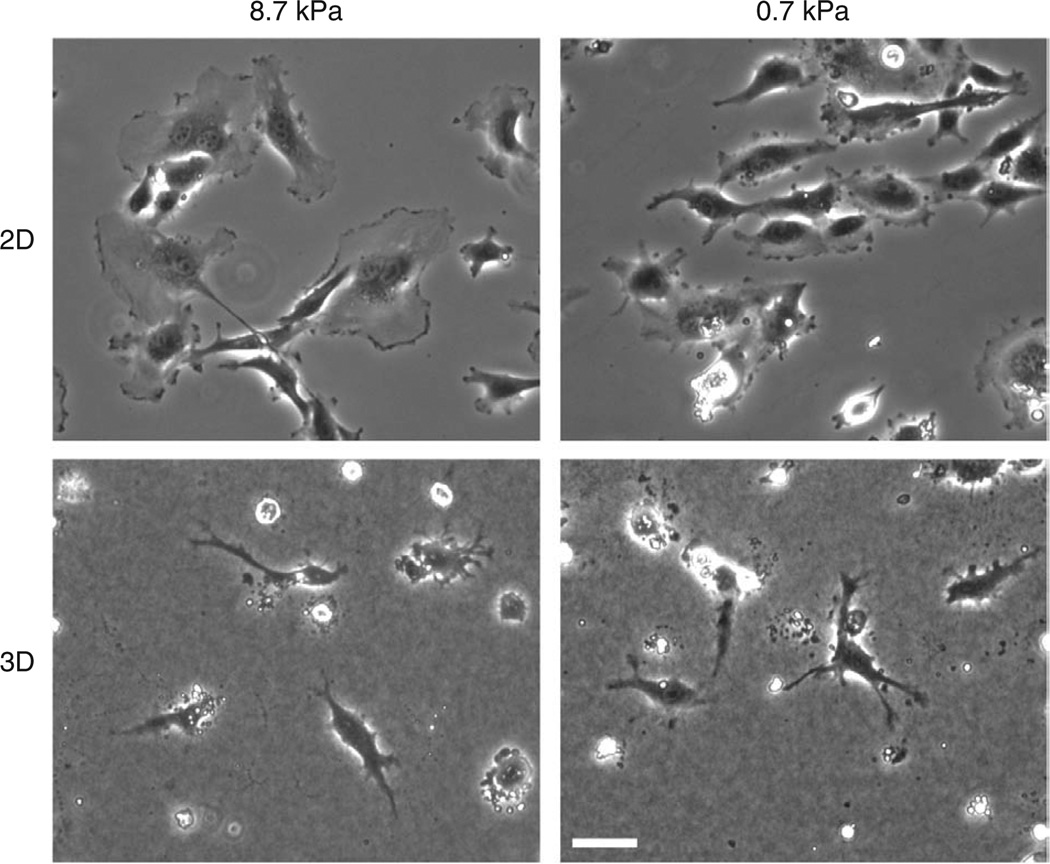
Regulation of cell functions by the physical properties of the extracellular matrix (ECM) has emerged as a crucial contributor to development and disease. Two specific physical properties of the ECM, stiffness and dimensionality, each influence cell signaling and function. As these ECM physical properties are linked to other properties that also regulate cell behavior, e.g., integrin ligand density, parsing the specific contributions of ECM stiffness and dimensionality has proven difficult. Here we detail a simple protocol, which can be completed in 1-2 d, for combining three-dimensional (3D) ECM engagement with controlled underlying ECM stiffness. In these 'sandwich gels', cells are sandwiched between a 3D fibrillar ECM and an ECM-coupled polyacrylamide gel of defined compliance, allowing the study of the specific effects of ECM compliance on cell function in physiologically relevant 3D ECMs. This type of system enables high-resolution time-lapse imaging and is suitable for a wide range of cell types and molecular perturbations.
Figures
References
-
- Ingber DE. Mechanical signaling and the cellular response to extracellular matrix in angiogenesis and cardiovascular physiology. Circ. Res. 2002;91:877–887. - PubMed
-
- Discher DE, Janmey P, Wang YL. Tissue cells feel and respond to the stiffness of their substrate. Science. 2005;310:1139. - PubMed
-
- Pelham RJ, Jr, Wang YL. Cell locomotion and focal adhesions are regulated by the mechanical properties of the substrate. Biol. Bull. 1998;194:348–349. - PubMed
Publication types
MeSH terms
Substances
Grants and funding
LinkOut - more resources
Full Text Sources
Other Literature Sources
Research Materials
