


Developmental switch in spike timing-dependent plasticity at layers 4-2/3 in the rodent barrel cortex
- PMID: 23100422
- PMCID: PMC6704840
- DOI: 10.1523/JNEUROSCI.2506-12.2012
Developmental switch in spike timing-dependent plasticity at layers 4-2/3 in the rodent barrel cortex
Abstract
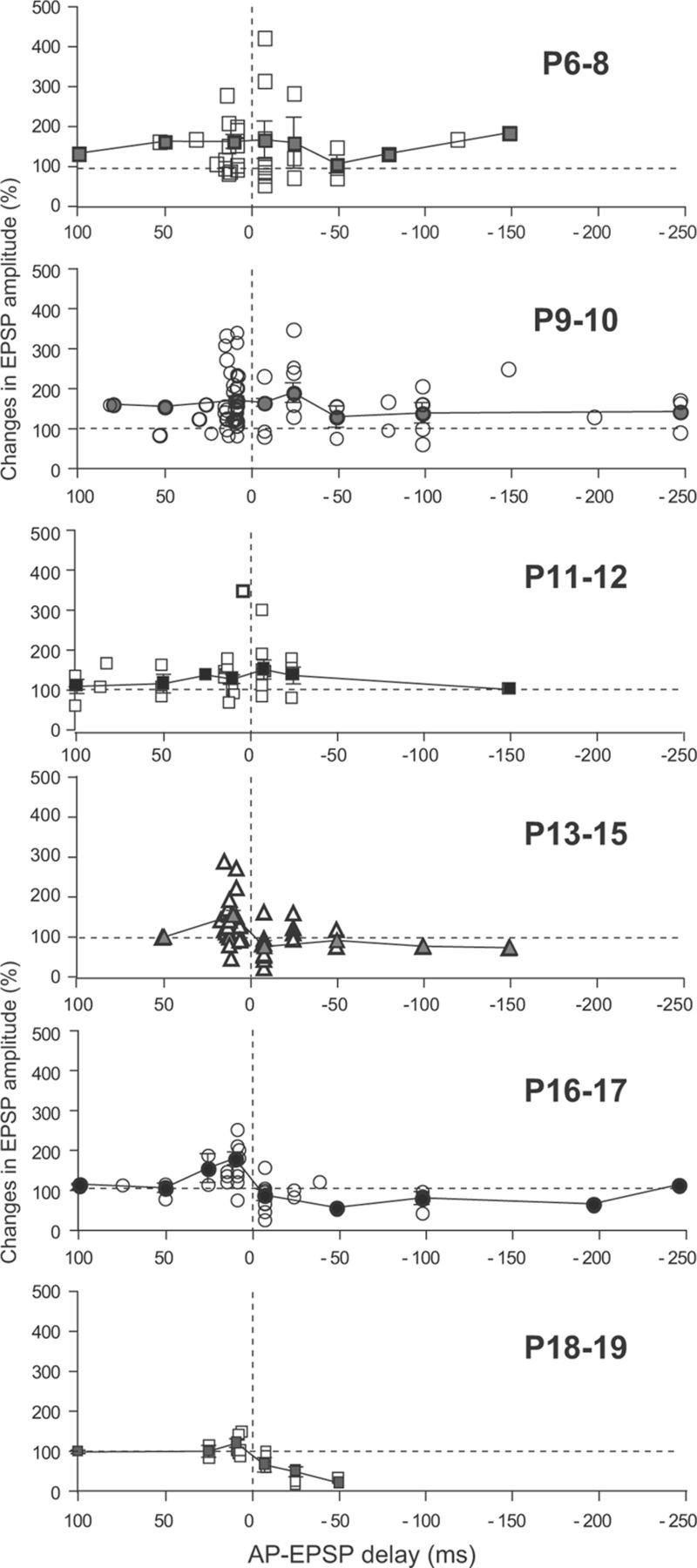
Sensory deprivation during the critical period induces long-lasting changes in cortical maps. In the rodent somatosensory cortex (S1), its precise initiation mechanism is not known, yet spike timing-dependent plasticity (STDP) at layer 4 (L4)-L2/3 synapses are thought to be crucial. Whisker stimulation causes "L4 followed by L2/3" cell firings, while acute single whisker deprivation suddenly reverses the sequential order in L4 and L2/3 neurons in the deprived column (Celikel et al., 2004). Reversed spike sequence then leads to long-term depression through an STDP mechanism (timing-dependent long-term depression), known as deprivation-induced suppression at L4-L2/3 synapses (Bender et al., 2006a), an important first step in the map reorganization. Here we show that STDP properties change dramatically on postnatal day 13-15 (P13-P15) in mice S1. Before P13, timing-dependent long-term potentiation (t-LTP) was predominantly induced regardless of spiking order. The induction of t-LTP required postsynaptic influx of Ca(2+), an activation of protein kinase A, but not calcium/calmodulin-dependent protein kinase II. Consistent with the strong bias toward t-LTP, whisker deprivation (all whiskers in Row "D") from P7-P12 failed to induce synaptic depression at L4-L2/3 synapses in the deprived column, but clear depression was seen if deprivation occurred after P14. Random activation of L4, L2/3 cells, as may occur in response to whisker stimulation before P13 during network formation, led to potentiation under the immature STDP rule, as predicted from the bias toward t-LTP regardless of spiking order. These findings describe a developmental switch in the STDP rule that may underlie the transition from synapse formation to circuit reorganization at L4-L2/3 synapses, both in distinct activity-dependent manners.
Figures




References
-
- Agmon A, Connors BW. Thalamocortical responses of mouse somatosensory (barrel) cortex in vitro. Neuroscience. 1991;41:365–379. - PubMed
-
- Allen CB, Celikel T, Feldman DE. Long-term depression induced by sensory deprivation during cortical map plasticity in vivo. Nat Neurosci. 2003;6:291–299. - PubMed
-
- Armstrong-James M. The nature and plasticity of sensory processing within adult rat barrel cortex. In: Jones EG, Diamond IT, editors. Cerebral Cortex. New York, London: Plenum; 1995. pp. 333–373.
-
- Armstrong-James M, Fox K, Das-Gupta A. Flow of excitation within rat barrel cortex on striking a single vibrissa. J Neurophysiol. 1992;68:1345–1358. - PubMed
Publication types
MeSH terms
Substances
LinkOut - more resources
Full Text Sources
Research Materials
Miscellaneous
