


Prolonged sedentary time and physical activity in workplace and non-work contexts: a cross-sectional study of office, customer service and call centre employees
- PMID: 23101767
- PMCID: PMC3546308
- DOI: 10.1186/1479-5868-9-128
Prolonged sedentary time and physical activity in workplace and non-work contexts: a cross-sectional study of office, customer service and call centre employees
Abstract
Background: To examine sedentary time, prolonged sedentary bouts and physical activity in Australian employees from different workplace settings, within work and non-work contexts.
Methods: A convenience sample of 193 employees working in offices (131), call centres (36) and customer service (26) was recruited. Actigraph GT1M accelerometers were used to derive percentages of time spent sedentary (<100 counts per minute; cpm), in prolonged sedentary bouts (≥20 minutes or ≥30 minutes), light-intensity activity (100-1951 cpm) and moderate-to-vigorous physical activity (MVPA; ≥1952 cpm). Using mixed models adjusted for confounders, these were compared for: work days versus non-work days; work hours versus non-work hours (work days only); and, across workplace settings.
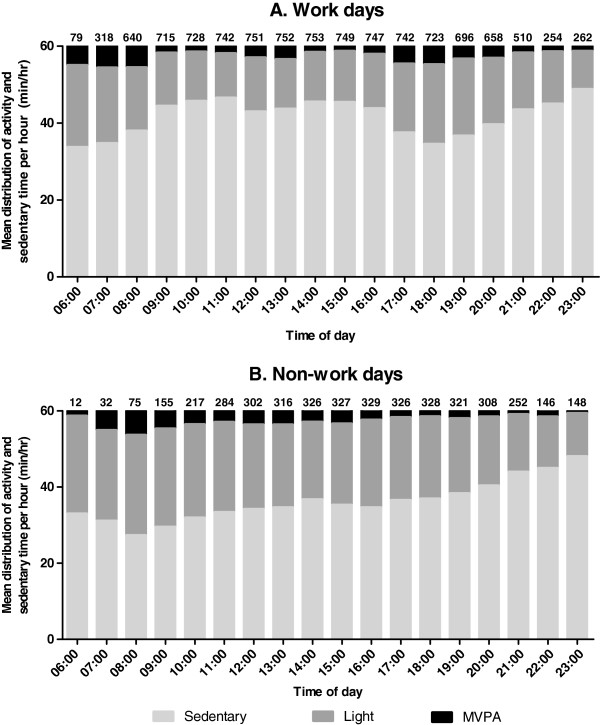
Results: Working hours were mostly spent sedentary (77.0%, 95%CI: 76.3, 77.6), with approximately half of this time accumulated in prolonged bouts of 20 minutes or more. There were significant (p<0.05) differences in all outcomes between workdays and non-work days, and, on workdays, between work- versus non-work hours. Results consistently showed "work" was more sedentary and had less light-intensity activity, than "non-work". The period immediately after work appeared important for MVPA. There were significant (p<0.05) differences in all sedentary and activity outcomes occurring during work hours across the workplace settings. Call-centre workers were generally the most sedentary and least physically active at work; customer service workers were typically the least sedentary and the most active at work.
Conclusion: The workplace is a key setting for prolonged sedentary time, especially for some occupational groups, and the potential health risk burden attached requires investigation. Future workplace regulations and health promotion initiatives for sedentary occupations to reduce prolonged sitting time should be considered.
Figures
References
-
- Dunstan DW, Salmon J, Owen N, Armstrong T, Zimmet PZ, Welborn TA, Cameron AJ, Dwyer T, Jolley D, Shaw JE. Physical activity and television viewing in relation to risk of undiagnosed abnormal glucose metabolism in adults. Diabetes Care. 2004;27(11):2603–2609. doi: 10.2337/diacare.27.11.2603. - DOI - PubMed
