


Review
doi: 10.1016/j.cld.2012.08.002.
Alcohol metabolism
Affiliations
- PMID: 23101976
- PMCID: PMC3484320
- DOI: 10.1016/j.cld.2012.08.002
Item in Clipboard
Review
Alcohol metabolism
Clin Liver Dis.
2012 Nov.
Abstract
This article describes the pathways and factors that modulate blood alcohol levels and metabolism and describes how the body disposes of alcohol. The various factors that play a role in the distribution of alcohol in the body, influence the absorption of alcohol, and contribute to first-pass metabolism of alcohol are described. Most alcohol is oxidized in the liver, and general principles and overall mechanisms for alcohol oxidation are summarized. The kinetics of alcohol elimination in-vivo and the various genetic and environmental factors that can modify the rate of alcohol metabolism are discussed.
Copyright © 2012 Elsevier Inc. All rights reserved.
Figures
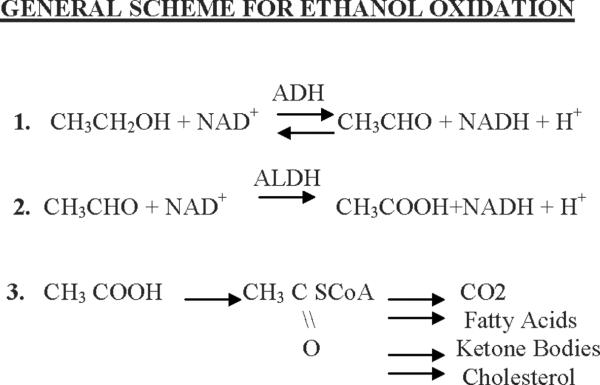
General scheme for alcohol oxidation. Alcohol is oxidized by alcohol and aldehyde dehydrogenases eventually to acetyl CoA. Depending on the nutritional, hormonal, energetic status, the acetyl CoA is converted to the indicated products.
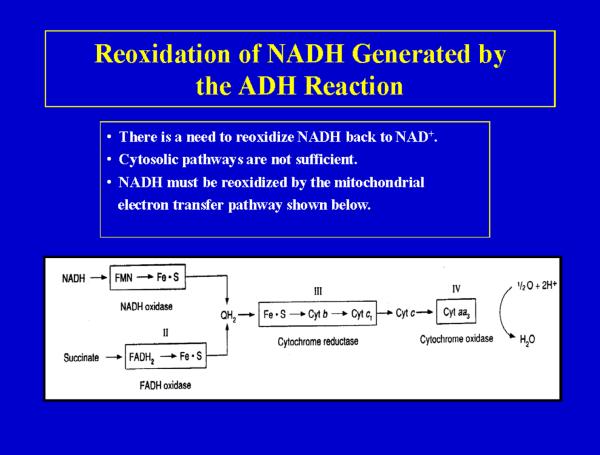
The mitochondrial respiratory chain. Reducing equivalents (electrons) enter the respiratory chain either from NADH or from succinate and are passed through a series of electron carriers to cytochrome oxidase which reacts with molecular oxygen to produce water. The NADH produced from the oxidation of alcohol by alcohol dehydrogenase is oxidized by the respiratory chain. Energy, in the form of ATP, is produced during this oxidation, hence, alcohol is of caloric value.
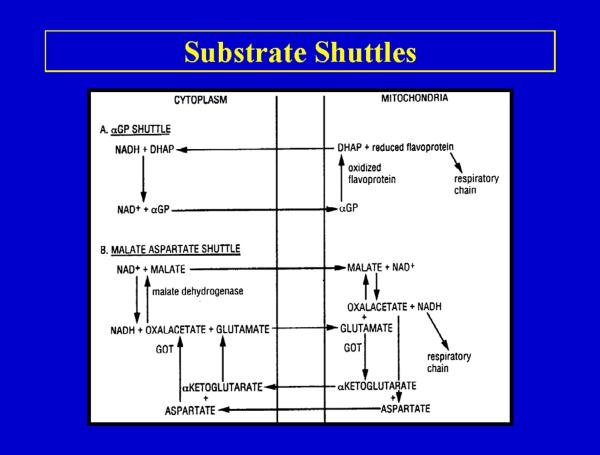
Substrate shuttle mechanisms for the reoxidation of NADH by the mitochondrial respiratory chain. The alcohol dehydrogenase reaction oxidizes alcohol in the liver cytosol and therefore produces NADH in the cytosol. This NADH cannot directly enter the mitochondria for oxidation (Fig 2) and therefore has to be transported into the mitochondria by either the α-glycerophosphate (a) or the malate-aspartate (b) shuttle.
References
-
- Khanna JM, Israel Y. Ethanol. Metabolism. Int. Review of Physiol. 1980;21:275–315. - PubMed
-
- Crabb DW, Bosron WF, Li TK. Ethanol Metabolism. Pharmac. Ther. 1987;34:59–73. - PubMed
-
- Kennedy NP, Tipton KF. Ethanol Metabolism and Alcoholic Liver Disease. Essays in Biochemistry. 1990;25:137–195. - PubMed
-
- Riveros-Rosas H, Julian-Sanchez A, Pina E. Enzymology of Ethanol and Acetaldehyde Metabolism in Mammals. Arch. Med. Res. 1997;28:453–471. - PubMed
-
- Kalant H. Pharmacokinetics of ethanol: Absorption, Distribution and Elimination. In: Begleiter H, Kissin B, editors. The Pharmacology of Alcohol and Alcohol Dependence. Oxford University Press; 1996. pp. 15–58.
Publication types
MeSH terms
Substances
Grants and funding
LinkOut - more resources
Full Text Sources
