Review
. 2012 Oct 26;19(10):1222-36.
doi: 10.1016/j.chembiol.2012.08.019.

AMP-activated protein kinase: a target for drugs both ancient and modern

Affiliations
Review

AMP-activated protein kinase: a target for drugs both ancient and modern

D Grahame Hardie et al. Chem Biol. .

Abstract

The AMP-activated protein kinase (AMPK) is a sensor of cellular energy status. It is activated, by a mechanism requiring the tumor suppressor LKB1, by metabolic stresses that increase cellular ADP:ATP and/or AMP:ATP ratios. Once activated, it switches on catabolic pathways that generate ATP, while switching off biosynthetic pathways and cell-cycle progress. These effects suggest that AMPK activators might be useful for treatment and/or prevention of type 2 diabetes and cancer. Indeed, AMPK is activated by the drugs metformin and salicylate, the latter being the major breakdown product of aspirin. Metformin is widely used to treat diabetes, while there is epidemiological evidence that both metformin and aspirin provide protection against cancer. We review the mechanisms of AMPK activation by these and other drugs, and by natural products derived from traditional herbal medicines.


Figures

Figure 1
Figure 1
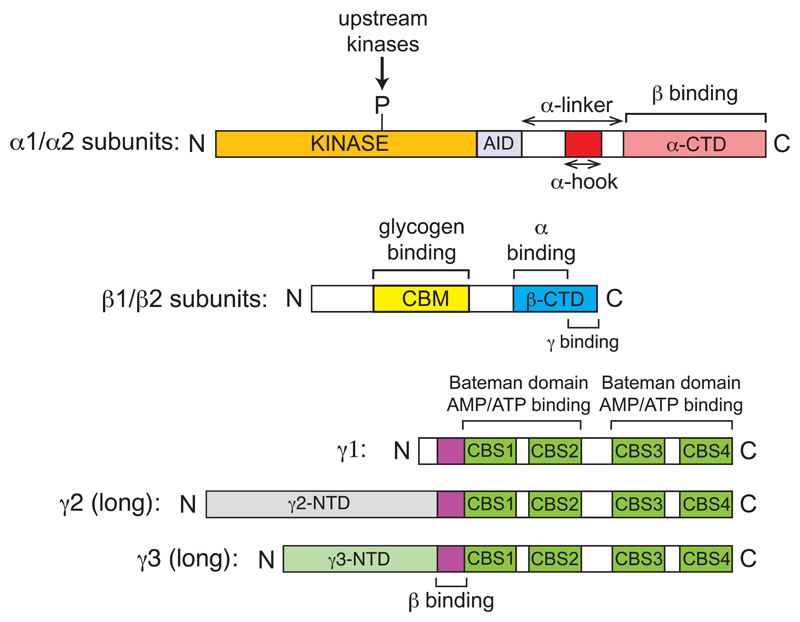
Domain structure of the α, β and γ subunits of AMPK and their isoforms. KEY: α-subunits: AID, auto-inhibitory domain, α-CTD, C-terminal domain; β-subunits: CBM, carbohydrate-binding module; β-CTD, C-terminal domain; γ subunits: CBS1, CBS2, CBS3, CBS4, cystathione β-synthase repeats; γ2-NTD, N-terminal extension of “long” version of γ2 subunit; γ3-NTD, N-terminal extension of “long” version of γ3 subunit.
Figure 2
Figure 2
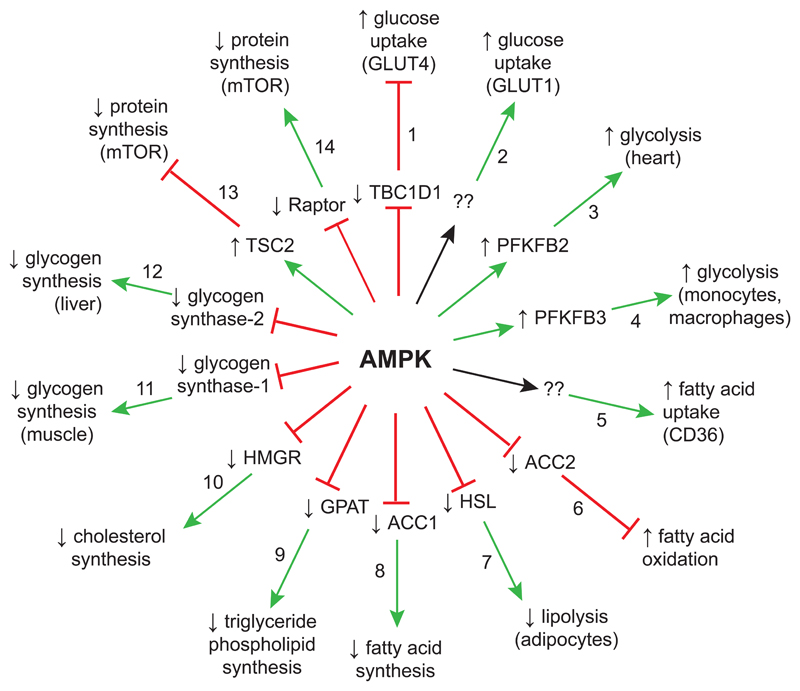
Acute metabolic effects of AMPK activation. Upward/downward arrows indicate that the target protein (inner wheel) or pathway (outer wheel) are activated/inactivated. See text for numbering and key to acronyms. Green arrows on the “spokes” of the wheel indicate activation, red lines with a bar at the end indicate inhibition, while black arrows and “??” indicate that the direct target protein that explains the effect is not known.
Figure 3
Figure 3
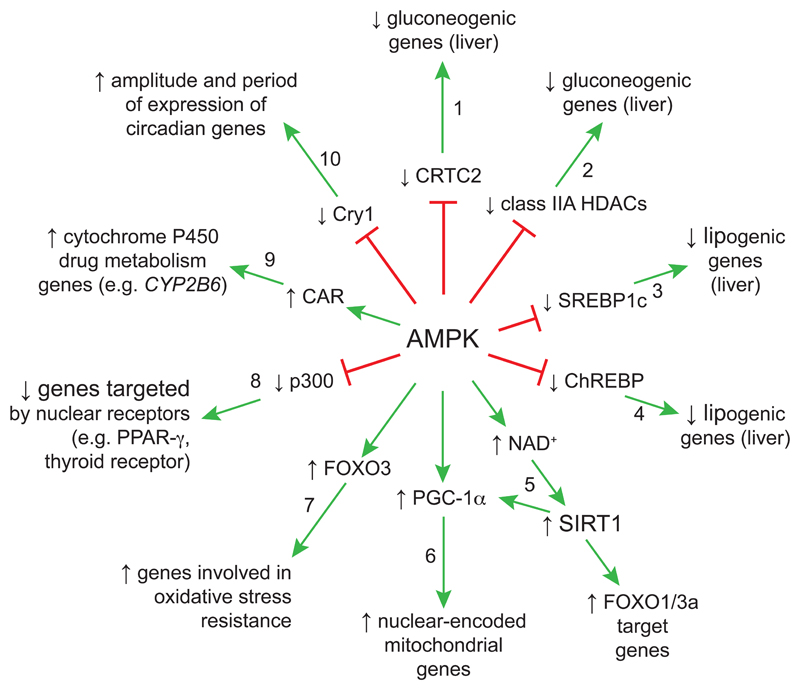
Effects of AMPK activation on transcription. Upward/downward arrows indicate that the target transcription factor or co-activator (inner wheel) or target genes (outer wheel) are activated/inactivated. Note that SIRT1 (on spoke 5) deacetylates both FOXO family transcription factors and the transcriptional co-activator PGC-1α.
Figure 4
Figure 4
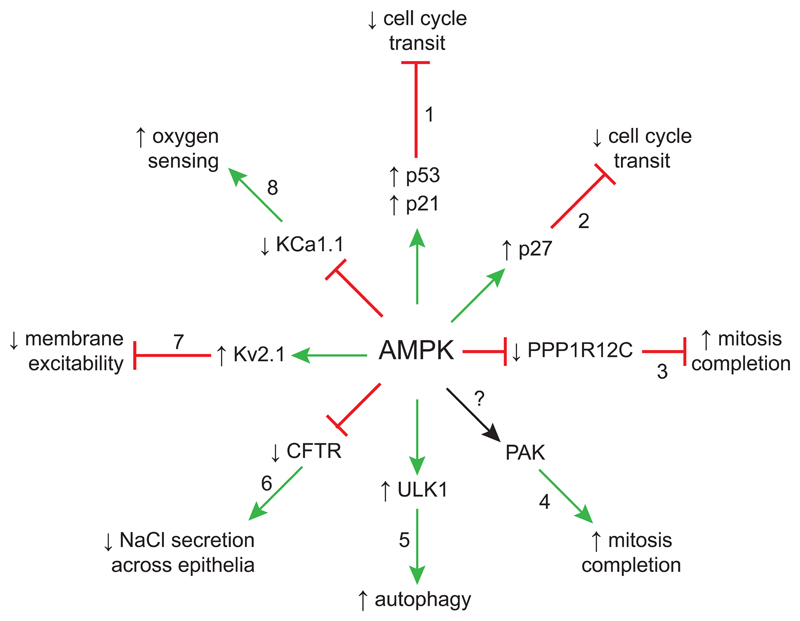
Effects of AMPK activation other than on metabolism and/or transcription. Upward/downward arrows indicate that the functions of the target protein (inner wheel) or target process (outer wheel) are activated/inactivated.
Figure 5
Figure 5
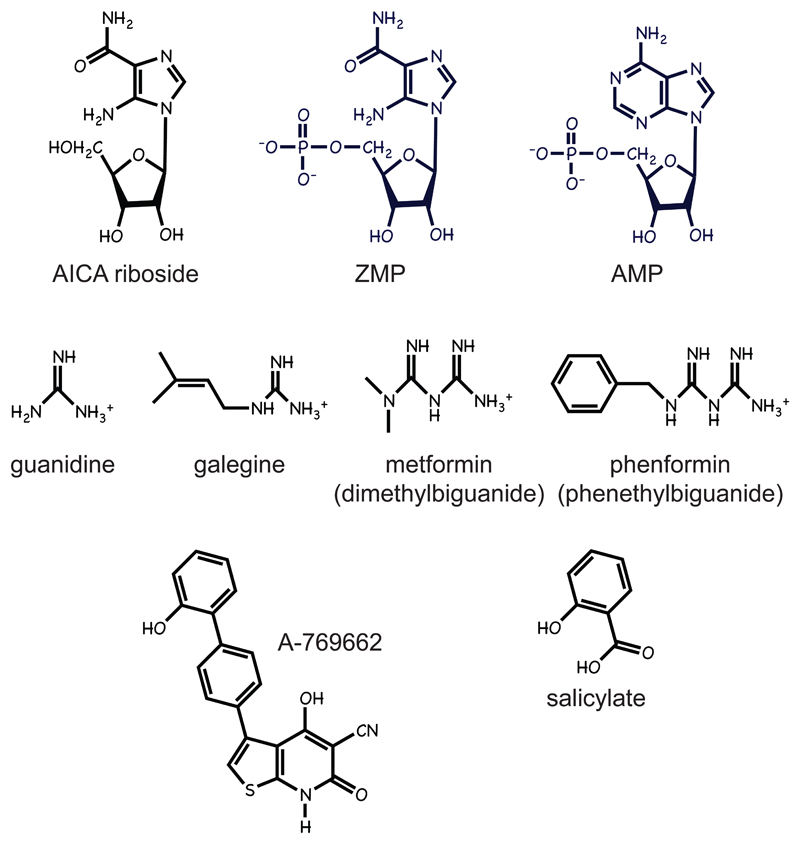
Structures of some AMPK-activating compounds and related compounds.

References

    1. Ahmadian M, Abbott MJ, Tang T, Hudak CS, Kim Y, Bruss M, Hellerstein MK, Lee HY, Samuel VT, Shulman GI, et al. Desnutrin/ATGL is regulated by AMPK and is required for a brown adipose phenotype. Cell Metab. 2011;13:739–748. - PMC - PubMed
    1. Ai H, Ihlemann J, Hellsten Y, Lauritzen HP, Hardie DG, Galbo H, Ploug T. Effect of fiber type and nutritional state on AICAR- and contraction-stimulated glucose transport in rat muscle. Am J Physiol. 2002;282:E1291–E1300. - PubMed
    1. Alessi DR, Sakamoto K, Bayascas JR. Lkb1-dependent signaling pathways. Annu Rev Biochem. 2006;75:137–163. - PubMed
    1. Amodeo GA, Rudolph MJ, Tong L. Crystal structure of the heterotrimer core of Saccharomyces cerevisiae AMPK homologue SNF1. Nature. 2007;449:492–495. - PubMed
    1. Bain J, Plater L, Elliott M, Shpiro N, Hastie CJ, McLauchlan H, Klevernic I, Arthur JS, Alessi DR, Cohen P. The selectivity of protein kinase inhibitors: a further update. Biochem J. 2007;408:297–315. - PMC - PubMed

Publication types

MeSH terms

LinkOut - more resources