


Vascular responses to long- and short-term exposure to fine particulate matter: MESA Air (Multi-Ethnic Study of Atherosclerosis and Air Pollution)
- PMID: 23103035
- PMCID: PMC3665082
- DOI: 10.1016/j.jacc.2012.08.973
Vascular responses to long- and short-term exposure to fine particulate matter: MESA Air (Multi-Ethnic Study of Atherosclerosis and Air Pollution)
Abstract
Objectives: This study evaluated the association of long- and short-term air pollutant exposures with flow-mediated dilation (FMD) and baseline arterial diameter (BAD) of the brachial artery using ultrasound in a large multicity cohort.
Background: Exposures to ambient air pollution, especially long-term exposure to particulate matter <2.5 μm in aerodynamic diameter (PM(2.5)), are linked with cardiovascular mortality. Short-term exposure to PM(2.5) has been associated with decreased FMD and vasoconstriction, suggesting that adverse effects of PM(2.5) may involve endothelial dysfunction. However, long-term effects of PM(2.5) on endothelial dysfunction have not been investigated.
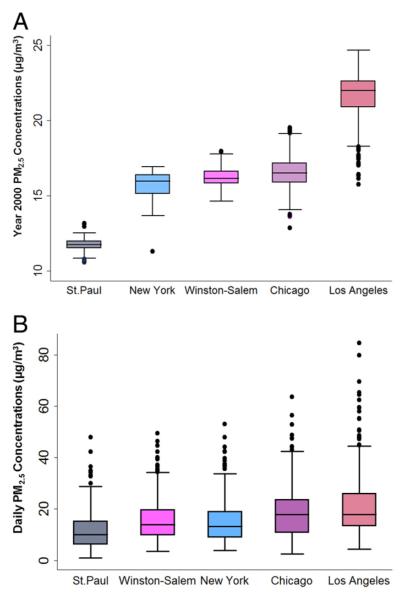
Methods: FMD and BAD were measured by brachial artery ultrasound at the initial examination of the Multi-Ethnic Study of Atherosclerosis. Long-term PM(2.5) concentrations were estimated for the year 2000 at each participant's residence (n = 3,040) using a spatio-temporal model informed by cohort-specific monitoring. Short-term PM(2.5) concentrations were based on daily central-site monitoring in each of the 6 cities.
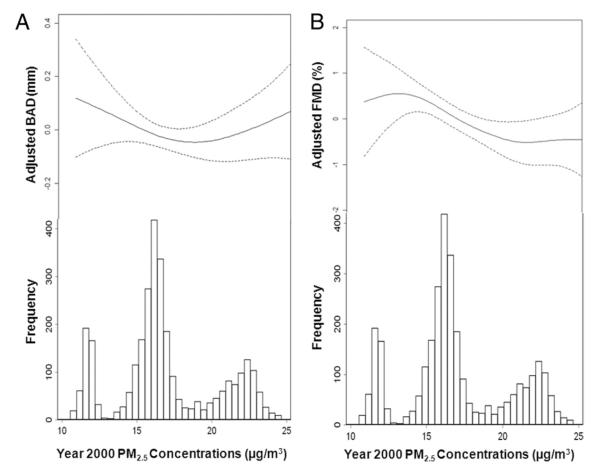
Results: An interquartile increase in long-term PM(2.5) concentration (3 μg/m(3)) was associated with a 0.3% decrease in FMD (95% confidence interval [CI] of difference: -0.6 to -0.03; p = 0.03), adjusting for demographic characteristics, traditional risk factors, sonographers, and 1/BAD. Women, nonsmokers, younger participants, and those with hypertension seemed to show a greater association of PM(2.5) with FMD. FMD was not significantly associated with short-term variation in PM(2.5) (-0.1% per 12 μg/m(3) daily increase [95% CI: -0.2 to 0.04] on the day before examination).
Conclusions: Long-term PM(2.5) exposure was significantly associated with decreased endothelial function according to brachial ultrasound results. These findings may elucidate an important pathway linking air pollution and cardiovascular mortality.
Trial registration: ClinicalTrials.gov NCT00005487.
Copyright © 2012 American College of Cardiology Foundation. Published by Elsevier Inc. All rights reserved.
Figures
Comment in
-
Chronic air pollution exposure and endothelial dysfunction: what you can't see--can harm you.J Am Coll Cardiol. 2012 Nov 20;60(21):2167-9. doi: 10.1016/j.jacc.2012.08.974. Epub 2012 Oct 24. J Am Coll Cardiol. 2012. PMID: 23103034 No abstract available.
-
Risk factors: Long-term effects of air pollution.Nat Rev Cardiol. 2012 Dec;9(12):672. doi: 10.1038/nrcardio.2012.162. Epub 2012 Nov 13. Nat Rev Cardiol. 2012. PMID: 23149837 No abstract available.
References
-
- Dockery DW, Pope CA, 3rd, Xu X, et al. An association between air pollution and mortality in six U.S. cities. N Engl J Med. 1993;329:1753–9. - PubMed
-
- Samet JM, Dominici F, Curriero FC, Coursac I, Zeger SL. Fine particulate air pollution and mortality in 20 U.S. cities, 1987–1994. N Engl J Med. 2000;343:1742–9. - PubMed
-
- Brook RD, Rajagopalan S, Pope CA, 3rd, et al. Particulate matter air pollution and cardiovascular disease: an update to the scientific statement from the American Heart Association. Circulation. 2010;121:2331–78. - PubMed
-
- Mills NL, Tornqvist H, Robinson SD, et al. Diesel exhaust inhalation causes vascular dysfunction and impaired endogenous fibrinolysis. Circulation. 2005;112:3930–6. - PubMed
-
- O’Neill MS, Veves A, Zanobetti A, et al. Diabetes enhances vulnerability to particulate air pollution-associated impairment in vascular reactivity and endothelial function. Circulation. 2005;111:2913–20. - PubMed
Publication types
MeSH terms
Substances
Associated data
Grants and funding
LinkOut - more resources
Full Text Sources
Medical
Molecular Biology Databases
Research Materials
