. 2012 Nov 29;2(5):1169-77.
doi: 10.1016/j.celrep.2012.09.019. Epub 2012 Oct 25.

Antagonism between MES-4 and Polycomb repressive complex 2 promotes appropriate gene expression in C. elegans germ cells

Affiliations

Antagonism between MES-4 and Polycomb repressive complex 2 promotes appropriate gene expression in C. elegans germ cells

Laura J Gaydos et al. Cell Rep. .

Abstract

The Caenorhabditis elegans MES proteins are key chromatin regulators of the germline. MES-2, MES-3, and MES-6 form the C. elegans Polycomb repressive complex 2 and generate repressive H3K27me3. MES-4 generates H3K36me3 on germline-expressed genes. Transcript profiling of dissected mutant germlines revealed that MES-2/3/6 and MES-4 cooperate to promote the expression of germline genes and repress the X chromosomes and somatic genes. Results from genome-wide chromatin immunoprecipitation showed that H3K27me3 and H3K36me3 occupy mutually exclusive domains on the autosomes and that H3K27me3 is enriched on the X. Loss of MES-4 from germline genes causes H3K27me3 to spread to germline genes, resulting in reduced H3K27me3 elsewhere on the autosomes and especially on the X. Our findings support a model in which H3K36me3 repels H3K27me3 from germline genes and concentrates it on other regions of the genome. This antagonism ensures proper patterns of gene expression for germ cells, which includes repression of somatic genes and the X chromosomes.


Figures

Figure 1
Figure 1
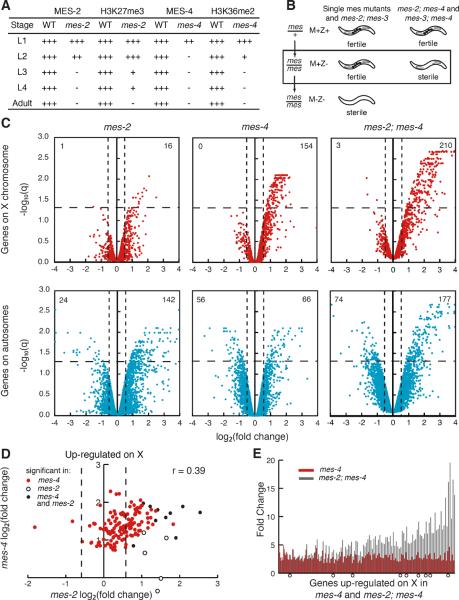
Microarray analysis of germlines from mes-2, mes-4, and mes-2; mes-4 mutants compared to wild type. (A) Perdurance (+) of maternal MES proteins and histone marks in mes-2 and mes-4 mutants. See also Figure S1. (B) Summary of phenotypes of mes single and double mutants. M=maternal supply, Z=zygotic expression. See also Figure S2. Germlines were dissected from M+Z− mes mutants (box). (C) Volcano plots showing log2 of the fold change (FC) between mes and wild-type expression and the false discovery rate (−log10 q) of all genes on the microarray. Dashed lines mark the significance cut-off of q=0.05 and 1.5-fold up- or down-regulation. The numbers of genes significantly up- or down-regulated are in the top quadrants. Genes with log2(FC) >4 or <−4 are represented as 4 or −4. For validation of data by quantitative PCR, see Table S1. (D) Comparison of log2(FC) of X-linked genes significantly mis-regulated in mes-4 only (red circles), mes-2 only (white circles), and both mes-4 and mes-2 (black circles). Dashed lines show 1.5-fold up- or down-regulation. Correlation coefficient is 0.39. (E) Fold changes of genes significantly up-regulated in mes-4 (red bars) and mes-2; mes-4 (black bars). Open circles, genes significantly up-regulated in mes-2 as well.
Figure 2
Figure 2
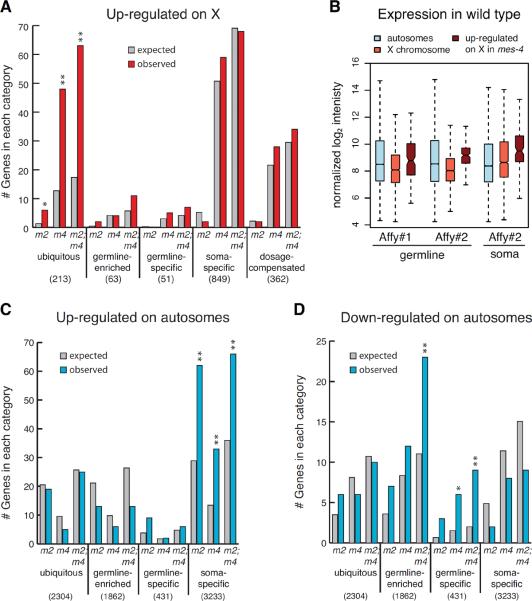
Genes mis-regulated in mes mutant germlines are enriched for particular expression categories. (A,C,D) Expected and observed numbers of genes in different expression categories among genes up-regulated on the X (A), genes up-regulated on autosomes (C), and genes down-regulated on autosomes (D) in mes-2 (m2), mes-4 (m4) and mes-2; mes-4 (m2; m4) compared to wild type (WT). See text and supplement for definitions of expression categories. Numbers in parentheses are the total number of genes in each category on the X or on the autosomes. Asterisks indicate significantly more genes than expected (hypergeometric test p-value < 0.01 (*) or < 0.001 (**)). See also Figure S4. (B) Comparison of autosomal and X-linked transcript levels in wild-type germlines and somatic tissue analyzed on single-color Affymetrix microarrays (Affy #1; (Tabuchi et al., 2011)) and tiling arrays (Affy #2; (Spencer et al., 2011)).
Figure 3
Figure 3
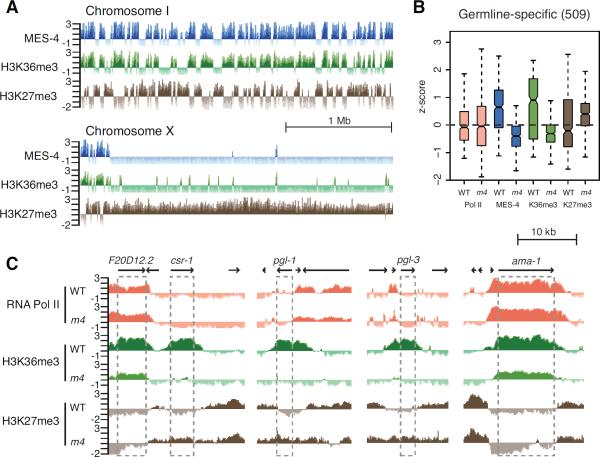
Genomic distributions of MES-4, H3K36me3, and H3K27me3. (A) ChIP z-scores (standardized log2 ratios of ChIP/Input signals) of MES-4, H3K36me3, and H3K27me3 across the leftmost 3 Mb of ChrI and ChrX. (B) Levels of RNA Polymerase II, MES-4, H3K36me3, and H3K27me3 on germline-specific genes in wild type (WT) and mes-4(RNAi) (m4). Each box extends from the 25th to 75th percentile of the z-scores in the set. Whiskers extend to the 2.5th and 97.5th percentile. Wedges around the median indicate 95% confidence interval for the medians. See also Figure S3. (C) Genome browser views of germline genes (csr-1, pgl-1, and pgl-3), showing absence of Pol II in wild type, and loss of H3K36me3 and acquisition of H3K27me3 in mes-4(RNAi). F20D12.2 and ama-1 have Pol II, and do not lose H3K36me3 or acquire H3K27me3 in mes-4(RNAi).
Figure 4
Figure 4
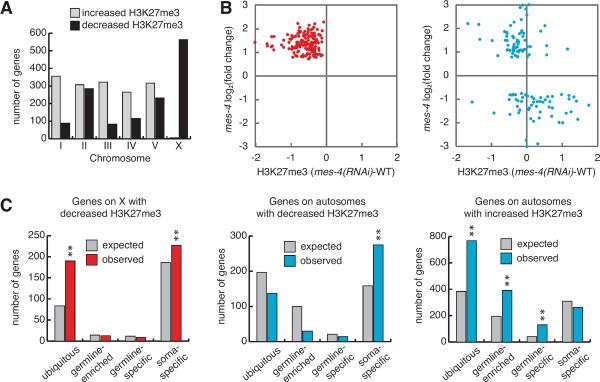
Assessment of redistribution of H3K27me3 upon depletion of MES-4. (A) Number of genes on each chromosome with significantly increased or decreased H3K27me3 in mes-4(RNAi) compared to wild type. (B) For 276 genes mis-regulated in mes-4 mutant germlines, comparison of gene mis-expression (X genes, red circles; autosomal genes, blue circles) versus change in H3K27me3 levels between mes-4(RNAi) and wild-type early embryos. (C) Expected and observed numbers of genes in different expression categories among genes with significantly increased or decreased H3K27me3 in mes-4(RNAi) compared to wild type.

Comment in

References

    1. Bender LB, Cao R, Zhang Y, Strome S. The MES-2/MES-3/MES-6 complex and regulation of histone H3 methylation in C. elegans. Curr Biol. 2004;14:1639–1643. - PubMed
    1. Bender LB, Suh J, Carroll CR, Fong Y, Fingerman IM, Briggs SD, Cao R, Zhang Y, Reinke V, Strome S. MES-4: an autosome-associated histone methyltransferase that participates in silencing the X chromosomes in the C. elegans germ line. Development. 2006;133:3907–3917. - PMC - PubMed
    1. Capowski EE, Martin P, Garvin C, Strome S. Identification of grandchildless loci whose products are required for normal germ-line development in the nematode Caenorhabditis elegans. Genetics. 1991;129:1061–1072. - PMC - PubMed
    1. Ernst J, Kellis M. Discovery and characterization of chromatin states for systematic annotation of the human genome. Nat Biotechnol. 2010;28:817–825. - PMC - PubMed
    1. Fong Y, Bender L, Wang W, Strome S. Regulation of the different chromatin states of autosomes and X chromosomes in the germ line of C. elegans. Science. 2002;296:2235–2238. - PMC - PubMed

MeSH terms

Associated data