


Reducing suicidal ideation: cost-effectiveness analysis of a randomized controlled trial of unguided web-based self-help
- PMID: 23103835
- PMCID: PMC3517339
- DOI: 10.2196/jmir.1966
Reducing suicidal ideation: cost-effectiveness analysis of a randomized controlled trial of unguided web-based self-help
Abstract
Background: Suicidal ideation is highly prevalent, but often remains untreated. The Internet can be used to provide accessible interventions.
Objective: To evaluate the cost-effectiveness of an online, unguided, self-help intervention for reducing suicidal ideation.
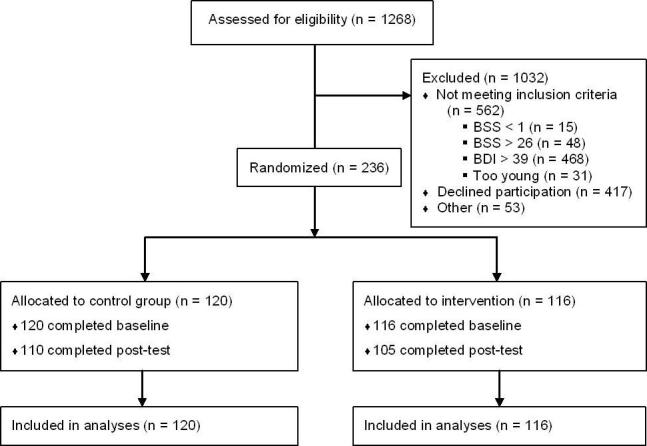
Methods: A total of 236 adults with mild to moderate suicidal thoughts, defined as scores between 1-26 on the Beck Scale for Suicide Ideation (BSS), were recruited in the general population and randomized to the intervention (n = 116) or to a waitlist, information-only, control group (n = 120). The intervention aimed to decrease the frequency and intensity of suicidal ideation and consisted of 6 modules based on cognitive behavioral techniques. Participants in both groups had unrestricted access to care as usual. Assessments took place at baseline and 6 weeks later (post-test). All questionnaires were self-report and administered via the Internet. Treatment response was defined as a clinically significant decrease in suicidal ideation on the BSS. Total per-participant costs encompassed costs of health service uptake, participants' out-of-pocket expenses, costs stemming from production losses, and intervention costs. These were expressed in Euros (€) for the reference year 2009.
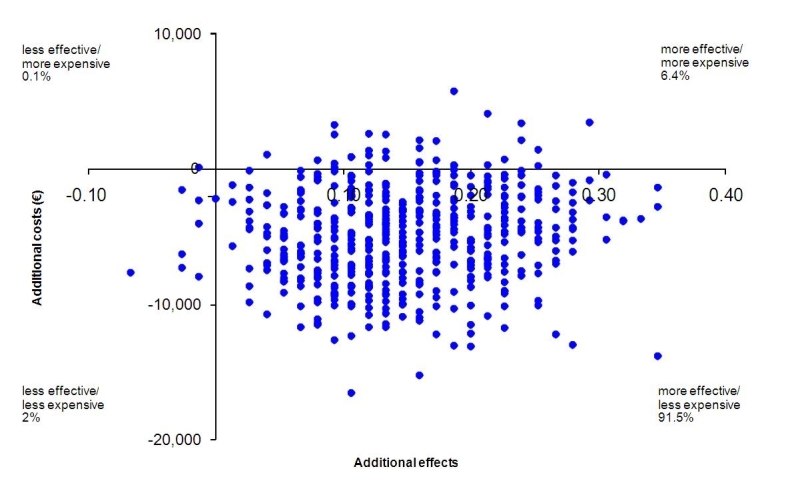
Results: At post-test, treatment response was 35.3% and 20.8% in the experimental and control conditions, respectively. The incremental effectiveness was 0.35 - 0.21 = 0.15 (SE 0.06, P = .01). The annualized incremental costs were -€5039 per participant. Therefore, the mean incremental cost-effectiveness ratio (ICER) was estimated to be -€5039/0.15 = -€34,727 after rounding (US -$41,325) for an additional treatment response, indicating annual cost savings per treatment responder.
Conclusions: This is the first trial to indicate that online self-help to reduce suicidal ideation is feasible, effective, and cost saving. Limitations included reliance on self-report and a short timeframe (6 weeks). Therefore, replication with a longer follow-up period is recommended.
Conflict of interest statement
None declared.
Figures

References
-
- Bruffaerts R, Demyttenaere K, Hwang I, Chiu WT, Sampson N, Kessler RC, Alonso J, Borges G, de Girolamo G, de Graaf R, Florescu S, Gureje O, Hu C, Karam EG, Kawakami N, Kostyuchenko S, Kovess-Masfety V, Lee S, Levinson D, Matschinger H, Posada-Villa J, Sagar R, Scott KM, Stein DJ, Tomov T, Viana MC, Nock MK. Treatment of suicidal people around the world. Br J Psychiatry. 2011 Jul;199(1):64–70. doi: 10.1192/bjp.bp.110.084129. http://bjp.rcpsych.org/cgi/pmidlookup?view=long&pmid=21263012bjp.bp.110.084129 - DOI - PMC - PubMed
-
- van Spijker BA, van Straten A, Kerkhof AJ. The effectiveness of a web-based self-help intervention to reduce suicidal thoughts: a randomized controlled trial. Trials. 2010;11:25. doi: 10.1186/1745-6215-11-25. http://www.trialsjournal.com/content/11//251745-6215-11-25 - DOI - PMC - PubMed
-
- Andrews G, Cuijpers P, Craske MG, McEvoy P, Titov N. Computer therapy for the anxiety and depressive disorders is effective, acceptable and practical health care: a meta-analysis. PLoS One. 2010;5(10):e13196. doi: 10.1371/journal.pone.0013196. http://dx.plos.org/10.1371/journal.pone.0013196 - DOI - PMC - PubMed
Publication types
MeSH terms
LinkOut - more resources
Full Text Sources
Medical
