Review
. 2012 Sep 1;125(Pt 17):3949-56.
doi: 10.1242/jcs.093633.

Leukocyte migration from a fish eye's view

Affiliations
Review

Leukocyte migration from a fish eye's view

Qing Deng et al. J Cell Sci. .

Abstract

In the last five years, the zebrafish (Danio rerio) has rapidly gained popularity as a model system for studying leukocyte migration and trafficking in vivo. The optical clarity of zebrafish embryos, as well as the potential for genetic manipulation and the development of tools for live imaging, have provided new insight into how leukocytes migrate in response to directional cues in live animals. This Commentary discusses recent progress in our understanding of how leukocytes migrate in vivo, including the role of intracellular signaling through phosphatidylinositol 3-kinase (PI3K) in both random and directed migration. The importance of leukocyte reverse migration in the resolution of inflammation will also be discussed. Finally, we will highlight how zebrafish models have helped to provide new insight into leukocyte migration and the way in which migration is altered in disease.


Figures
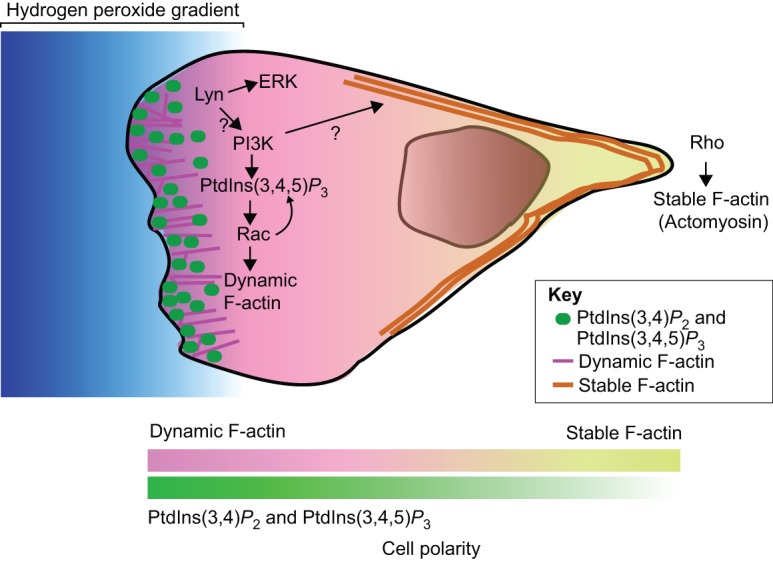
Fig. 1.
Fig. 1.
Cell polarity during neutrophil migration in zebrafish. Polarized activation of PI3K is required for cell motility (Weiner, 2002; Kolsch et al., 2008). The products of PI3K, PtdIns(3,4)P2 and PtdIns(3,4,5)P3, accumulate at the cell front and activate downstream signaling components, including Rac GTPases, which lead to polymerization of dynamic F-actin and protrusion of the leading edge. Rac further activates PI3K, thereby forming a positive feedback loop that amplifies cell polarity and promotes neutrophil migration (Kolsch et al., 2008; Yoo et al., 2010). PI3K also regulates neutrophil tail retraction through unknown mechanisms (Yoo et al., 2010). With regards to neutrophils, a hydrogen peroxide gradient is generated by injured tissue (Niethammer et al., 2009) and the Src family kinase, Lyn, is oxidized and activated by hydrogen peroxide (Yoo et al., 2011), which leads to activation of ERK and/or PI3K and directed migration. The lines at the bottom of the diagram (‘cell polarity’) indicate the gradient of changes in actin dynamics from more dynamic F-actin at the front of the cell to a stable population in the rear, and asymmetric enrichment of PtdIns(3,4)P2 and PtdIns(3,4,5)P3 at the front of migrating neutrophils.
Fig. 2.
Fig. 2.
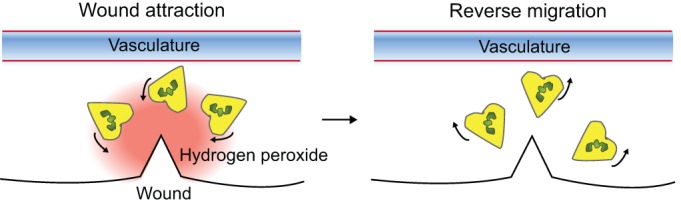
Neutrophil reverse migration. Following tissue injury, neutrophils are rapidly attracted to the injury site by a tissue gradient of hydrogen peroxide (Niethammer et al., 2009). The majority of neutrophils migrate back to the vasculature (reverse migration) during resolution of inflammation (Mathias et al., 2006; Yoo and Huttenlocher, 2011). The underlying mechanisms that regulate neutrophil reverse migration are not known.
Fig. 3.
Fig. 3.
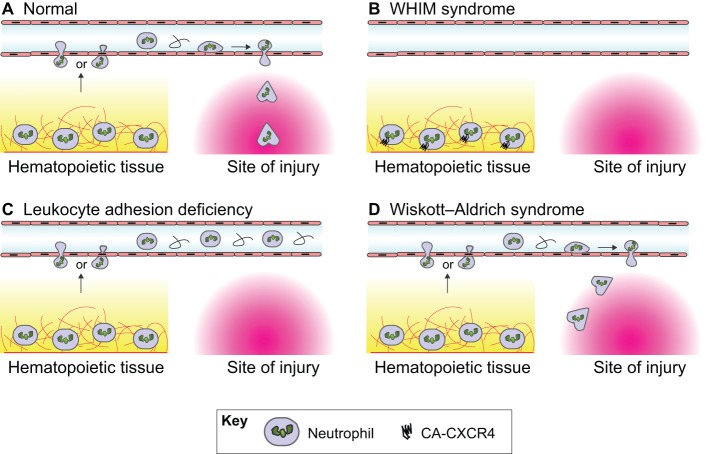
Schematic diagram showing different disease models in zebrafish. (A) In mammals, under normal conditions, tissue injury leads to neutrophils becoming mobilized from the hematopoietic tissue, migrating into the vasculature and exiting the vasculature at sites that are close to the site of injury. Neutrophil migration across the endothelium occurs either through transcellular (i.e. through the cell body) or paracellular (i.e. through cell–cell junctions) routes. Neutrophils then undergo interstitial migration to reach the site of injury. In zebrafish, neutrophils can be recruited directly from the hematopoietic tissue to wounds in certain contexts (Yoo et al., 2011). (B) In patients with WHIM syndrome (Walters et al., 2010), neutrophils are retained in hematopoietic tissue by constitutively active CXCR4 signaling and are, therefore, absent from the vasculature or site of injury. (C) In patients with leukocyte adhesion deficiency as a result of a dominant inhibitory mutation in Rac2 (Deng et al., 2011), neutrophils are released into the vasculature, but are not able to migrate out of the vasculature and are, therefore, absent at sites of injury. (D) In patients with Wiskott-Aldrich syndrome, which is caused by a WASP deficiency (Cvejic et al., 2008), neutrophils are not able to efficiently migrate to the site of tissue injury.

References

    1. Afonso P. V., Parent C. A. (2011). PI3K and chemotaxis: a priming issue? Sci. Signal. 4, pe22 10.1126/scisignal.2002019 - DOI - PubMed
    1. Ambruso D. R., Knall C., Abell A. N., Panepinto J., Kurkchubasche A., Thurman G., Gonzalez–Aller C., Hiester A., deBoer M., Harbeck R. J.et al. (2000). Human neutrophil immunodeficiency syndrome is associated with an inhibitory Rac2 mutation. Proc. Natl. Acad. Sci. USA 97, 4654–4659 10.1073/pnas.080074897 - DOI - PMC - PubMed
    1. Bertrand J. Y., Chi N. C., Santoso B., Teng S., Stainier D. Y., Traver D. (2010). Haematopoietic stem cells derive directly from aortic endothelium during development. Nature 464, 108–111 10.1038/nature08738 - DOI - PMC - PubMed
    1. Bobe J., Goetz F. W. (2001). Molecular cloning and expression of a TNF receptor and two TNF ligands in the fish ovary. Comp. Biochem. Physiol. B Biochem. Mol. Biol. 129, 475–481 10.1016/S1096-4959(01)00353-0 - DOI - PubMed
    1. Bohinjec J., Andoljsek D. (1992). Neutrophil-releasing activity of recombinant human granulocyte-macrophage colony stimulating factor in myelokathexis. Br. J. Haematol. 82, 169–170 10.1111/j.1365-2141.1992.tb04609.x - DOI - PubMed

Publication types