


Effects of Hurricane Katrina on nursing facility resident mortality, hospitalization, and functional decline
- PMID: 23105032
- PMCID: PMC3773950
- DOI: 10.1001/dmp.2010.11
Effects of Hurricane Katrina on nursing facility resident mortality, hospitalization, and functional decline
Abstract
Background: The study was designed to examine the 30- and 90-day mortality and hospitalization rates among nursing facility (NF) residents in the affected areas of Louisiana and Mississippi following Hurricane Katrina and to assess the rate of significant posthurricane functional decline.
Methods: A secondary data analysis was conducted using Medicare claims merged with NF resident data from the Minimum Data Set. Thirty- and 90-day mortality and hospitalization rates for long-stay (>90 days) residents residing in 141 at-risk NFs during Hurricane Katrina were compared to rates for residents residing at the same facilities during the same time period in prior nonhurricane years (2003 and 2004). Functional decline was assessed as a 4+ drop in function using a 28-point Minimum Data Set Activities of Daily Living Scale.
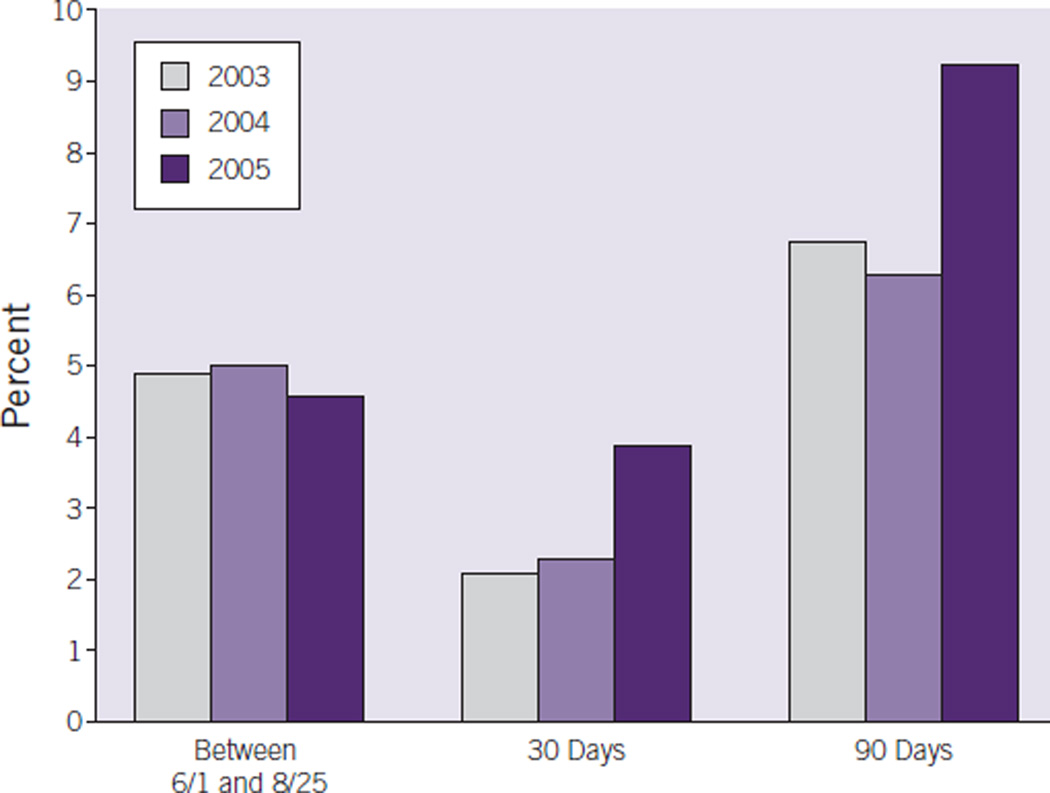
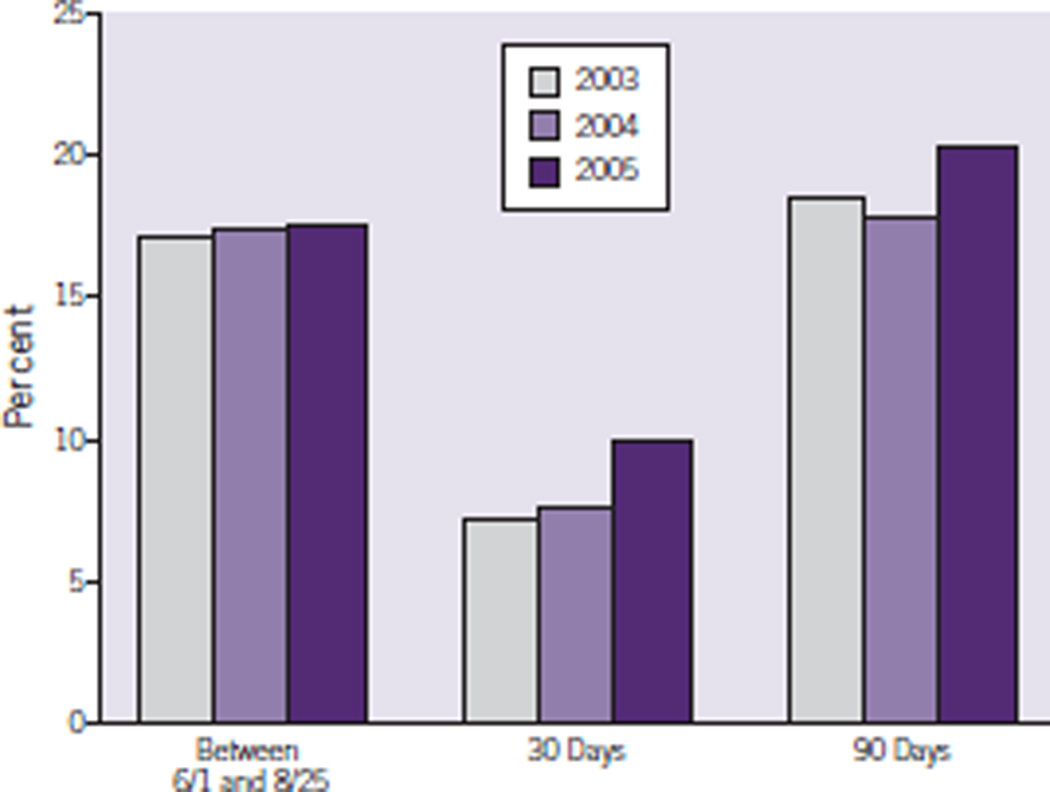
Results: There were statistically significant differences (all P < .0001) in mortality, hospitalization, and functional decline among residents exposed to Hurricane Katrina. At 30 days, the mortality rate was 3.88% among the exposed cohort compared with 2.10% and 2.28% for residents in 2003 and 2004, respectively. The 90-day mortality rate was 9.27% compared with 6.71% and 6.31%, respectively. These mortality differences translated into an additional 148 deaths at 30 days and 230 deaths at 90 days. The 30-day hospitalization rate was 9.87% compared with 7.21% and 7.53%, respectively. The 90-day hospitalization rate was 20.39% compared with 18.61% and 17.82%, respectively. Finally, the rate of significant functional decline among survivors was 6.77% compared with 5.81% in 2003 and 5.10% in 2004.
Conclusions: NF residents experienced a significant increase in mortality, hospitalization, and functional decline during Hurricane Katrina.
Conflict of interest statement
Figures
References
-
- Hull A, Struck D. At NH, Katrina dealt only the first blow. Washington Post. 2005 Sep;23:A1.
-
- Harris G. In NH, a fight lost to rising waters. New York Times. 2005 Sep;7:A1.
-
- Dosa DM, Grossman N, Wetle T, Mor V. To evacuate or not to evacuate: lessons learned from Louisiana nursing home administrators following Hurricanes Katrina and Rita. J Am Med Dir Assoc. 2007;8(3):142–149. - PubMed
-
- Franco C, Toner E, Waldhorn R, Maldin B, O’Toole T, Inglesby TV. Systemic collapse: Medical care in the aftermath of Hurricane Katrina. Biosecur Bioterror. 2006;4(2):135–146. - PubMed
Publication types
MeSH terms
Grants and funding
LinkOut - more resources
Full Text Sources
Medical
