


Cervical lidocaine for IUD insertional pain: a randomized controlled trial
- PMID: 23107081
- PMCID: PMC3492878
- DOI: 10.1016/j.ajog.2012.09.018
Cervical lidocaine for IUD insertional pain: a randomized controlled trial
Abstract
Objective: Anticipated pain with intrauterine device (IUD) insertion may be a barrier to widespread use. Our objective was to evaluate the efficacy of intracervical 2% lidocaine gel for pain relief with IUD insertion.
Study design: We performed a double-blind, randomized controlled trial of women undergoing IUD insertion. Participants were randomly assigned to 2% lidocaine or placebo gel. Study gel (3 mL) was placed 3 minutes prior to IUD insertion. Pain scores were measured at various time points using a 10-point visual analog scale.
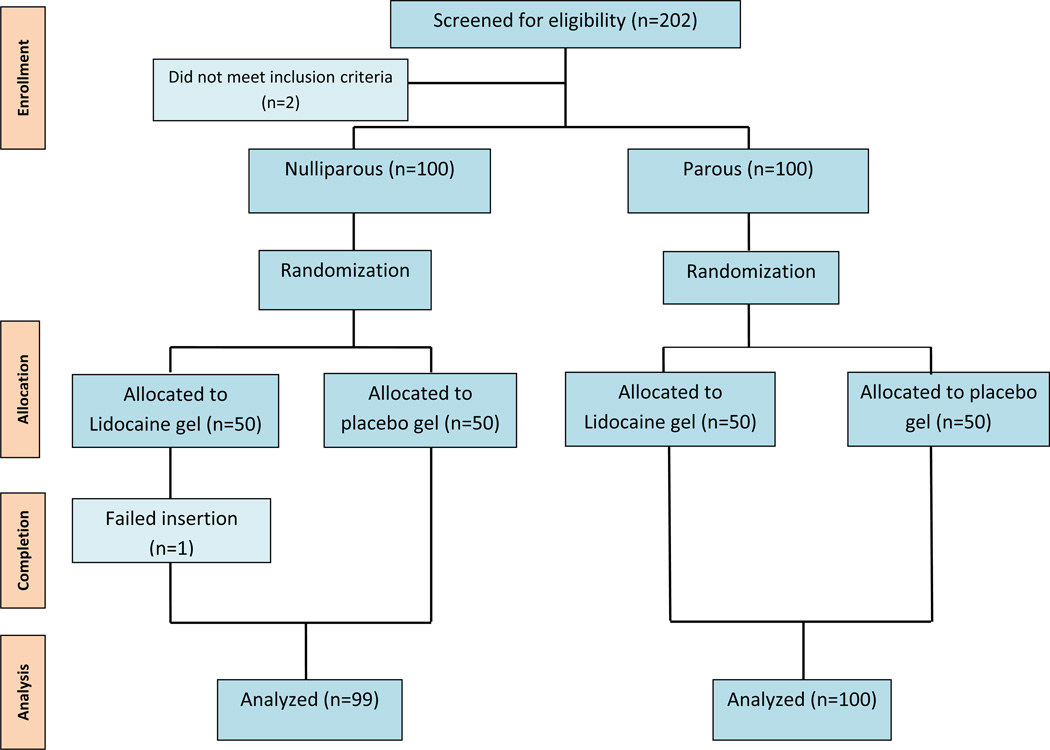
Results: Of the 200 participants randomized, 199 completed the study. Pain scores among lidocaine and placebo arms were similar at tenaculum placement (lidocaine and placebo: median, 4; range, 0-10; P = .15) and with insertion (lidocaine: median, 5; range, 1-10; placebo: median, 6; range, 0-10; P = .16). These results did not differ by parity.
Conclusion: Topical or intracervical 2% lidocaine gel prior to IUD insertion does not decrease pain scores.
Copyright © 2012 Mosby, Inc. All rights reserved.
Conflict of interest statement
Disclosure: None of the above authors have a conflict of interest
References
-
- Finer LB, Henshaw SK. Disparities in rates of unintended pregnancy in the United States, 1994 and 2001. Perspect Sex Reprod Health. 2006 Jun;38(2):90–96. - PubMed
-
- Suhonen S, Haukkamaa M, Jakobsson T, Rauramo I. Clinical performance of a levonorgestrel-releasing intrauterine system and oral contraceptives in young nulliparous women: a comparative study. Contraception. 2004 May;69(5):407–412. - PubMed
-
- Kulier R, O'Brien PA, Helmerhorst FM, Usher-Patel M, D'Arcangues C. Copper containing, framed intra-uterine devices for contraception. Cochrane Database Syst Rev. 2007;(4) CD005347. - PubMed
-
- O'Brien PA, Kulier R, Helmerhorst FM, Usher-Patel M, d'Arcangues C. Copper-containing, framed intrauterine devices for contraception: a systematic review of randomized controlled trials. Contraception. 2008 May;77(5):318–327. - PubMed
