


Personalized targeted therapy for lung cancer
- PMID: 23109866
- PMCID: PMC3472758
- DOI: 10.3390/ijms130911471
Personalized targeted therapy for lung cancer
Abstract
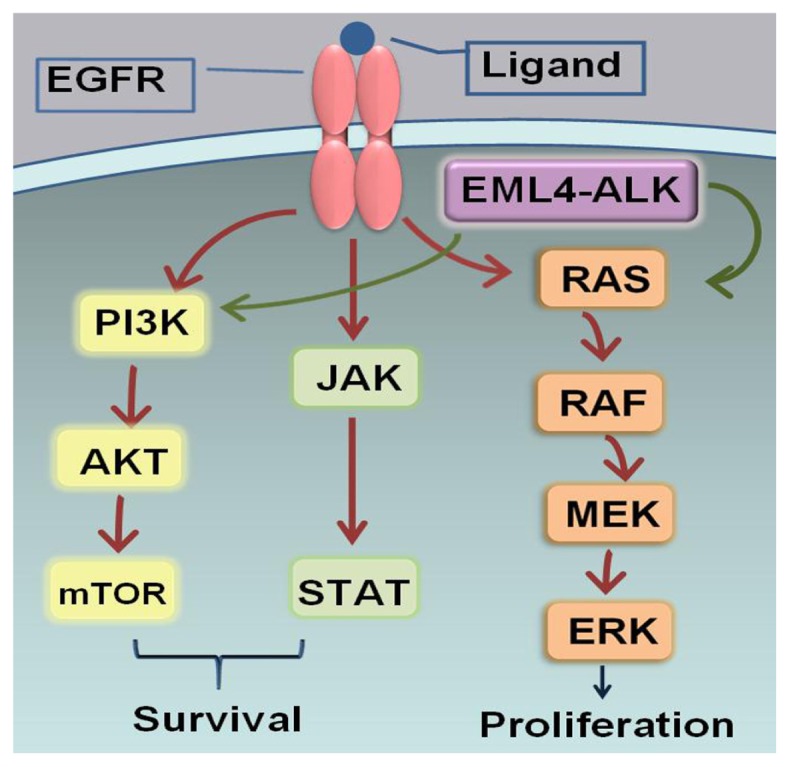
Lung cancer has long been recognized as an extremely heterogeneous disease, since its development is unique in every patient in terms of clinical characterizations, prognosis, response and tolerance to treatment. Personalized medicine refers to the use of markers to predict which patient will most likely benefit from a treatment. In lung cancer, the well-developed epidermal growth factor receptor (EGFR) and the newly emerging EML4-anaplastic lymphoma kinase (ALK) are important therapeutic targets. This review covers the basic mechanism of EGFR and EML4-ALK activation, the predictive biomarkers, the mechanism of resistance, and the current targeted tyrosine kinase inhibitors. The efficacy of EGFR and ALK targeted therapies will be discussed in this review by summarizing the prospective clinical trials, which were performed in biomarker-based selected patients. In addition, the revolutionary sequencing and systems strategies will also be included in this review since these technologies will provide a comprehensive understanding in the molecular characterization of cancer, allow better stratification of patients for the most appropriate targeted therapies, eventually resulting in a more promising personalized treatment. The relatively low incidence of EGFR and ALK in non-Asian patients and the lack of response in mutant patients limit the application of the therapies targeting EGFR or ALK. Nevertheless, it is foreseeable that the sequencing and systems strategies may offer a solution for those patients.
Keywords: ALK; EGFR; biomarker; lung cancer; next-generation sequencing.
Figures

References
-
- American cancer society. Cancer facts & figures 2011. [accessed on 24 June 2012]. Available online: http://www.cancer.org/acs/groups/content/@epidemiologysurveilance/docume....
-
- Jemal A., Bray F., Center M.M., Ferlay J., Ward E., Forman D. Global cancer statistics, 2011. CA. Cancer J. Clin. 2011;61:69–90. - PubMed
-
- National Comprehensive Cancer Network. [accessed on 10 September 2012]. Available online: http://www.nccn.org/professionals/physician_gls/pdf/nscl.pdf.
-
- Sequist L.V., Lynch T.J. EGFR tyrosine kinase inhibitors in lung cancer: An evolving story. Annu. Rev. Med. 2008;59:429–442. - PubMed
Publication types
MeSH terms
Substances
LinkOut - more resources
Full Text Sources
Other Literature Sources
Medical
Research Materials
Miscellaneous
