


How to tackle tremor - systematic review of the literature and diagnostic work-up
- PMID: 23109928
- PMCID: PMC3478569
- DOI: 10.3389/fneur.2012.00146
How to tackle tremor - systematic review of the literature and diagnostic work-up
Abstract
Background: Tremor is the most prevalent movement disorder in clinical practice. It is defined as involuntary, rhythmic, oscillatory movements. The diagnostic process of patients with tremor can be laborious and challenging, and a clear, systematic overview of available diagnostic techniques is lacking. Tremor can be a symptom of many diseases, but can also represent a distinct disease entity.
Objective: The objective of this review is to give a clear, systematic and step-wise overview of the diagnostic work-up of a patient with tremor. The clinical relevance and value of available laboratory tests in patients with tremor will be explored.
Methods: We systematically searched through EMBASE. The retrieved articles were supplemented by articles containing relevant data or provided important background information. Studies that were included investigated the value and/or usability of diagnostic tests for tremor.
Results: In most patients, history and clinical examination by an experienced movement disorders neurologist are sufficient to establish a correct diagnosis, and further ancillary examinations will not be needed. Ancillary investigation should always be guided by tremor type(s) present and other associated signs and symptoms. The main ancillary examination techniques currently are electromyography and SPECT imaging. Unfortunately, many techniques have not been studied in large prospective, diagnostic studies to be able to determine important variables like sensitivity and specificity.
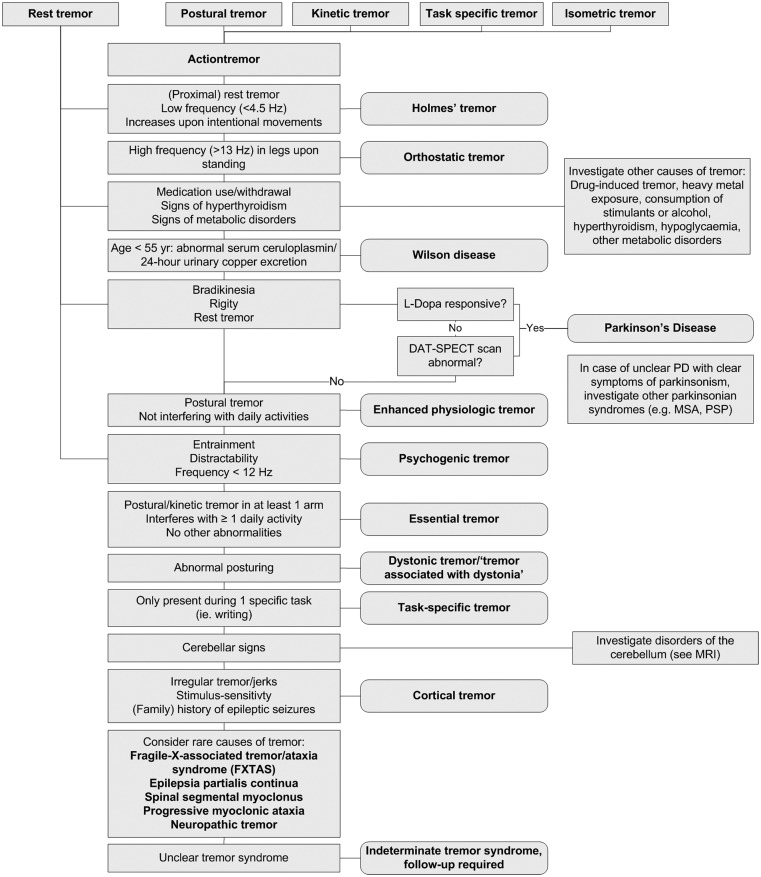
Conclusion: When encountering a patient with tremor, history, and careful clinical examination should guide the diagnostic process. Adherence to the diagnostic work-up provided in this review will help the diagnostic process of these patients.
Keywords: action tremor; diagnosis; differential diagnosis; electromyography; essential tremor; tremor.
Figures

References
-
- Bairactaris C., Demakopoulos N., Tripsianis G., Sioka C., Farmakiotis D., Vadikolias K., Heliopoulos I., Georgoulias P., Tsougos I., Papanastasiou I., Piperidou C. (2009). Impact of dopamine transporter single photon emission computed tomography imaging using I-123 ioflupane on diagnoses of patients with Parkinsonian syndromes. J. Clin. Neurosci. 16, 246–25210.1016/j.jocn.2008.01.020 - DOI - PubMed
-
- Bartova P., Skoloudik D., Kraft O., Bernatek J., Havel M., Ressner P. (2012). “Transcranial sonography and 123I FP-CIT spect in movement disorders,” in WFN 19th World Congress on Parkinson’s Disease and Related Disorders (Shanghai: Conference Publication; ), S94
LinkOut - more resources
Full Text Sources
