. 2012 Oct 24:3:219.
doi: 10.3389/fgene.2012.00219. eCollection 2012.

Long non-coding RNAs in cancer progression

Affiliations

Long non-coding RNAs in cancer progression

Keiko Tano et al. Front Genet. .

Abstract

Recent large-scale transcriptome analyses have revealed that transcription is spread throughout the mammalian genomes, yielding large numbers of transcripts, including long non-coding RNAs (lncRNAs) with little or no protein-coding capacity. Dozens of lncRNAs have been identified as biologically significant. In many cases, lncRNAs act as key molecules in the regulation of processes such as chromatin remodeling, transcription, and post-transcriptional processing. Several lncRNAs (e.g., MALAT1, HOTAIR, and ANRIL) are associated with human diseases, including cancer. Those lncRNAs associated with cancer are often aberrantly expressed. Although the underlying molecular mechanisms by which lncRNAs regulate cancer development are unclear, recent studies have revealed that such aberrant expression of lncRNAs affects the progression of cancers. In this review, we highlight recent findings regarding the roles of lncRNAs in cancer biology.

Keywords: ANRIL; HOTAIR; MALAT1; cancer; disease; large non-coding RNA.


Figures
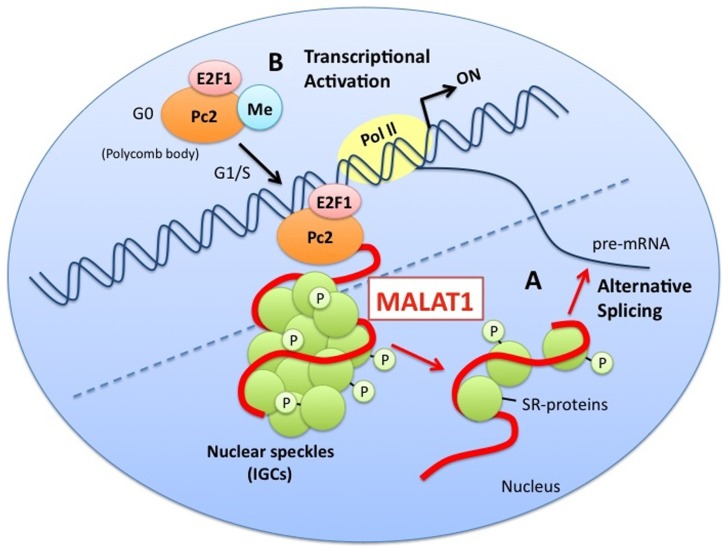
FIGURE 1
FIGURE 1
A model for the functions of MALAT1. MALAT1 stably localizes to nuclear speckles (interchromatin granule clusters; IGCs). (A) MALAT1 regulates alternative splicing by interacting with pre-mRNA splicing factors (SR proteins) and modulating the distribution and levels of active SR proteins. (B) MALAT1 regulates relocation of growth-control genes from the repressive environment of polycomb bodies (PcGs) to the gene activation milieu of the interchromatin granules (ICGs), in response to growth signals, by interacting with unmethylated Pc2. This leads to the promotion of E2F1 SUMOylation, and the activation of transcription of genes related to the control of growth.

References

    1. Bei J. X., Li Y., Jia W. H., Feng B. J., Zhou G., Chen L. Z., et al. (2010). A genome-wide association study of nasopharyngeal carcinoma identifies three new susceptibility loci. Nat. Genet. 42 599–603 - PubMed
    1. Birney E., Stamatoyannopoulos J. A., Dutta A., Guigo R., Gingeras T. R., Margulies E. H., et al. (2007). Identification and analysis of functional elements in 1% of the human genome by the ENCODE pilot project. Nature 447 799–816 - PMC - PubMed
    1. Bishop D. T., Demenais F., Iles M. M., Harland M., Taylor J. C., Corda E., et al. (2009). Genome-wide association study identifies three loci associated with melanoma risk. Nat. Genet. 41 920–925 - PMC - PubMed
    1. Burd C. E., Jeck W. R., Liu Y., Sanoff H. K., Wang Z., Sharpless N. E. (2010). Expression of linear and novel circular forms of an INK4/ARF-associated non-coding RNA correlates with atherosclerosis risk. PLoS Genet. 6 e1001233 10.1371/journal.pgen.1001233 - DOI - PMC - PubMed
    1. Clark M. B., Johnston R. L., Inostroza-Ponta M., Fox A. H., Fortini E., Moscato P., et al. (2012). Genome-wide analysis of long noncoding RNA stability. Genome Res. 22 885–898 - PMC - PubMed

LinkOut - more resources
