


Quantitative 3.0T MR spectroscopy reveals decreased creatine concentration in the dorsolateral prefrontal cortex of patients with social anxiety disorder
- PMID: 23110183
- PMCID: PMC3479123
- DOI: 10.1371/journal.pone.0048105
Quantitative 3.0T MR spectroscopy reveals decreased creatine concentration in the dorsolateral prefrontal cortex of patients with social anxiety disorder
Abstract
Background: The brain biochemical changes of social anxiety have not been clarified although there have been a limited number of MR spectroscopic studies which utilized metabolite/creatine ratios. Present study aimed to explore the alteration of absolute metabolite concentration in social anxiety disorder using quantitative MR spectroscopy.
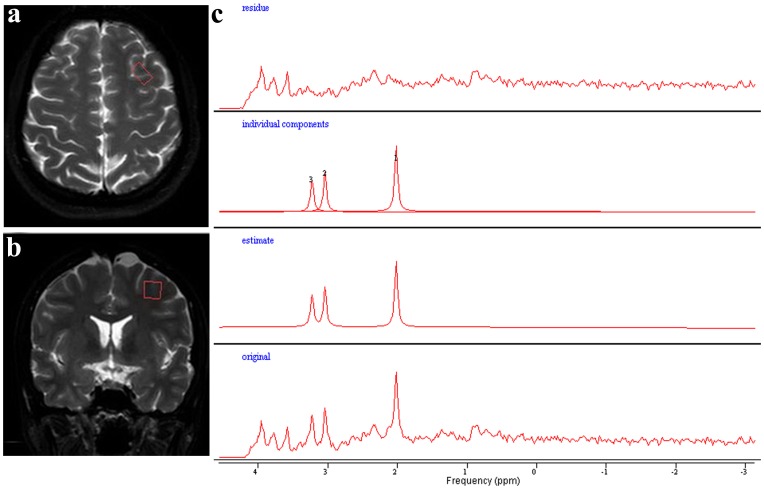
Materials and methods: With a 3.0T MR scanner, single voxel MR spectroscopy (stimulated echo acquisition mode, TR/TE/TM = 2000/20/16 ms) was performed in the left dorsolateral prefrontal cortex and related regions of nine medication-free patients with social anxiety disorder and nine controls. Absolute metabolite concentration was calculated using tissue water as the internal reference and corrected for the partial volume of cerebrospinal fluid.
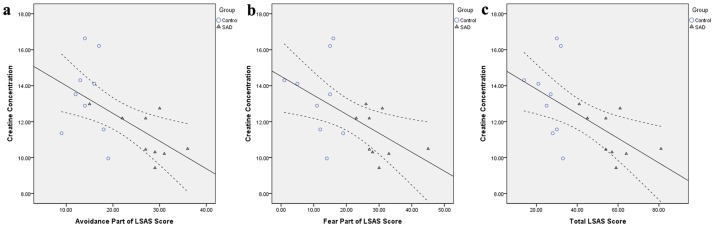
Results: In the left dorsolateral prefrontal cortex, the N-acetyl aspartate/creatine ratio of patients was significantly higher than that of controls, and this was due to the decrease of creatine concentration instead of the increase of N-acetyl aspartate concentration. Furthermore, the creatine concentration of the left dorsolateral prefrontal cortex was negatively correlated with the scores of Liebowitz social anxiety scale.
Conclusions: The alteration of creatine level in the left dorsolateral prefrontal cortex suggests abnormal energy metabolism and correlates with symptom severity in social anxiety disorder. And metabolite concentration is preferable to metabolite/creatine ratio for the investigation of individual, absolute metabolite changes in this region of social anxiety disorder.
Conflict of interest statement
Figures
References
-
- Lee S, Lee MT, Kwok K (2005) A community-based telephone survey of social anxiety disorder in Hong Kong. J Affect Disord 88: 183–186. - PubMed
-
- Xiao R, Wu WL, Hu JM, Qiu CJ, Wang Q, et al. (2006) [Prevalence and risk factors of social anxiety disorder in high schools and universities in Chengdu]. Sichuan Da Xue Xue Bao Yi Xue Ban 37: 636–640. - PubMed
-
- Grachev ID, Apkarian AV (2000) Anxiety in healthy humans is associated with orbital frontal chemistry. Mol Psychiatry 5: 482–488. - PubMed
-
- Pollack MH, Jensen JE, Simon NM, Kaufman RE, Renshaw PF (2008) High-field MRS study of GABA, glutamate and glutamine in social anxiety disorder: response to treatment with levetiracetam. Prog Neuropsychopharmacol Biol Psychiatry 32: 739–743. - PubMed
-
- Tupler LA, Davidson JR, Smith RD, Lazeyras F, Charles HC, et al. (1997) A repeat proton magnetic resonance spectroscopy study in social phobia. Biol Psychiatry 42: 419–424. - PubMed
