


Genome-wide association study of insect bite hypersensitivity in two horse populations in the Netherlands
- PMID: 23110538
- PMCID: PMC3524047
- DOI: 10.1186/1297-9686-44-31
Genome-wide association study of insect bite hypersensitivity in two horse populations in the Netherlands
Abstract
Background: Insect bite hypersensitivity is a common allergic disease in horse populations worldwide. Insect bite hypersensitivity is affected by both environmental and genetic factors. However, little is known about genes contributing to the genetic variance associated with insect bite hypersensitivity. Therefore, the aim of our study was to identify and quantify genomic associations with insect bite hypersensitivity in Shetland pony mares and Icelandic horses in the Netherlands.
Methods: Data on 200 Shetland pony mares and 146 Icelandic horses were collected according to a matched case-control design. Cases and controls were matched on various factors (e.g. region, sire) to minimize effects of population stratification. Breed-specific genome-wide association studies were performed using 70 k single nucleotide polymorphisms genotypes. Bayesian variable selection method Bayes-C with a threshold model implemented in GenSel software was applied. A 1 Mb non-overlapping window approach that accumulated contributions of adjacent single nucleotide polymorphisms was used to identify associated genomic regions.
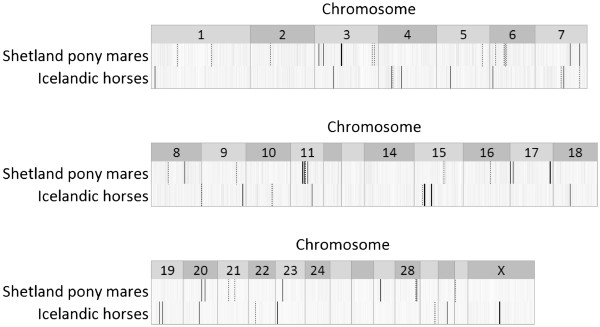
Results: The percentage of variance explained by all single nucleotide polymorphisms was 13% in Shetland pony mares and 28% in Icelandic horses. The 20 non-overlapping windows explaining the largest percentages of genetic variance were found on nine chromosomes in Shetland pony mares and on 14 chromosomes in Icelandic horses. Overlap in identified associated genomic regions between breeds would suggest interesting candidate regions to follow-up on. Such regions common to both breeds (within 15 Mb) were found on chromosomes 3, 7, 11, 20 and 23. Positional candidate genes within 2 Mb from the associated windows were identified on chromosome 20 in both breeds. Candidate genes are within the equine lymphocyte antigen class II region, which evokes an immune response by recognizing many foreign molecules.
Conclusions: The genome-wide association study identified several genomic regions associated with insect bite hypersensitivity in Shetland pony mares and Icelandic horses. On chromosome 20, associated genomic regions in both breeds were within 2 Mb from the equine lymphocyte antigen class II region. Increased knowledge on insect bite hypersensitivity associated genes will contribute to our understanding of its biology, enabling more efficient selection, therapy and prevention to decrease insect bite hypersensitivity prevalence.
Figures


References
-
- Gortel K. Equine parasitic hypersensitivity. Equine Pract. 1998;20:14–16.
-
- Meiswinkel R, Baylis M, Labuschagne K. Stabling and the protection of horses from Culicoides bolitinos (Diptera: Ceratopogonidae), a recently identified vector of African horse sickness. Bull Ent Res. 2000;90:509–515. - PubMed
-
- de Raat IJ, van den Boom R, van Poppel M, van Oldruitenborgh-Oosterbaan MM S. The effect of a topical insecticide containing permethrin on the number of Culicoides midges caught near horses with and without insect bite hypersensitivity in the Netherlands. Tijdschr Diergeneeskd. 2008;133:838–842. - PubMed
-
- van den Boom R, Kempenaars M, Sloet van Oldruitenborgh-Oosterbaan MM. The healing effects of a topical phytogenic ointment on insect bite hypersensitivity lesions in horses. Tijdschr Diergeneeskd. 2011;136:20–26. - PubMed
Publication types
MeSH terms
LinkOut - more resources
Full Text Sources
Medical
Miscellaneous
