. 2012 Oct;24(10):4266-80.
doi: 10.1105/tpc.112.103002. Epub 2012 Oct 30.

Arabidopsis chloroplast RNA binding proteins CP31A and CP29A associate with large transcript pools and confer cold stress tolerance by influencing multiple chloroplast RNA processing steps

Affiliations

Arabidopsis chloroplast RNA binding proteins CP31A and CP29A associate with large transcript pools and confer cold stress tolerance by influencing multiple chloroplast RNA processing steps

Christiane Kupsch et al. Plant Cell. 2012 Oct.

Abstract

Chloroplast RNA metabolism is mediated by a multitude of nuclear encoded factors, many of which are highly specific for individual RNA processing events. In addition, a family of chloroplast ribonucleoproteins (cpRNPs) has been suspected to regulate larger sets of chloroplast transcripts. This together with their propensity for posttranslational modifications in response to external cues suggested a potential role of cpRNPs in the signal-dependent coregulation of chloroplast genes. We show here on a transcriptome-wide scale that the Arabidopsis thaliana cpRNPs CP31A and CP29A (for 31 kD and 29 kD chloroplast protein, respectively), associate with large, overlapping sets of chloroplast transcripts. We demonstrate that both proteins are essential for resistance of chloroplast development to cold stress. They are required to guarantee transcript stability of numerous mRNAs at low temperatures and under these conditions also support specific processing steps. Fine mapping of cpRNP-RNA interactions in vivo suggests multiple points of contact between these proteins and their RNA ligands. For CP31A, we demonstrate an essential function in stabilizing sense and antisense transcripts that span the border of the small single copy region and the inverted repeat of the chloroplast genome. CP31A associates with the common 3'-terminus of these RNAs and protects them against 3'-exonucleolytic activity.


Figures
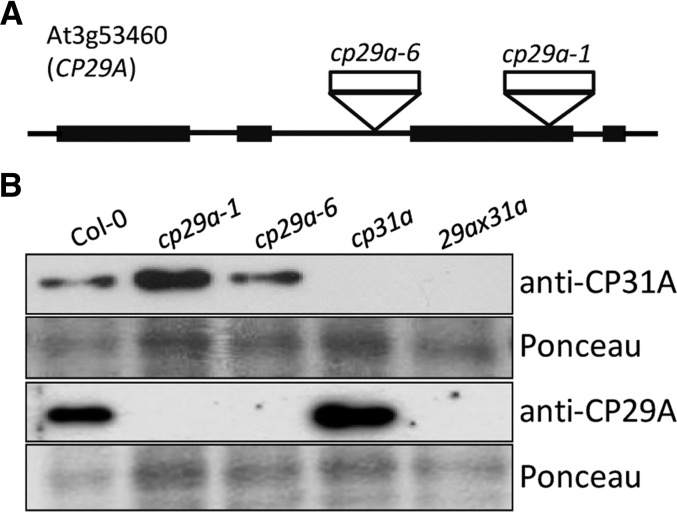
Figure 1.
Figure 1.
Isolation of cp29a Null Mutants. (A) Gene map of CP29A (At3g53460) with four exons (black bars) and three introns (black lines). Positions of the T-DNA insertions cp29a-1 (SALK_003066) and cp29a-6 (001G06) are marked by triangles. (B) Immunoblot analyses using anti-CP29A and anti-CP31A antibodies demonstrate the absence of CP29A and CP31A in cp29a and cp31a single mutants, respectively, and the lack of both proteins in cp29a × cp31a double mutants. A quantitative analysis with dilutions of wild-type protein extracts demonstrates that loss of CP29A does not affect the accumulation of CP31A and vice versa (see Supplemental Figure 1 online).
Figure 2.
Figure 2.
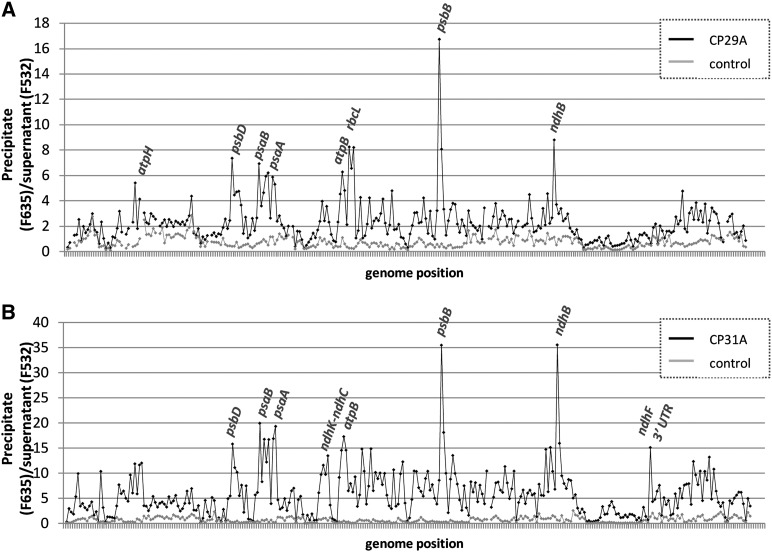
Identification of RNAs Associated with CP29A and CP31A in Chloroplast Stroma. The enrichment ratios (pellet F635/supernatant F532) were normalized between three assays involving wild-type stroma, one control assay with stroma from the corresponding null mutants (from cp29a [A] or cp31a [B] seedlings, respectively), and one control assay involving wild-type stroma, but assayed with preimmune serum of the corresponding antibody. The median normalized values for replicate spots from the mutant data and from the control assays were plotted according to chromosomal position. The data used to generate these graphs are provided in Supplemental Data Set 1 online.
Figure 3.
Figure 3.
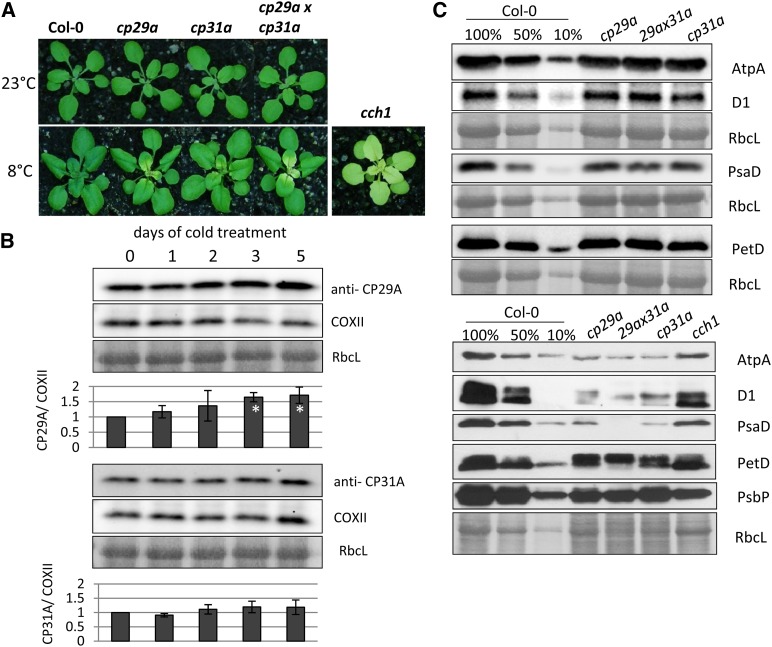
Phenotype and Protein Accumulation in cp29a and cp31a Single and Double Mutants. (A) Macroscopic effects of cold stress on cpRNP mutants. Top tier: Plants grown for 3 weeks at 23°C. Bottom tier: Plants grown for 18 d at 23°C, then shifted to 8°C for additional 3 weeks. Phenotype of the cch1 mutant grown after cold treatment is included as control for photosynthetic deficiency. (B) Expression of CP29A (top part) and CP31A (bottom part) during cold treatment. Two-week-old Arabidopsis plants were exposed to cold stress (8°C), and tissue samples were taken after 1, 2, 3, and 5 d of cold treatment. For immunoblot analysis, the four youngest leaves of every plant were harvested. Equal amounts of total protein were separated by SDS-PAGE, blotted to nitrocellulose membranes, and hybridized with anti-CP29A and anti-CP31A antibodies. Equal loading is demonstrated by Ponceau staining of RbcL and by reprobing the blots after stripping with an antibody against the mitochondrial COXII protein. Signals were measured using a chemiluminoimager. The maximum signal intensity measured at 0 d was set to 1. Signals were normalized to COX2 signals. Standard deviations are based on three biological replicates. Significance of changes relative to day 0 was calculated with a two-tailed, paired Student’s t test. White asterisks denote P values below 0.05 (i.e., a significant induction in the cold). (C) Immunological analysis of photosynthetic enzyme accumulation in cp29a and cp31a single and double mutants. The accumulation of representative subunits of the ATP synthase (AtpA), photosystem II (D1), photosystem I (PsaD), and the cytochrome b6f complex (PetD) were analyzed by probing immunoblots with specific antisera. Blots were prepared with total leaf proteins from the wild type with dilutions indicated and from cp29a, cp31a, and cp29axcp31a mutant seedlings grown at normal temperatures for 3 weeks (top part) or from the bleached tissue from plants grown for 18 d at 23°C and then cold-stressed for an additional 3 weeks at 8°C (bottom panels). The blots were stained with Ponceau S to visualize the large subunit of ribulose-1,5-bisphosphate carboxylase/oxygenase (RbcL; corresponding Ponceau stains and antibody probing are shown as blocks of panels; i.e., several blots were probed with multiple antibodies).
Figure 4.
Figure 4.
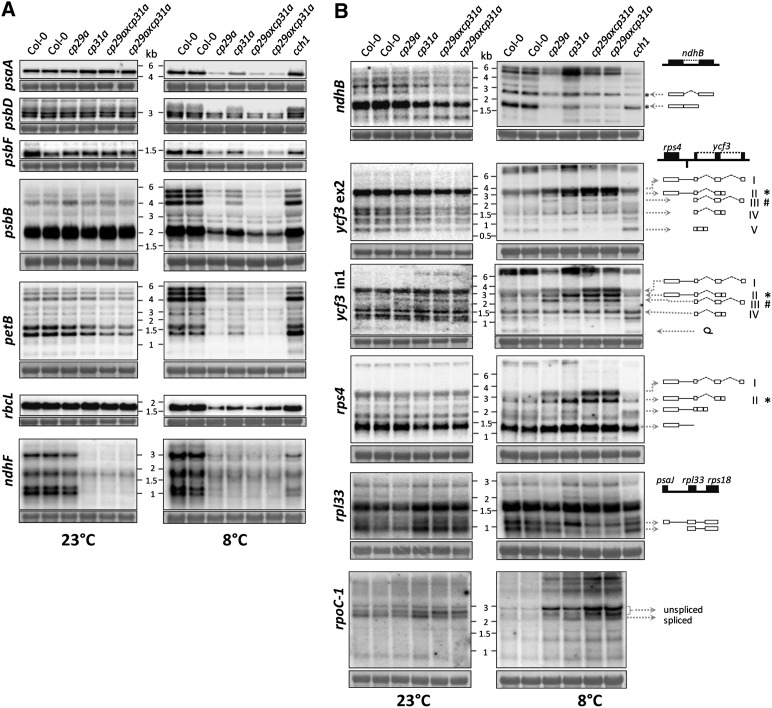
Analysis of Transcript Accumulation in cp29a and cp31a Mutants at 23 and 8°C. Four micrograms of total leaf RNA from the indicated genotypes was fractionated on 1.2% agarose gels and analyzed by hybridization to probes for the plastid RNAs indicated (see Supplemental Table 1 online for primer sequences). Equal loading was controlled by staining the cytosolic 25S rRNA (25S) with methylene blue. Autoradiographs shown on the left are prepared with plants grown at normal temperatures; those on the right from plants cold-treated for 3 weeks. (A) Transcript patterns with reductions (i.e., with quantitative but not qualitative changes in the transcript pattern) after cold treatment relative to wild-type controls. (B) Genes with altered transcript patterns under cold stress conditions. Cartoons of the assessed operons are shown at the right. Selected transcripts are represented as well. Open boxes, cistrons; exons; lines, intergenic regions; dotted lines, introns.
Figure 5.
Figure 5.
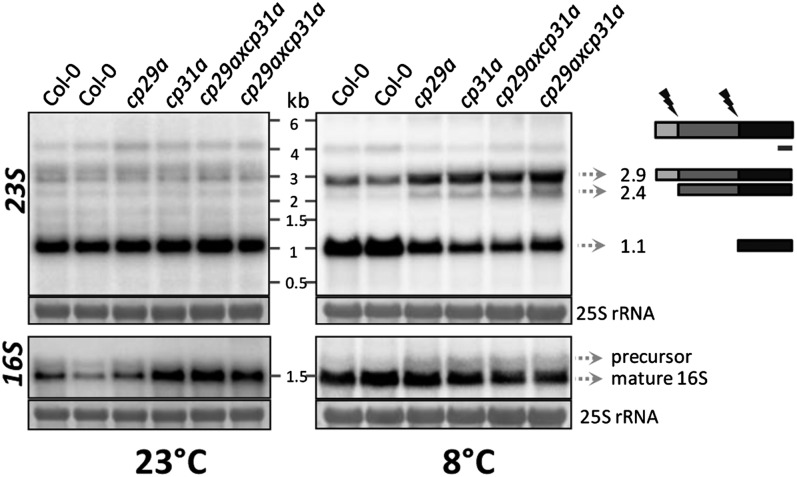
Analysis of rRNA Accumulation in cp29a and cp31a Mutants at 23 and 8°C. Four micrograms of total leaf RNA from wild-type and mutant plants before and after 3 weeks of cold stress were subjected to RNA gel blot analyses using probes for the 16S and 23S rRNAs (see Supplemental Table 1 online for primer sequences). Equal loading was controlled by staining the cytosolic 25S rRNA (25S) with methylene blue. Autoradiographs shown at left were prepared with plants grown at 23°C; those on the right from plants cold-treated (8°C) for 3 weeks. Cartoon: The 23S rRNA is matured into three fragments on chloroplast ribosomes by cleavage of the precursor (flashes). The probe used detects the 3′-end of the 23S rRNA and is indicated by a black bar.
Figure 6.
Figure 6.
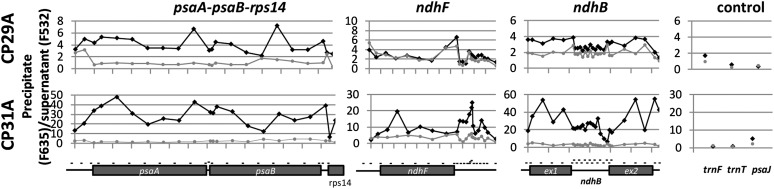
Mapping of cpRNP Binding Sites on Selected Chloroplast mRNAs. RIP-chip assays using stroma extracts and antisera against CP29A (top) or CP31A (bottom) were performed using an array with oligonucleotide probes antisense to three transcription units, psaA-psaB-rps14, ndhF, and intron containing ndhB. Oligos against nontargets of the two cpRNPs (trnF, trnT, and psaJ) were included as well. The oligos were distributed to represent all areas of the target transcripts of the two cpRNPs as indicated by short thin lines in the schematic representation drawn to scale below the charts. The enrichment ratios (pellet F635/supernatant F532) were normalized between three assays from wild-type extracts with CP29A- and CP31A-specific antibodies (black lines) and controlled with two assays from mutant extracts and one assay using preimmune serum of the antibody in case of CP29A (gray lines). For CP31A, two experiments were controlled using the preimmune serum of the antibody and one is controlled using an HA antibody. We did not use mutant serum in the latter case because it lacks the ndhF mRNA (Tillich et al., 2009), which is one target to be analyzed in this approach. The median values for three experiments and three controls are provided in Supplemental Data Set 2 online.
Figure 7.
Figure 7.
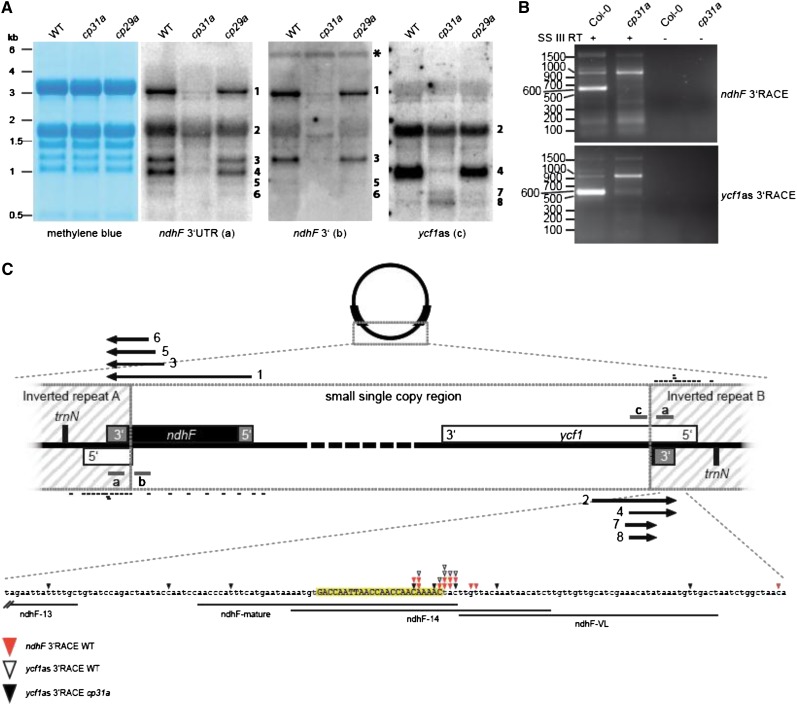
CP31A Stabilizes ndhF and Antisense Transcripts of ycf1 under Normal Growth Conditions. (A) RNA gel blots using strand-specific RNA probes showing that ndhF and ycf1as transcripts are strongly reduced in cp31a mutants. ndhF 3′-UTR probe (a) lies within the IR region and detects ndhF and ycf1as transcripts. ndhF3′ (b) and ycf1as (c) probes are located in the SSC region and selectively detect ndhF and ycf1as transcripts, respectively. Methylene blue staining of membranes is shown as a loading control. A signal corresponding to the tricistronic transcript psaA-psaB-rps14 is marked by an asterisk. WT, the wild type. (B) 3′-RACE detects transcript termini, which are strongly reduced in cp31a mutants. Primers inside the SSC region were used to amplify 3′ ends of ndhF and ycf1as transcripts. The band at 600 bp was gel eluted and cloned. The corresponding 3′ ends are shown in (C). (C) Map of the two borders between the SSC and IR regions. ndhF and ycf1 genes are transcribed from right to left. ndhF and ycf1as transcripts are shown as arrows with numbers corresponding to the bands detected in the RNA gel blots in (A). The probes used in RNA gel blots are shown as gray bars. Positions of the oligonucleotides used to determine the binding sites of CP31A (Figure 6) are marked with black bars. The 3′-ends identified in (B) are shown as color-coded triangles. The 3′-ends from ndhF wild-type RNA are shown with closed red triangles, those for ycf1as wild-type RNA with open triangles. The 3′-ends from ycf1as transcripts obtained from cp31a RNA are shown by closed triangles. A short noncoding RNA found at the position of mature 3′-ends is shown in uppercase letters and highlighted in yellow.
Figure 8.
Figure 8.
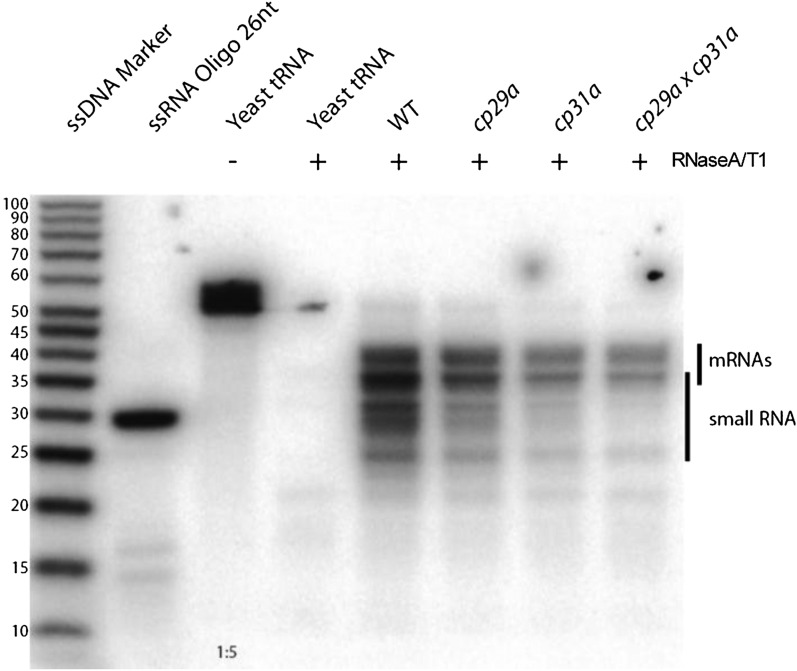
A Small RNA Corresponding to the 3′-End of ndhF Is Strongly Reduced in cp31a Mutants. Mature ndhF and ycf1as transcripts and the small RNA located at the mature 3′-end are detected by an RNase protection assay. A radioactive probe complementary to the small RNA is hybridized to total RNA from the wild type and mutants as indicated. Double-stranded RNA is protected from degradation by single-strand specific RNases A and T1. Protected fragments were separated in a denaturing polyacrylamide gel. In negative control experiments without chloroplast RNA, yeast tRNAs were added to arrive at similar final RNA concentrations. This serves as control for degradation of the probe during the procedure (-RNase) or self-protection of the probe (+RNase). End-labeled RNA oligo and single-strand DNA (ssDNA) ladder are shown as size markers. WT, the wild type.

References

    1. Barkan A. (1993). Nuclear mutants of maize with defects in chloroplast polysome assembly have altered chloroplast RNA metabolism. Plant Cell 5: 389–402 - PMC - PubMed
    1. Barkan A. (2011). Expression of plastid genes: Organelle-specific elaborations on a prokaryotic scaffold. Plant Physiol. 155: 1520–1532 - PMC - PubMed
    1. Beick S., Schmitz-Linneweber C., Williams-Carrier R., Jensen B., Barkan A. (2008). The pentatricopeptide repeat protein PPR5 stabilizes a specific tRNA precursor in maize chloroplasts. Mol. Cell. Biol. 28: 5337–5347 - PMC - PubMed
    1. Cho W.K., Geimer S., Meurer J. (2009). Cluster analysis and comparison of various chloroplast transcriptomes and genes in Arabidopsis thaliana. DNA Res. 16: 31–44 - PMC - PubMed
    1. Churin Y., Hess W.R., Börner T. (1999). Cloning and characterization of three cDNAs encoding chloroplast RNA-binding proteins from barley (Hordeum vulgare L.): Differential regulation of expression by light and plastid development. Curr. Genet. 36: 173–181 - PubMed

Publication types

MeSH terms

Associated data