


Risk factors for hospitalization and medical intensive care unit (MICU) admission among HIV-infected Veterans
- PMID: 23111572
- PMCID: PMC4182723
- DOI: 10.1097/QAI.0b013e318278f3fa
Risk factors for hospitalization and medical intensive care unit (MICU) admission among HIV-infected Veterans
Abstract
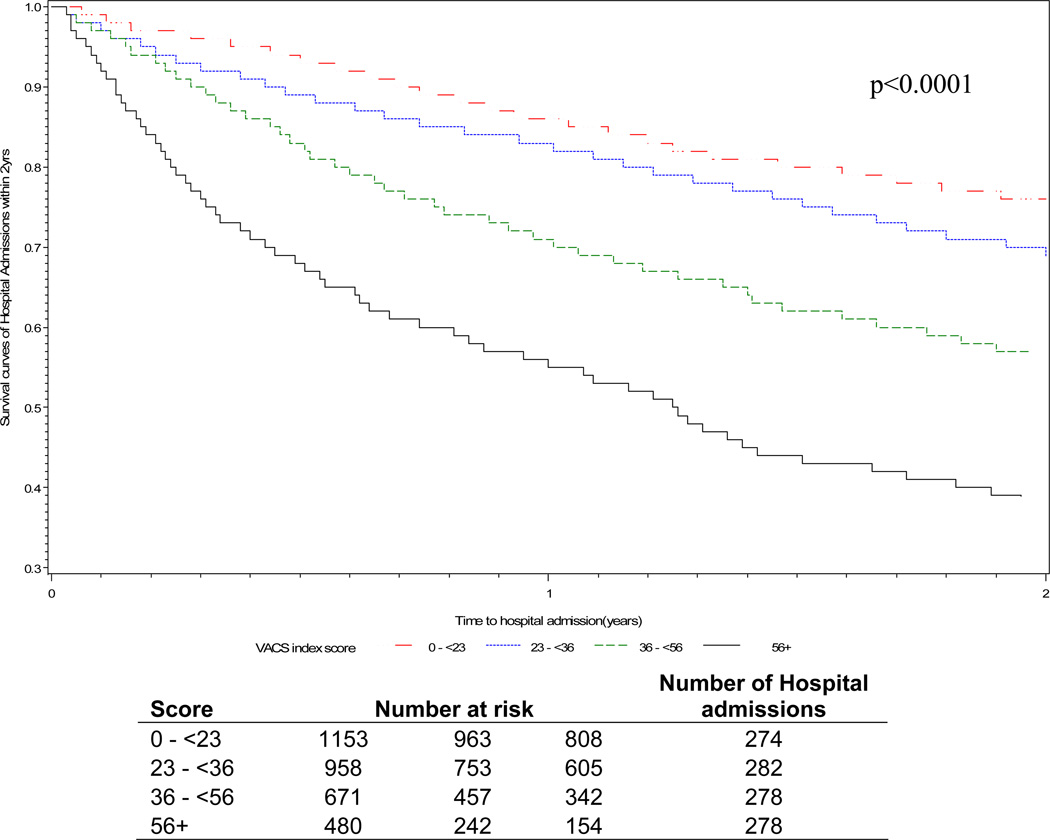
Objective: With improved survival of HIV-infected persons on antiretroviral therapy and growing prevalence of non-AIDS diseases, we asked whether the VACS Index, a composite measure of HIV-associated and general organ dysfunction predictive of all-cause mortality, predicts hospitalization and medical intensive care unit (MICU) admission. We also asked whether AIDS and non-AIDS conditions increased risk after accounting for VACS Index score.
Methods: We analyzed data from the Veterans Aging Cohort Study (VACS), a prospective study of HIV-infected Veterans receiving care between 2002 and 2008. Data were obtained from the electronic medical record, VA administrative databases, and patient questionnaires and were used to identify comorbidities and calculate baseline VACS Index scores. The primary outcome was first hospitalization within 2 years of VACS enrollment. We used multivariable Cox regression to determine risk factors associated with hospitalization and logistic regression to determine risk factors for MICU admission, given hospitalization.
Results: Of 3410 patients, 1141 were hospitalized within 2 years; 203 (17.8%)/1141 patients included an MICU admission. Median VACS Index scores were 25 (no hospitalization), 34 (hospitalization only), and 51 (MICU). In adjusted analyses, a 5-point increment in VACS Index score was associated with 10% higher risk of hospitalization and MICU admission. In addition to VACS Index score, Hispanic ethnicity, current smoking, hazardous alcohol use, chronic obstructive pulmonary disease, hypertension, diabetes, and prior AIDS-defining event predicted hospitalization. Among those hospitalized, VACS Index score, cardiac disease, and prior cancer predicted MICU admission.
Conclusions: The VACS Index predicted hospitalization and MICU admission as did current smoking, hazardous alcohol use, and AIDS and certain non-AIDS diagnoses.
Figures
References
-
- Chatila W, Kreimer DT, Criner GJ. Quality of life in survivors of prolonged mechanical ventilatory support. Crit Care Med. 2001;29:737–742. - PubMed
-
- Goldstein RL, Campion EW, Thibault GE, Mulley AG, Skinner E. Functional outcomes following medical intensive care. Crit Care Med. 1986;14:783–788. - PubMed
-
- Konopad E, Noseworthy TW, Johnston R, Shustack A, Grace M. Quality of life measures before and one year after admission to an intensive care unit. Crit Care Med. 1995;23:1653–1659. - PubMed
-
- Rimachi R, Vincent JL, Brimioulle S. Survival and quality of life after prolonged intensive care unit stay. Anaesth Intensive Care. 2007;35:62–67. - PubMed
-
- Wu AW, Damiano AM, Lynn J, et al. Predicting future functional status for seriously ill hospitalized adults. The SUPPORT prognostic model. Ann Intern Med. 1995;122:342–350. - PubMed
Publication types
MeSH terms
Grants and funding
LinkOut - more resources
Full Text Sources
Other Literature Sources
Medical
