


Mutual information rate and bounds for it
- PMID: 23112809
- PMCID: PMC3480398
- DOI: 10.1371/journal.pone.0046745
Mutual information rate and bounds for it
Abstract
The amount of information exchanged per unit of time between two nodes in a dynamical network or between two data sets is a powerful concept for analysing complex systems. This quantity, known as the mutual information rate (MIR), is calculated from the mutual information, which is rigorously defined only for random systems. Moreover, the definition of mutual information is based on probabilities of significant events. This work offers a simple alternative way to calculate the MIR in dynamical (deterministic) networks or between two time series (not fully deterministic), and to calculate its upper and lower bounds without having to calculate probabilities, but rather in terms of well known and well defined quantities in dynamical systems. As possible applications of our bounds, we study the relationship between synchronisation and the exchange of information in a system of two coupled maps and in experimental networks of coupled oscillators.
Conflict of interest statement
Figures
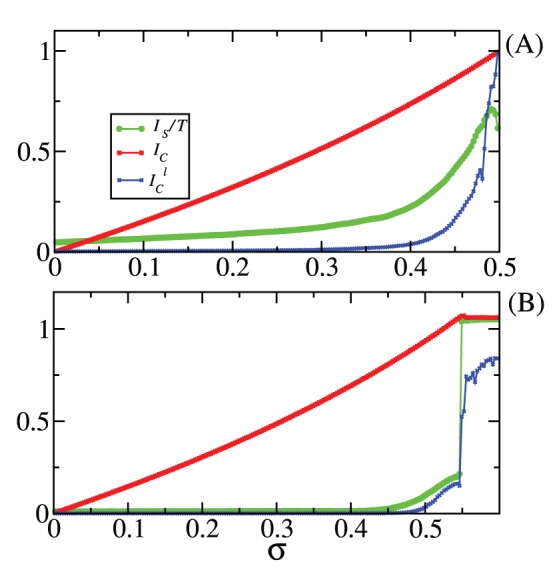
 and in (B)
  . The units of
  ,
,  , and
, and  are [bits/iteration].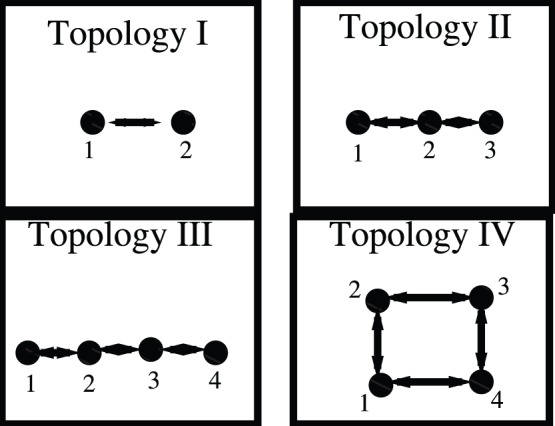
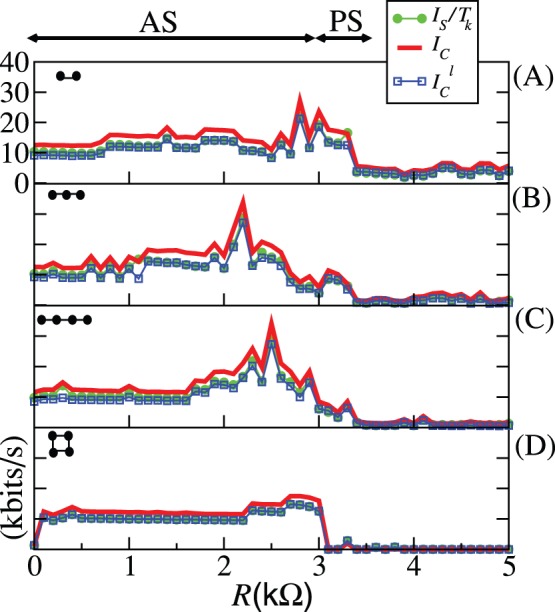
 as (green online) filled circles,
  as the (red online) thick line, and
  as the (blue online) squares, for a varying coupling resistance
  . The unit of these quantities shown in these figures is (kbits/s). (A) Topology I, (B) Topology II, (C) Topology III, and (D) Topology IV. In all figures,
  increases smoothly from 1.25 to 1.95 as
  varies from 0.1k
 to 5k
to 5k . The line on the top of the figure represents the interval of resistance values responsible to induce almost synchronisation (AS) and phase synchronisation (PS).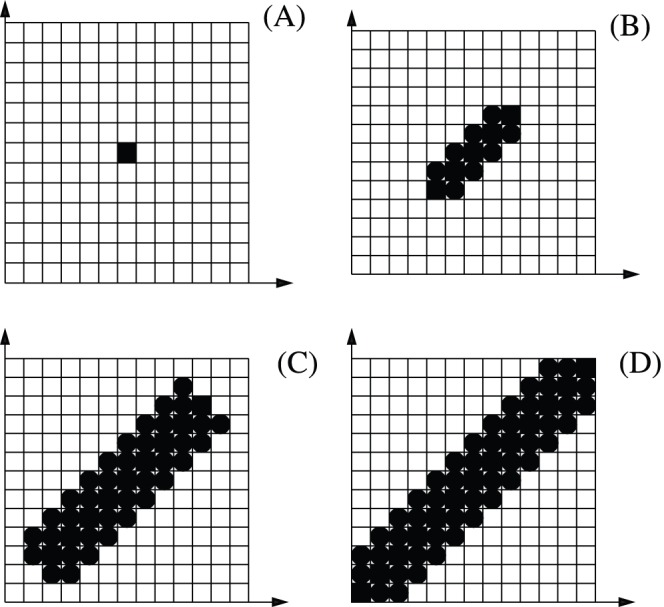
 the points do not spread any longer (D).
References
-
- Shannon CE (1948) A Mathematical Theory of Communication. Bell System Technical Journal 27: 379–423.
-
- Strong SP, Koberle R, de Ruyter van Steveninck RR, Bialek W (1998) Entropy and Information in Neural Spike Trains. Phys. Rev. Lett. 80: 197–200.
-
- Sporns O, Chialvo DR, Kaiser M, Hilgetag CC (2004) Organization, development and function of complex brain networks. Trends in Cognitive Sciences. 8: 418–425. - PubMed
-
- Palus M, Komárek V, Procházka T, Hrncir Z, Sterbova K (2001) Synchronization and information ow in EEGs of epileptic patients. IEEE Engineering in Medicice and Biology Sep/Oct: 65–71. - PubMed
-
- Donges JF, Zou Y, Marwan N, Kurths J (2009) Complex networks in climate dynamics. Eur. Phys. J. 174: 157–179.
Publication types
MeSH terms
LinkOut - more resources
Full Text Sources
Research Materials
