


The apolipoprotein E (APOE) gene appears functionally monomorphic in chimpanzees (Pan troglodytes)
- PMID: 23112842
- PMCID: PMC3480407
- DOI: 10.1371/journal.pone.0047760
The apolipoprotein E (APOE) gene appears functionally monomorphic in chimpanzees (Pan troglodytes)
Abstract
Background: The human apolipoprotein E (APOE) gene is polymorphic, with three primary alleles (E2, E3, E4) that differ at two key non-synonymous sites. These alleles are functionally different in how they bind to lipoproteins, and this genetic variation is associated with phenotypic variation for several medical traits, including cholesterol levels, cardiovascular health, Alzheimer's disease risk, and longevity. The relative frequencies of these alleles vary across human populations, and the evolution and maintenance of this diversity is much debated. Previous studies comparing human and chimpanzee APOE sequences found that the chimpanzee sequence is most similar to the human E4 allele, although the resulting chimpanzee protein might function like the protein coded for by the human E3 allele. However, these studies have used sequence data from a single chimpanzee and do not consider whether chimpanzees, like humans, show intra-specific and subspecific variation at this locus.
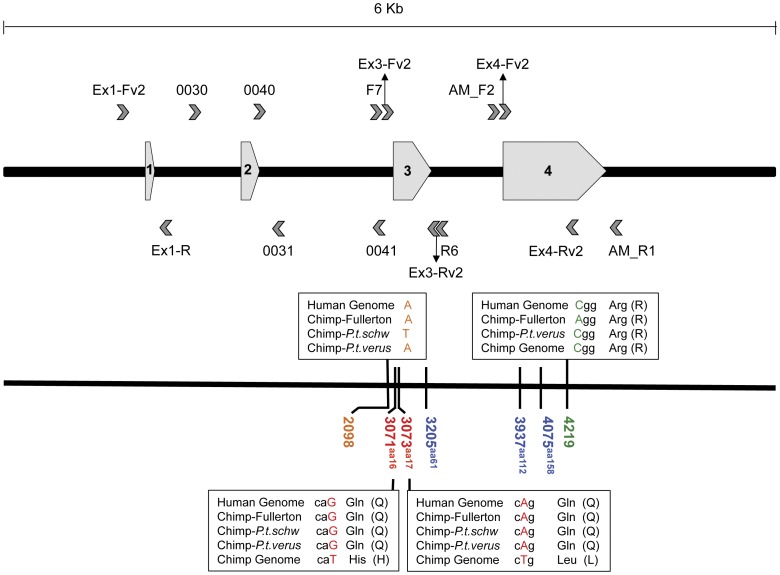
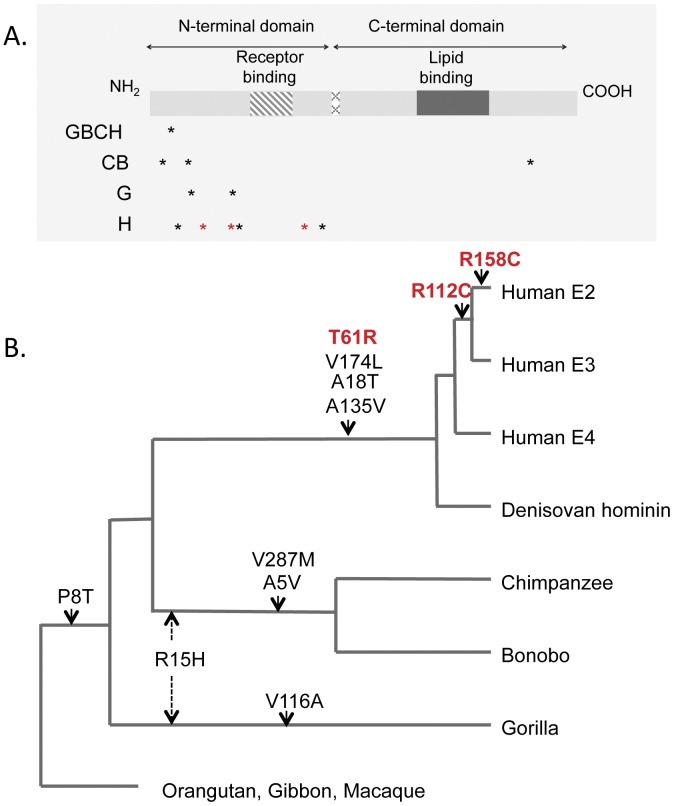
Methodology and principal findings: To examine potential intraspecific variation, we sequenced the APOE gene of 32 chimpanzees. This sample included 20 captive individuals representing the western subspecies (P. troglodytes verus) and 12 wild individuals representing the eastern subspecies (P. t. schweinfurthii). Variation in our resulting sequences was limited to one non-coding, intronic SNP, which showed fixed differences between the two subspecies. We also compared APOE sequences for all available ape genera and fossil hominins. The bonobo APOE protein is identical to that of the chimpanzee, and the Denisovan APOE exhibits all four human-specific, non-synonymous changes and appears functionally similar to the human E4 allele.
Conclusions: We found no coding variation within and between chimpanzee populations, suggesting that the maintenance of functionally diverse APOE polymorphisms is a unique feature of human evolution.
Conflict of interest statement
Figures
References
-
- Mahley RW, Rall SC (2000) Apolipoprotein E: Far more than a lipid transport protein. Annual Review of Genomics and Human Genetics 1: 507–537. - PubMed
-
- Mahley RW (1988) Apolipoprotein-E - Cholesterol transport protein with expanding role in cell biology. Science 240: 622–630. - PubMed
-
- Enard W (2012) Functional primate genomics-leveraging the medical potential. J Mol Med 90: 471–480. - PubMed
-
- Finch CE, Stanford CB (2004) Meat-adaptive genes and the evolution of slower aging in humans. Quarterly Review of Biology 79: 3–50. - PubMed
Publication types
MeSH terms
Substances
Grants and funding
LinkOut - more resources
Full Text Sources
Research Materials
Miscellaneous
