


Epistasis analysis for estrogen metabolic and signaling pathway genes on young ischemic stroke patients
- PMID: 23112845
- PMCID: PMC3480403
- DOI: 10.1371/journal.pone.0047773
Epistasis analysis for estrogen metabolic and signaling pathway genes on young ischemic stroke patients
Abstract
Background: Endogenous estrogens play an important role in the overall cardiocirculatory system. However, there are no studies exploring the hormone metabolism and signaling pathway genes together on ischemic stroke, including sulfotransferase family 1E (SULT1E1), catechol-O-methyl-transferase (COMT), and estrogen receptor α (ESR1).
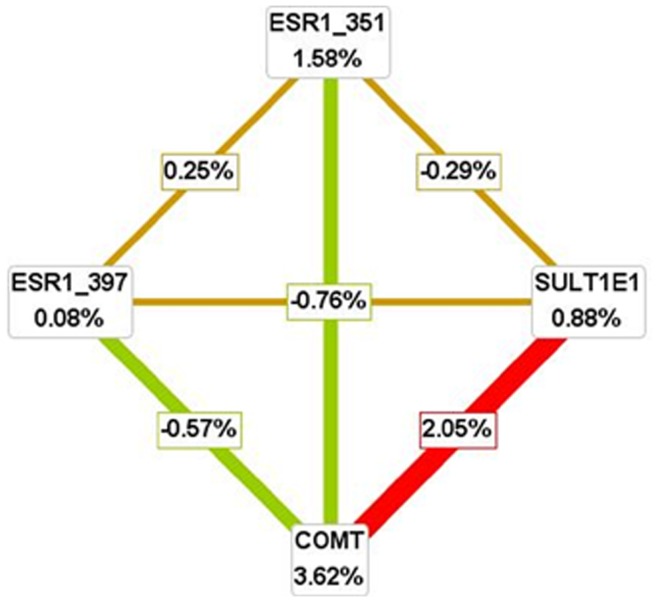
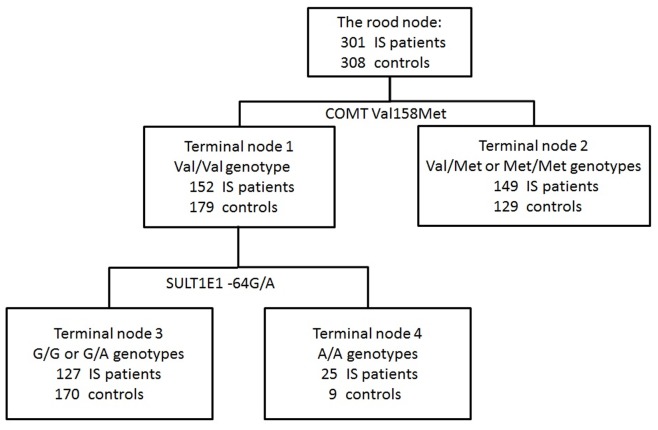
Methods: A case-control study was conducted on 305 young ischemic stroke subjects aged </= 50 years and 309 age-matched healthy controls. SULT1E1 -64G/A, COMT Val158Met, ESR1 c.454-397 T/C and c.454-351 A/G genes were genotyped and compared between cases and controls to identify single nucleotide polymorphisms associated with ischemic stroke susceptibility. Gene-gene interaction effects were analyzed using entropy-based multifactor dimensionality reduction (MDR), classification and regression tree (CART), and traditional multiple regression models.
Results: COMT Val158Met polymorphism showed a significant association with susceptibility of young ischemic stroke among females. There was a two-way interaction between SULT1E1 -64G/A and COMT Val158Met in both MDR and CART analysis. The logistic regression model also showed there was a significant interaction effect between SULT1E1 -64G/A and COMT Val158Met on ischemic stroke of the young (P for interaction = 0.0171). We further found that lower estradiol level could increase the risk of young ischemic stroke for those who carry either SULT1E1 or COMT risk genotypes, showing a significant interaction effect (P for interaction = 0.0174).
Conclusions: Our findings support that a significant epistasis effect exists among estrogen metabolic and signaling pathway genes and gene-environment interactions on young ischemic stroke subjects.
Conflict of interest statement
Figures
References
-
- Rossouw JE (2002) Hormones, genetic factors, and gender differences in cardiovascular disease. Cardiovasc Res 53: 550–557. - PubMed
-
- Spyridopoulos I, Sullivan AB, Kearney M, Isner JM, Losordo DW (1997) Estrogen-receptor-mediated inhibition of human endothelial cell apoptosis. Estradiol as a survival factor. Circulation 95: 1505–1514. - PubMed
-
- Krasinski K, Spyridopoulos I, Asahara T, van der Zee R, Isner JM, et al. (1997) Estradiol accelerates functional endothelial recovery after arterial injury. Circulation 95: 1768–1772. - PubMed
-
- Iafrati MD, Karas RH, Aronovitz M, Kim S, Sullivan TR Jr, et al. (1997) Estrogen inhibits the vascular injury response in estrogen receptor alpha-deficient mice. Nat Med 3: 545–548. - PubMed
Publication types
MeSH terms
Substances
LinkOut - more resources
Full Text Sources
Medical
Research Materials
Miscellaneous
