


Retrospective epidemiological study for the characterization of community- acquired pneumonia and pneumococcal pneumonia in adults in a well-defined area of Badalona (Barcelona, Spain)
- PMID: 23114195
- PMCID: PMC3532136
- DOI: 10.1186/1471-2334-12-283
Retrospective epidemiological study for the characterization of community- acquired pneumonia and pneumococcal pneumonia in adults in a well-defined area of Badalona (Barcelona, Spain)
Abstract
Background: Community-acquired pneumonia (CAP) has large impact on direct healthcare costs, especially those derived from hospitalization. This study determines impact, clinical characteristics, outcome and economic consequences of CAP in the adult (≥18 years) population attended in 6 primary-care centers and 2 hospitals in Badalona (Spain) over a two-year period.
Methods: Medical records were identified by codes from the International Classification of Diseases in databases (January 1st 2008-December 31st 2009).
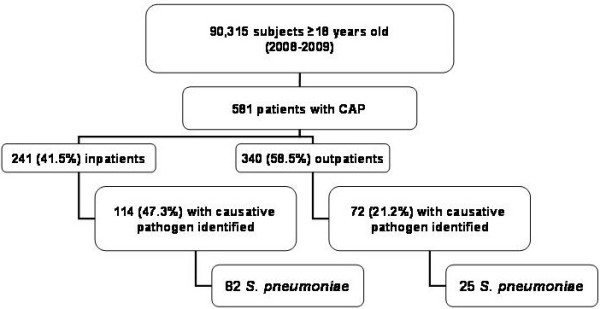
Results: A total of 581 patients with CAP (55.6% males, mean age 57.5 years) were identified. Prevalence: 0.64% (95% CI: 0.5%-0.7%); annual incidence: 3.0 cases/1,000 inhabitants (95% CI: 0.2-0.5). Up to 241 (41.5%) required hospitalization. Hospital admission was associated (p<0.002) with liver disease (OR=5.9), stroke (OR=3.6), dementia (OR=3.5), COPD (OR=2.9), diabetes mellitus (OR=1.9) and age (OR=1.1 per year). Length of stay (4.4±0.3 days) was associated with PSI score (β=0.195), in turn associated with age (r=0.827) and Charlson index (r=0.497). Microbiological tests were performed in all inpatients but only in 35% outpatients. Among patients with microbiological tests, results were positive in 51.7%, and among them, S pneumoniae was identified in 57.5% cases. Time to recovery was 29.9±17.2 days. Up to 7.5% inpatients presented complications, 0.8% required ICU admission and 19.1% readmission. Inhospital mortality rate was 2.5%. Adjusted mean total cost was €2,332.4/inpatient and €698.6/outpatient (p<0.001). Patients with pneumococcal CAP (n=107) showed higher comorbidity and hospitalization (76.6%), higher PSI score, larger time to recovery and higher overall costs among inpatients.
Conclusions: Strategies preventing CAP, thus reducing hospital admissions could likely produce substantial costs savings in addition to the reduction of CAP burden.
References
-
- British Thoracic Society. Guidelines for the management of community acquired pneumonia in adults: update 2009. Thorax. 2009;64(Suppl. III):iii1–iii55. - PubMed
-
- de Miguel DJ, Alvarez-Sala JL. Prognostic factors in community-acquired pneumonia [Article in Spanish] An Med Interna. 2007;24:465–466. - PubMed
-
- Gutiérrez F, Masiá M, Rodríguez JC, Mirete C, Soldán B, Padilla S, Hernández I, De Ory F, Royo G, Hidalgo AM. Epidemiology of community-acquired pneumonia in adult patients at the dawn of the 21st century: a prospective study on the Mediterranean coast of Spain. Clin Microbiol Infect. 2005;11:788–800. doi: 10.1111/j.1469-0691.2005.01226.x. - DOI - PMC - PubMed
Publication types
MeSH terms
LinkOut - more resources
Full Text Sources
Miscellaneous
