. 2012 Oct;24(10):4281-93.
doi: 10.1105/tpc.112.101253. Epub 2012 Oct 31.

Constitutively active mitogen-activated protein kinase versions reveal functions of Arabidopsis MPK4 in pathogen defense signaling

Affiliations

Constitutively active mitogen-activated protein kinase versions reveal functions of Arabidopsis MPK4 in pathogen defense signaling

Souha Berriri et al. Plant Cell. 2012 Oct.

Abstract

Plant mitogen-activated protein kinases (MAPKs) are involved in important processes, including stress signaling and development. In a functional yeast screen, we identified mutations that render Arabidopsis thaliana MAPKs constitutively active (CA). Importantly, CA-MAPKs maintain their specificity toward known activators and substrates. As a proof-of-concept, Arabidopsis MAPK4 (MPK4) function in plant immunity was investigated. In agreement with the phenotype of mpk4 mutants, CA-MPK4 plants were compromised in pathogen-induced salicylic acid accumulation and disease resistance. MPK4 activity was found to negatively regulate pathogen-associated molecular pattern-induced reactive oxygen species production but had no impact on callose deposition, indicating that CA-MPK4 allows discriminating between processes regulated by MPK4 activity from processes indirectly affected by mpk4 mutation. Finally, MPK4 activity was also found to compromise effector-triggered immunity conditioned by the Toll Interleukin-1 Receptor-nucleotide binding (NB)-Leu-rich repeat (LRR) receptors RPS4 and RPP4 but not by the coiled coil-NB-LRR receptors RPM1 and RPS2. Overall, these data reveal important insights on how MPK4 regulates plant defenses and establishes that CA-MAPKs offer a powerful tool to analyze the function of plant MAPK pathways.


Figures
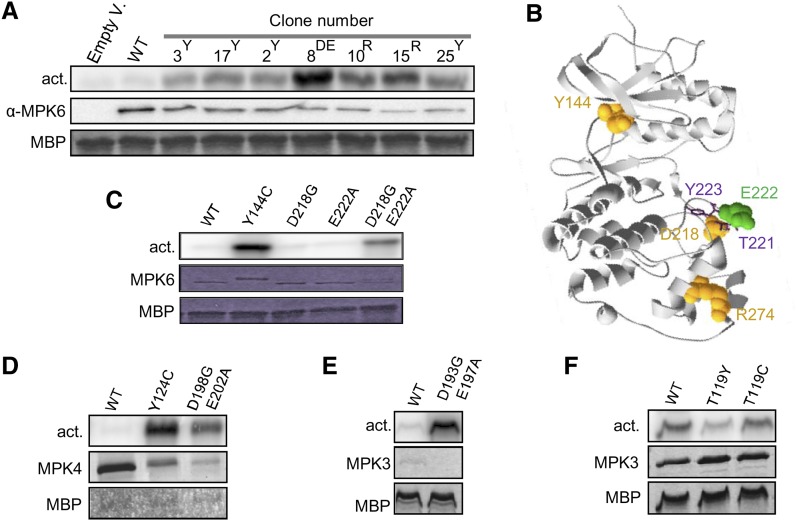
Figure 1.
Figure 1.
Characterization of CA-MAPK Activity. (A) Kinase activity toward MBP of wild-type (WT) MPK6 and candidate mutants (containing Tyr-144 [Y], Arg-274 [R], or Asp-218 Glu-222 [DE] mutations) after MPK6 immunoprecipitation from pbs2Δhog1Δ yeast cells. Clone numbers refer to Supplemental Table 1 online. (B) Ribbon diagram of ERK2-based MPK6 structure with space field residues identified as CA mutations in the yeast screen. Sticks represent Thr-221 and Tyr-223 of the TEY motif. (C) Kinase activity toward MBP of recombinant wild-type MPK6 and CA mutants. (D) to (F) Kinase activity toward MBP of recombinant MPK4 (D) and MPK3 ([E] and [F]) with CA mutations produced as His-tagged ([C], [D], and [F]) or periHisMBP–tagged (E) proteins.
Figure 2.
Figure 2.
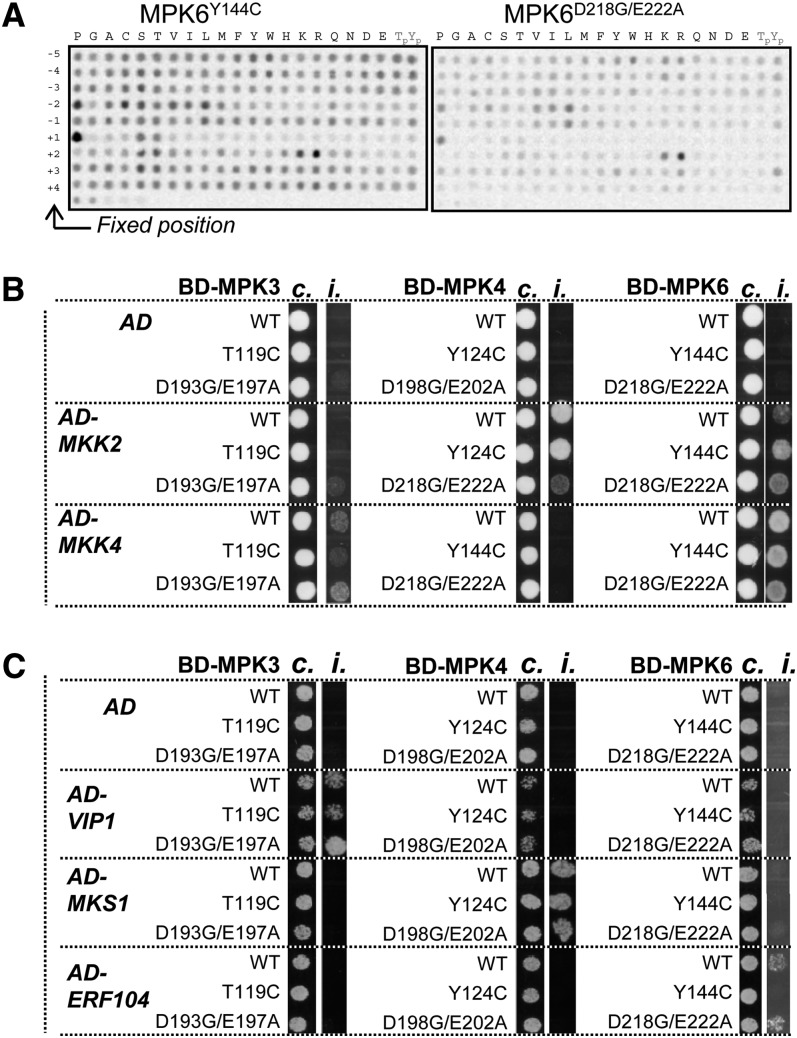
Substrate Preferences and Interaction Specificities of the Wild Type and CA-MAPKs. (A) Phosphorylation of the semidegenerate peptide array by MPK6Y144C and MPK6D218G/E222A. (B) and (C) Combinatory interaction in yeast two-hybrid assays of wild-type (WT) and CA forms of MPK3, 4, and 6 with MKK2 and MKK4 (B) and with VIP1, MKS1, and ERF104 (C). Cotransformed single yeast colonies were spotted on control medium (c.) and selective medium (i.) supplemented with 65 mM (B) or 100 mM 3-amino-1,2,4-triazole (C).
Figure 3.
Figure 3.
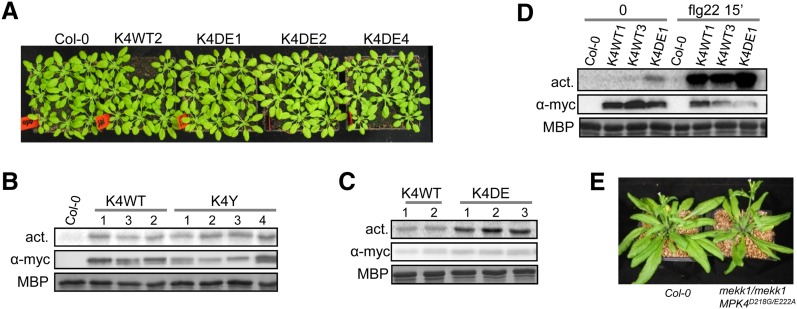
Characterization of Arabidopsis mpk4-2 Mutants Complemented with CA-MPK4 Loci. (A) Morphological aspect of mpk4-2/mpk4-2 lines complemented with MPK4WT and MPK4D198G/E202A. Plants were grown in short days for 5 weeks. K4WT and K4DE are abbreviations for mpk4 lines complemented with pGREEN0229-MPK4L-PC2 and pGREEN0229-MPK4LD198G/E202A-PC2, respectively. Numbers 1 to 4 refer to line numbers. (B) and (C) Kinase activity toward MBP of MPK4-myc immunoprecipitated from mpk4-2/mpk4-2 lines complemented with MPK4WT ([B] and [C]), MPK4Y124C (B), and MPK4D198G/E202A (C). K4Y (B) is an abbreviation for mpk4 lines complemented with pGREEN0229-MPK4LY124C-PC2. (D) Kinase activity of K4WT and K4DE lines upon 15 min flg22 (1 µM) treatment. (E) Morphological phenotype of 5-week-old mekk1-1/mekk1-1 MPK4D198G/E202A plants grown in long days. mekk1-1/mekk1-1 plants barely survive 2 weeks in pots. [See online article for color version of this figure.]
Figure 4.
Figure 4.
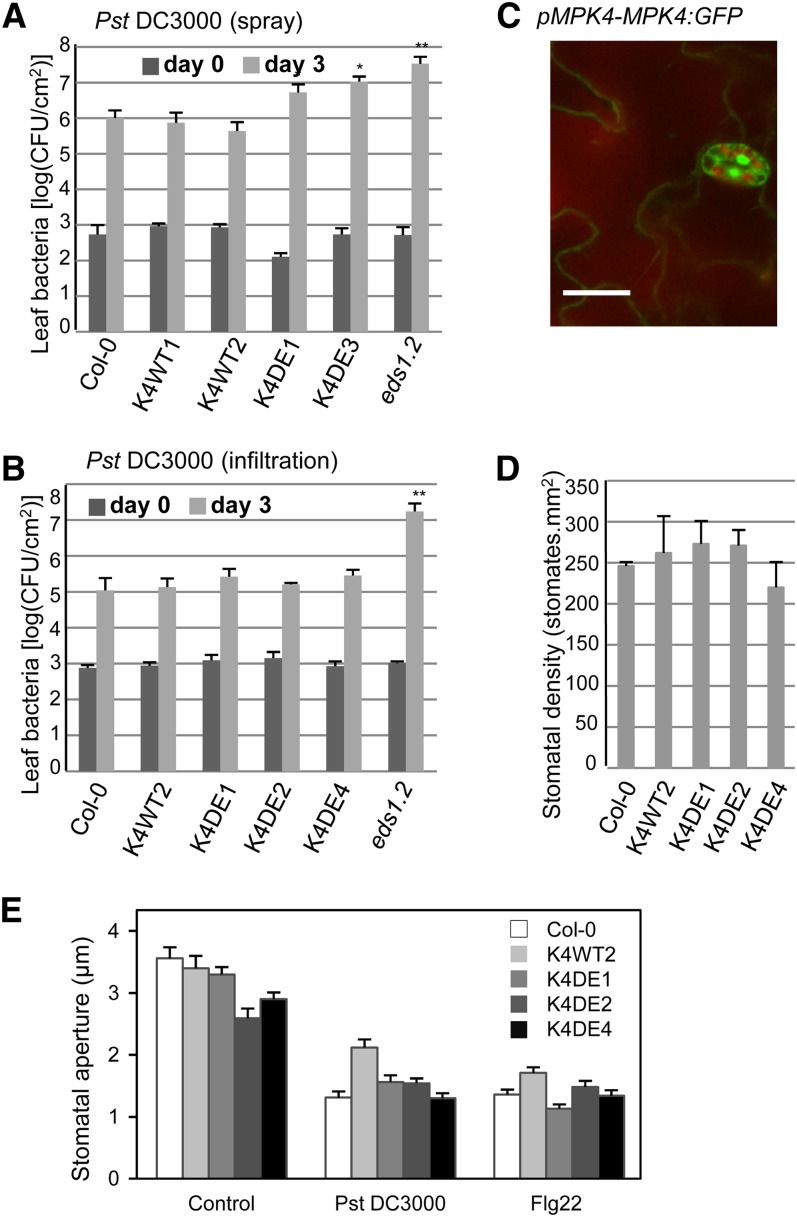
Defense Responses of Arabidopsis mpk4-2 Mutants Complemented with CA-MPK4 Loci to Pst DC3000. (A) and (B) Growth of Pst DC3000 after spray inoculation (A) or leaf infiltration (B) in the indicated genotypes. Bacterial titers were determined 2 h (day 0, dark-gray bars) and 3 d (light-gray bars) after inoculation. Bars are average of four replicates, and error bars show sd. Results are representative of three independent experiments. *P < 0.05 and **P < 0.01. (C) Microscopy localization of a GFP-tagged MPK4 expressed from its own locus. Bar = 20 µm. (D) Stomatal densities assessed in wild-type and three K4DE lines. Data are mean ± se (n = 6). (E) Pst DC3000–induced (108 cfu/mL) and flg22-induced (5 µM) stomatal closure in wild-type and three K4DE lines. Data are mean ± se (n > 60).
Figure 5.
Figure 5.
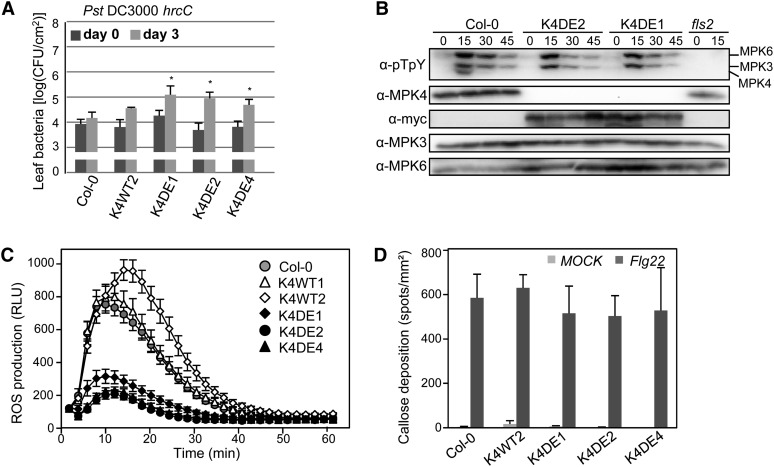
Characterization of PTI Responses in CA-MPK4 Lines. (A) Growth of Pst DC3000 hrcC on the indicated genotypes. Bacterial titers were determined 2 h (day 0, dark-gray bars) and 3 d (light-gray bars) after spray inoculation. Bars are average of four replicates, and error bars show sd. Results are representative of three independent experiments. *P < 0.05 (B) Flg22-induced activation of MAPKs in Col-0 and two CA-MPK4 lines at the indicated time points, using anti-pTEpY immunoblot. (C) Oxidative burst response in wild-type and CA lines in response to 0.5 µM flg22. Results are means ± se (n > 20) of a representative experiment among four. P value < 10−7 at 11 min for all K4DE lines. RLU, relative light units. (D) Callose production in 4- to 5-week-old plants of the indicated genotypes infiltrated with half-strength MS or half-strength MS supplemented with 300 nM flg22. Data are means ± se of four independent experiments except for K4DE4 line with two experiments (n > 10 leaves).
Figure 6.
Figure 6.
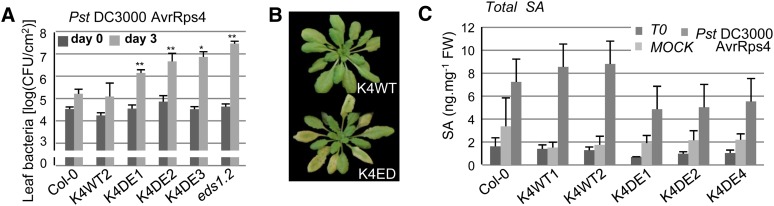
Characterization of RPS4-Mediated ETI in CA-MPK4 Lines. (A) Growth of Pst DC3000 AvrRps4 in the indicated genotypes. Bacterial titers were determined 2 h (day 0, dark-gray bars) and 3 d (light-gray bars) after spray inoculation. Bars are average of at least four replicates, and error bars show sd. *P value < 0.05 and **P value < 0.01. Similar results were obtained in at least three independent experiments. (B) Disease symptoms observed on K4WT and K4DE lines 3 d after inoculation with Pst DC3000 AvrRps4. (C) SA content before (T0) and 24 h after spray inoculation with Pst DC3000 AvrRps4 or after mock treatment with 10 mM MgCl2. Bars represent the average of three independent biological replicates. After Pst DC3000 AvrRps4 treatment, the SA content of Col-0 and wild-type lines taken together was 8.2 ± 1.0 ng⋅mg−1 fresh weight (FW) (n = 9) and of K4DE lines was 5.1 ± 1.0 ng⋅mg−1 fresh weight (n = 9) (the difference is statistically significant; P value < 0.05).
Figure 7.
Figure 7.
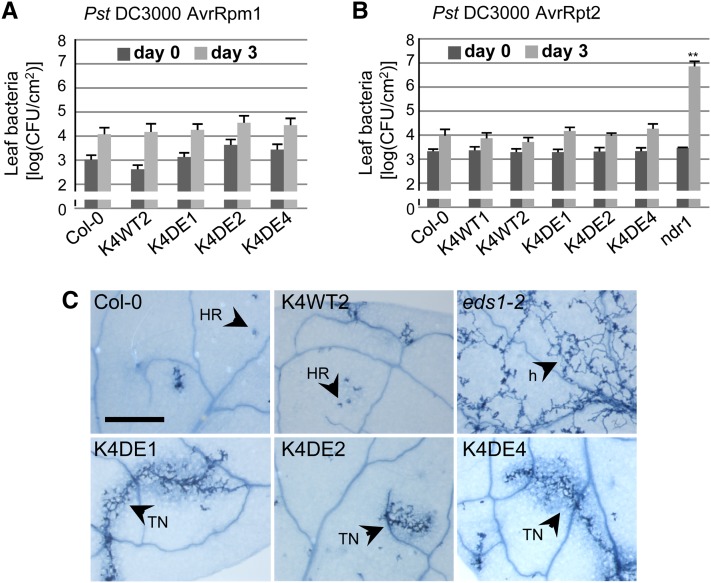
ETI Responses in CA-MPK4 Lines. (A) and (B) Growth of Pst DC3000 AvrRpm1 (A) and Pst DC3000 AvrRpt2 (B) in the indicated genotypes. Bacterial titers were determined 2 h (day 0, dark-gray bars) and 3 d (light-gray bars) post spray inoculation. Bars are average of at least four replicates, and error bars show sd. **P value < 0.01. Similar results were obtained in at least three independent experiments. (C) Growth of H. arabidopsidis Emwa1 and cell death structures in leaves of the indicated genotypes. Leaves were stained with lactophenol trypan blue 6 d after inoculation. h, hyphae; HR, hypersensitive response; TN, trailing necrosis. Bar = 500 nm. [See online article for color version of this figure.]

References

    1. Aarts N., Metz M., Holub E., Staskawicz B.J., Daniels M.J., Parker J.E. (1998). Different requirements for EDS1 and NDR1 by disease resistance genes define at least two R gene-mediated signaling pathways in Arabidopsis. Proc. Natl. Acad. Sci. USA 95: 10306–10311 - PMC - PubMed
    1. Andreasson E., Ellis B. (2010). Convergence and specificity in the Arabidopsis MAPK nexus. Trends Plant Sci. 15: 106–113 - PubMed
    1. Andreasson E., et al. (2005). The MAP kinase substrate MKS1 is a regulator of plant defense responses. EMBO J. 24: 2579–2589 - PMC - PubMed
    1. Arabidopsis Genome Initiative (2000). Analysis of the genome sequence of the flowering plant Arabidopsis thaliana Nature 408: 796–815. - PubMed
    1. Asai T., Tena G., Plotnikova J., Willmann M.R., Chiu W.L., Gomez-Gomez L., Boller T., Ausubel F.M., Sheen J. (2002). MAP kinase signalling cascade in Arabidopsis innate immunity. Nature 415: 977–983 - PubMed

Publication types

MeSH terms

Associated data