


Using major outer membrane protein typing as an epidemiological tool to investigate outbreaks caused by milk-borne Campylobacter jejuni isolates in California
- PMID: 23115263
- PMCID: PMC3536209
- DOI: 10.1128/JCM.01845-12
Using major outer membrane protein typing as an epidemiological tool to investigate outbreaks caused by milk-borne Campylobacter jejuni isolates in California
Abstract
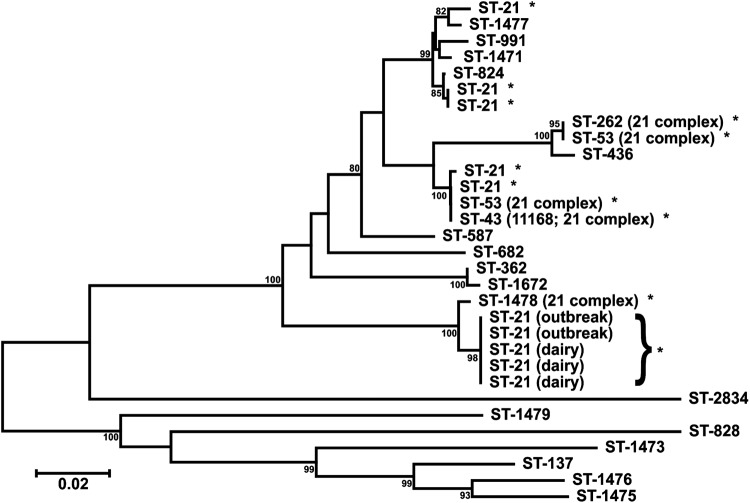
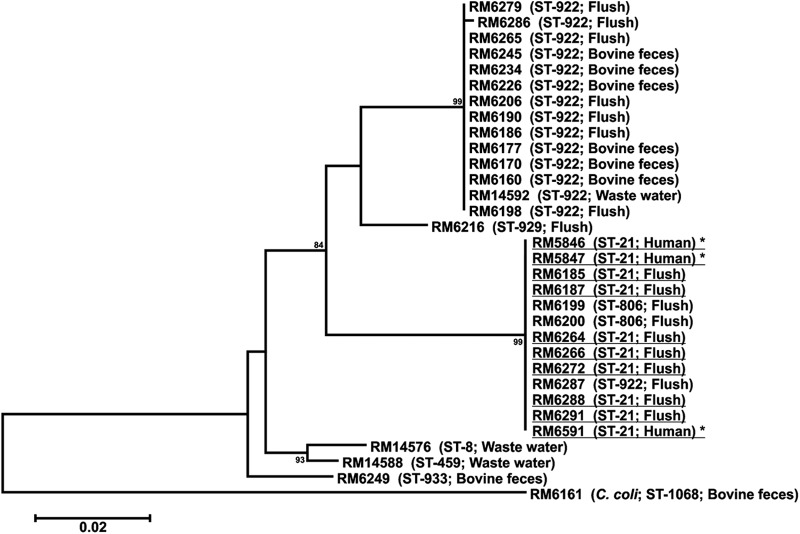
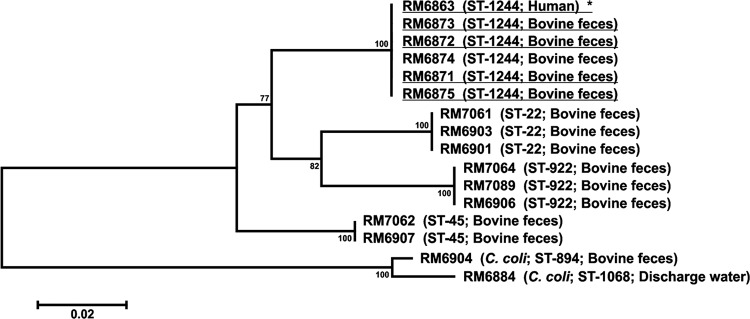
We describe using major outer membrane protein (MOMP) typing as a screen to compare the Campylobacter jejuni porA gene sequences of clinical outbreak strains from human stool with the porA sequences of dairy farm strains isolated during two milk-borne campylobacteriosis outbreak investigations in California. The genetic relatedness of clinical and environmental strains with identical or closely related porA sequences was confirmed by multilocus sequence typing and pulsed-field gel electrophoresis analysis. The first outbreak involved 1,644 C. jejuni infections at 11 state correctional facilities and was associated with consumption of pasteurized milk supplied by an on-site dairy (dairy A) at a prison in the central valley. The second outbreak involved eight confirmed and three suspect C. jejuni cases linked to consumption of commercial raw milk and raw chocolate colostrum at another central valley dairy (dairy B). Both dairies bottled fluid milk on the farm and distributed the finished product to off-site locations. Altogether, C. jejuni was isolated from 7 of 15 (46.7%) bovine fecal, 12 of 20 (60%) flush alley water, and 1 of 20 (5%) lagoon samples collected on dairy A. At dairy B, C. jejuni was cultured from 9 of 26 (34.6%) bovine fecal samples. Environmental strains indistinguishable from the clinical outbreak strains were found in five flush alley water samples (dairy A) and four bovine fecal samples (dairy B). The findings demonstrate that MOMP typing is a useful tool to triage environmental isolates prior to conducting more labor-intensive molecular typing methods.
Figures
References
-
- Centers for Disease Control and Prevention 2010. Preliminary FoodNet data on the incidence of infection with pathogens transmitted commonly through food—10 states, 2009. MMWR Morb. Mortal. Wkly. Rep. 59:418–422 - PubMed
-
- Miller WG, Mandrell RE. 2005. Prevalence of Campylobacter in the food and water supply: incidence, outbreaks, isolation and detection, p 101–163. In Ketley JM, Konkel ME. (ed), Campylobacter. Molecular and cellular biology. Horizon Bioscience, Norfolk, United Kingdom
-
- Yan SS, Pendrak ML, Foley SL, Powers JH. 2005. Campylobacter infection and Guillain-Barré syndrome: public health concerns from a microbial food safety perspective. Clin. Appl. Immunol. Rev. 5:285–305
Publication types
MeSH terms
Substances
Associated data
- Actions
- Actions
- Actions
- Actions
- Actions
- Actions
- Actions
- Actions
- Actions
- Actions
- Actions
- Actions
LinkOut - more resources
Full Text Sources
Medical
Molecular Biology Databases
