


How specific are emotional deficits? A comparison of empathic abilities in schizophrenia, bipolar and depressed patients
- PMID: 23116884
- PMCID: PMC3514634
- DOI: 10.1016/j.schres.2012.09.020
How specific are emotional deficits? A comparison of empathic abilities in schizophrenia, bipolar and depressed patients
Abstract
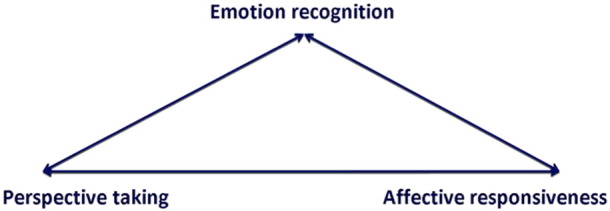
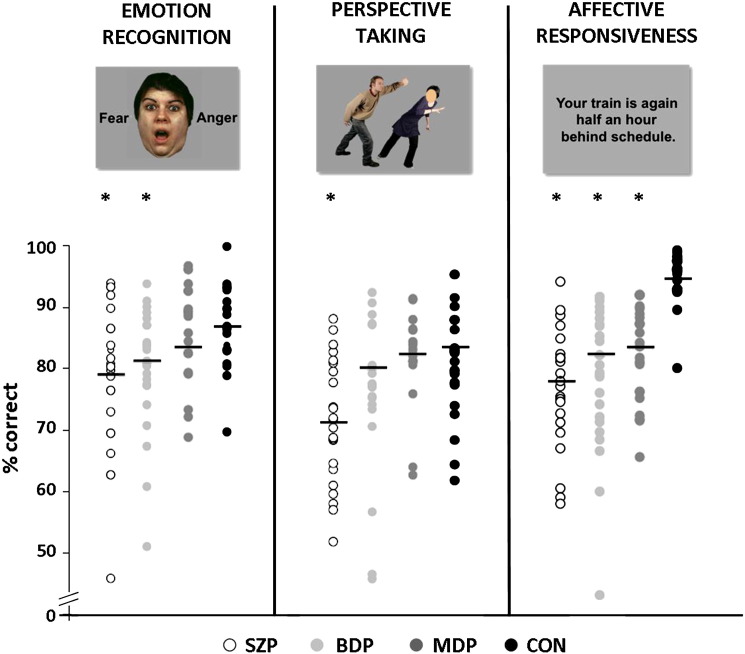
Empathy is a rather elaborated human ability and several recent studies highlight significant impairments in patients suffering from psychiatric disorders, such as schizophrenia, bipolar disorder or major depression. Therefore, the present study aimed at comparing behavioral empathy performance in schizophrenia, bipolar and depressed patients with healthy controls. All subjects performed three tasks tapping the core components of empathy: emotion recognition, emotional perspective taking and affective responsiveness. Groups were matched for age, gender, and verbal intelligence. Data analysis revealed three main findings: First, schizophrenia patients showed the strongest impairment in empathic performance followed by bipolar patients while depressed patients performed similar to controls in most tasks, except for affective responsiveness. Second, a significant association between clinical characteristics and empathy performance was only apparent in depression, indicating worse affective responsiveness with stronger symptom severity and longer duration of illness. Third, self-report data indicate that particularly bipolar patients describe themselves as less empathic, reporting less empathic concern and less perspective taking. Taken together, this study constitutes the first approach to directly compare specificity of empathic deficits in severe psychiatric disorders. Our results suggest disorder-specific impairments in emotional competencies that enable better characterization of the patient groups investigated and indicate different psychotherapeutic interventions.
Copyright © 2012 Elsevier B.V. All rights reserved.
Figures
References
-
- Achim A.M., Ouellet R., Roy M.-A., Jackson P.L. Assessment of empathy in first-episode psychosis and meta-analytic comparison with previous studies in schizophrenia. Psychiatry Res. 2011;190(1):3–8. - PubMed
-
- Addington J., Addington D. Facial affect recognition and information processing in schizophrenia and bipolar disorder. Schizophr. Res. 1998;32(3):171–181. - PubMed
-
- Anderson I.M., Shippen C., Juhasz G., Chase D., Thomas E., Downey D., Toth Z.G., Lloyd-Williams K., Elliott R., Deakin J.F. State-dependent alteration in face emotion recognition in depression. Br. J. Psychiatry. 2011;198(4):302–308. - PubMed
-
- Beck A.T., Erbaugh J., Ward C.H., Mock J., Mendelsohn M. An inventory for measuring depression. Arch. Gen. Psychiatry. 1961;4:561–571. - PubMed
-
- Blair R.J. Responding to the emotions of others: dissociating forms of empathy through the study of typical and psychiatric populations. Conscious. Cogn. 2005;14(4):698–718. - PubMed
