


Bicycling to school improves the cardiometabolic risk factor profile: a randomised controlled trial
- PMID: 23117560
- PMCID: PMC3533114
- DOI: 10.1136/bmjopen-2012-001307
Bicycling to school improves the cardiometabolic risk factor profile: a randomised controlled trial
Abstract
Objectives: To investigate whether bicycling to school improves cardiometabolic risk factor profile and cardiorespiratory fitness among children.
Design: Prospective, blinded, randomised controlled trial.
Setting: Single centre study in Odense, Denmark
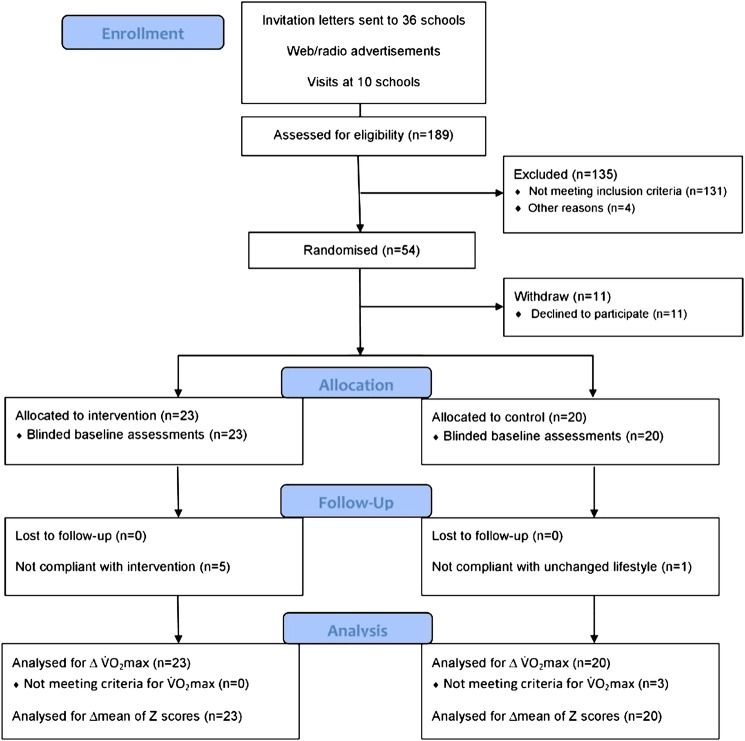
Participants: 43 children previously not bicycling to school were randomly allocated to control group (n=20) (ie, no change in lifestyle) or intervention group (ie, bicycling to school) (n=23).
Primary and secondary outcome measures: Change in cardiometabolic risk factor score and change in cardiorespiratory fitness.
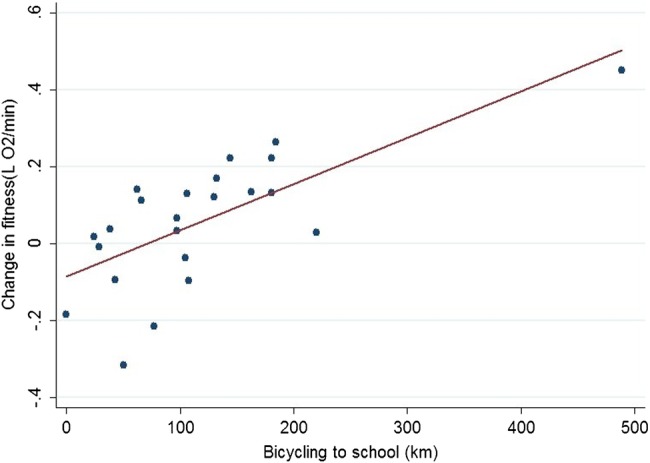
Results: All participants measured at baseline returned at follow-up. Based upon intention-to-treat (ITT) analyses, clustering of cardiometabolic risk factors was lowered by 0.58 SD (95% CI -1.03 to -0.14, p=0.012) in the bicycling group compared to the control group. Cardiorespiratory fitness (l O(2)/min) per se did not increase significantly more in the intervention than in the control group (β=0.0337, 95% CI -0.06 to 0.12, p=0.458).
Conclusions: Bicycling to school counteracted a clustering of cardiometabolic risk factors and should thus be recognised as potential prevention of type 2 diabetes mellitus and cardiovascular disease (CVD). The intervention did, however, not elicit a larger increase in cardiorespiratory fitness in the intervention group as compared with the control group.
Trial registration: Registered at http://www.clinicaltrials.gov (NCT01236222).
Figures
References
-
- Grundy SM. Metabolic syndrome pandemic. Arterioscler Thromb Vasc Biol 2008;28:629–36 - PubMed
-
- Weiss R, Dziura J, Burgert TS, et al. Obesity and the metabolic syndrome in children and adolescents. N Engl J Med 2004;350:2362–74 - PubMed
-
- Gami AS, Witt BJ, Howard DE, et al. Metabolic syndrome and risk of incident cardiovascular events and death: a systematic review and meta-analysis of longitudinal studies. J Am Coll Cardiol 2007;49:403–14 - PubMed
-
- Stern MP, Williams K, Gonzalez-Villalpando C, et al. Does the metabolic syndrome improve identification of individuals at risk of type 2 diabetes and/or cardiovascular disease? Diab Care 2004;27:2676–81 - PubMed
-
- Camhi SM, Katzmarzyk PT. Tracking of cardiometabolic risk factor clustering from childhood to adulthood. Int J Pediat Obes 2010;5:122–9 - PubMed
Associated data
LinkOut - more resources
Full Text Sources
Medical
