


Review
doi: 10.1155/2012/307093.
Epub 2012 Oct 16.
Initiation and regulation of complement during hemolytic transfusion reactions
Affiliations
- PMID: 23118779
- PMCID: PMC3479954
- DOI: 10.1155/2012/307093
Item in Clipboard
Review
Initiation and regulation of complement during hemolytic transfusion reactions
Clin Dev Immunol.
2012.
Abstract
Hemolytic transfusion reactions represent one of the most common causes of transfusion-related mortality. Although many factors influence hemolytic transfusion reactions, complement activation represents one of the most common features associated with fatality. In this paper we will focus on the role of complement in initiating and regulating hemolytic transfusion reactions and will discuss potential strategies aimed at mitigating or favorably modulating complement during incompatible red blood cell transfusions.
Figures

Antibody-mediated complement activation. IgM antibodies primarily exist as planar molecules. However, upon engagement of antigen, IgM antibodies undergo significant conformation changes that result in favorable exposure of multiple C1q binding domains. As a result, a single IgM molecule can initiate significant complement activation. In contrast, two separate IgG antibodies must engage antigen within close enough proximity to simultaneously engage the C1q fix complement.
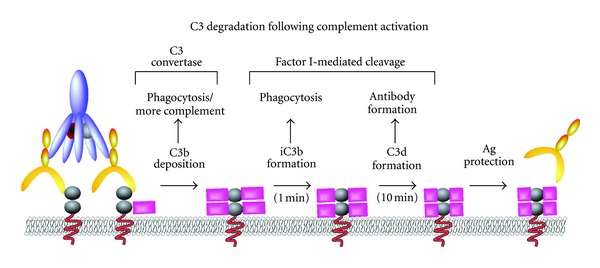
C3 degradation following complement activation. Conversion of C3 to C3b by C3 convertase complex results in rapid deposition of highly reactive C3b on the target surface. Degradation by inhibitory factor I, in concert with other regulatory molecules, results in conversion of C3b to iC3b. Although iC3b retains the capacity of C3b to engage complement receptors as an opsonin, it no longer participates in the production of additional complement. Additional cleavage of iC3b by factor I results in the formation of C3d, which no longer fixes complement or serves as an opsonin, although it may engage B cells and facilitate antibody formation. Decoration of antigen with C3d may result in protection of the antigen from additional antibody binding and subsequent effector function.
References
-
- Cannon JP, Haire RN, Rast JP, Litman GW. The phylogenetic origins of the antigen-binding receptors and somatic diversification mechanisms. Immunological Reviews. 2004;200:12–22. - PubMed
-
- Schwarz HP, Dorner F. Karl Landsteiner and his his major contributions to haematology. British Journal of Haematology. 2003;121(4):556–565. - PubMed
-
- Hajdu SI. Blood transfusion from antiquity to the discovery of the Rh factor. Annals of Clinical and Laboratory Science. 2003;33(4):471–473. - PubMed
-
- Landsteiner K. Zur Kenntnis der antifermativen, lytischen und agglutinierenden Wirkungendes Blutserums und der Lymphe. Zentralbl Bakteriol Parasitenkd. 1900;27:357–363.
Publication types
MeSH terms
Substances
LinkOut - more resources
Full Text Sources
Other Literature Sources
