


Sanitary pad interventions for girls' education in Ghana: a pilot study
- PMID: 23118968
- PMCID: PMC3485220
- DOI: 10.1371/journal.pone.0048274
Sanitary pad interventions for girls' education in Ghana: a pilot study
Abstract
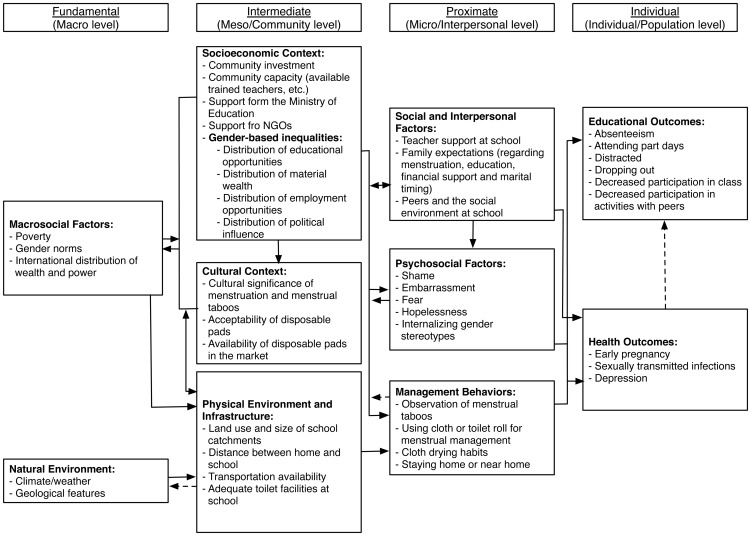
Background: Increased education of girls in developing contexts is associated with a number of important positive health, social, and economic outcomes for a community. The event of menarche tends to coincide with girls' transitions from primary to secondary education and may constitute a barrier for continued school attendance and performance. Following the MRC Framework for Complex Interventions, a pilot controlled study was conducted in Ghana to assess the role of sanitary pads in girls' education.
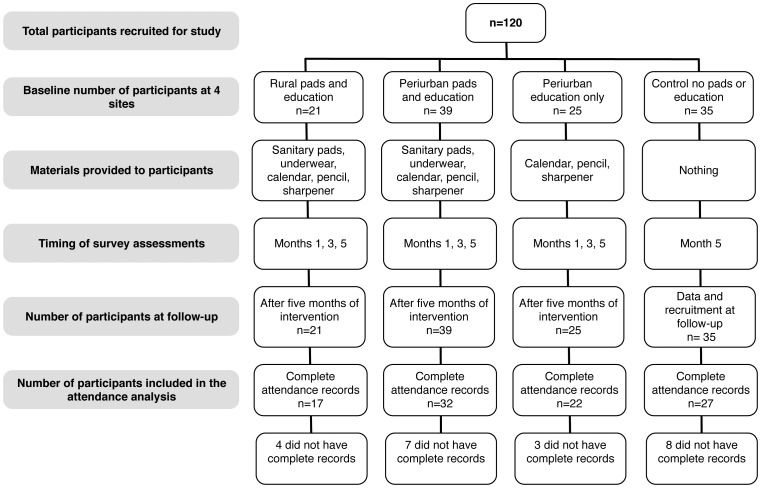
Methods: A sample of 120 schoolgirls between the ages of 12 and 18 from four villages in Ghana participated in a non-randomized trial of sanitary pad provision with education. The trial had three levels of treatment: provision of pads with puberty education; puberty education alone; or control (no pads or education). The primary outcome was school attendance.
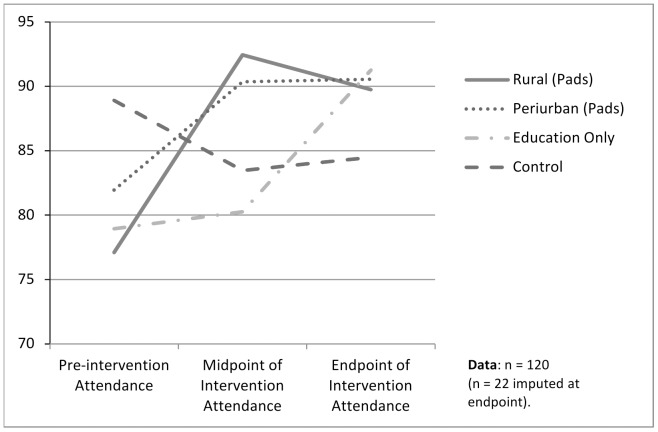
Results: After 3 months, providing pads with education significantly improved attendance among participants, (lambda 0.824, F = 3.760, p<.001). After 5 months, puberty education alone improved attendance to a similar level (M = 91.26, SD = 7.82) as sites where pads were provided with puberty education (Rural M = 89.74, SD = 9.34; Periurban M = 90.54, SD = 17.37), all of which were higher than control (M = 84.48, SD = 12.39). The total improvement through pads with education intervention after 5 months was a 9% increase in attendance. After 3 months, providing pads with education significantly improved attendance among participants. The changes in attendance at the end of the trial, after 5 months, were found to be significant by site over time. With puberty education alone resulting in a similar attendance level.
Conclusion: This pilot study demonstrated promising results of a low-cost, rapid-return intervention for girls' education in a developing context. Given the considerable development needs of poorer countries and the potential of young women there, these results suggest that a large-scale cluster randomized trial is warranted.
Trial registration: Pan African Clinical Trials Registry PACTR201202000361337.
Conflict of interest statement
Figures
References
-
- United Nations (2004) World Population Monitoring: Populations education and development. New York: United Nations.
-
- Kirk J, Sommer M (2006) Menstruation and Body Awareness: Linking Girls' Health with Girls' Education. Available: http://www.schools.watsan.net/content/download/323/2726/. Accessed: 1 September 2010.
-
- Mahon T, Fernandes M (2010) Menstrual Hygiene in South Asia: A Neglected I ssue for WASH (Water, Sanitation and Hygiene) Programmes. Gender & Development 18: 99–113.
-
- Ten VTA (2007) Menstrual Hygiene: A Neglected Condition for the Achievement of Several Millennium Development Goals. Zoetermeer, The Netherlands: Europe External Policy Advisors.
-
- Buckley T, Gottlieb A, editors (1988) Blood Magic: The Anthropology of Menstruation. Berkeley: University of California.
Publication types
MeSH terms
LinkOut - more resources
Full Text Sources
