


One-year clinical prediction in Chinese ischemic stroke patients using the CHADS2 and CHA2DS2-VASc scores: the China National Stroke Registry
- PMID: 23121837
- PMCID: PMC6493534
- DOI: 10.1111/cns.12021
One-year clinical prediction in Chinese ischemic stroke patients using the CHADS2 and CHA2DS2-VASc scores: the China National Stroke Registry
Abstract
Aims: We investigated whether CHADS2 or CHA2DS2-VASc scores could be used to predict 1-year prognosis in stroke recurrence, mortality, and mortality of ischemic stroke or transient ischemic attack (TIA) patients with nonvalvular atrial fibrillation (NVAF).
Methods: Patients were selected from a national prospective registry in China. The clinical prediction of the scores was examined using the C statistic. Univariate and multivariate logistic regressions were performed to analyze the relevant risk factors.
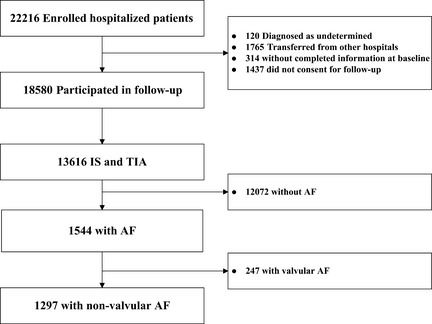
Results: Thousand two hundred and ninety-seven of 22,216 patients were enrolled in the study. For stroke recurrence rate, the C statistic value was 0.53 (odds ratio [OR] 1.15, 95% confidence interval [CI]: 1.01 to 1.32) for CHADS2 and 0.55 (OR 1.14, 95% CI: 1.05 to 1.24) for CHA2DS2-VASc; adding baseline National Institutes of Health Stroke Scale (NIHSS) score to these two scores, the value of C statistic was 0.58 (OR 1.25 95% CI: 1.14 to 1.37) and 0.58 (OR 1.19, 95% CI: 1.11 to 1.27), respectively.
Conclusions: Both CHADS2 and CHA2DS2-VASc scores have limitations in predicting the 1-year prognosis of stroke/TIA patients with NVAF in China. The predictive value of these two scores improved by adding the baseline NIHSS score.
© 2012 Blackwell Publishing Ltd.
Conflict of interest statement
The authors have no conflict of interest.
Figures
References
-
- Lin S, Wu B, Hao ZL, et al. Characteristics, treatment and outcome of ischemic stroke with atrial fibrillation in a chinese hospital‐based stroke study. Cerebrovasc Dis 2011;31:419–426. - PubMed
-
- Wen‐Hang QI. Retrospective investigation of hospitalised patients with atrial fibrillation in mainland china. Int J Cardiol 2005;105:283–287. - PubMed
-
- Gage BF, Waterman AD, Shannon W, Boechler M, Rich MW, Radford MJ. Validation of clinical classification schemes for predicting stroke: Results from the national registry of atrial fibrillation. JAMA 2001;285:2864–2870. - PubMed
-
- Lip GY, Nieuwlaat R, Pisters R, Lane DA, Crijns HJ. Refining clinical risk stratification for predicting stroke and thromboembolism in atrial fibrillation using a novel risk factor‐based approach: The euro heart survey on atrial fibrillation. Chest 2010;137:263–272. - PubMed
Publication types
MeSH terms
Substances
LinkOut - more resources
Full Text Sources
Medical
