Meta-Analysis
. 2012 Nov 2;91(5):863-71.
doi: 10.1016/j.ajhg.2012.09.013.

A multi-SNP locus-association method reveals a substantial fraction of the missing heritability

Affiliations
Meta-Analysis

A multi-SNP locus-association method reveals a substantial fraction of the missing heritability

Georg B Ehret et al. Am J Hum Genet. .

Abstract

There are many known examples of multiple semi-independent associations at individual loci; such associations might arise either because of true allelic heterogeneity or because of imperfect tagging of an unobserved causal variant. This phenomenon is of great importance in monogenic traits but has not yet been systematically investigated and quantified in complex-trait genome-wide association studies (GWASs). Here, we describe a multi-SNP association method that estimates the effect of loci harboring multiple association signals by using GWAS summary statistics. Applying the method to a large anthropometric GWAS meta-analysis (from the Genetic Investigation of Anthropometric Traits consortium study), we show that for height, body mass index (BMI), and waist-to-hip ratio (WHR), 3%, 2%, and 1%, respectively, of additional phenotypic variance can be explained on top of the previously reported 10% (height), 1.5% (BMI), and 1% (WHR). The method also permitted a substantial increase (by up to 50%) in the number of loci that replicate in a discovery-validation design. Specifically, we identified 74 loci at which the multi-SNP, a linear combination of SNPs, explains significantly more variance than does the best individual SNP. A detailed analysis of multi-SNPs shows that most of the additional variability explained is derived from SNPs that are not in linkage disequilibrium with the lead SNP, suggesting a major contribution of allelic heterogeneity to the missing heritability.


Figures

Figure 1
Figure 1
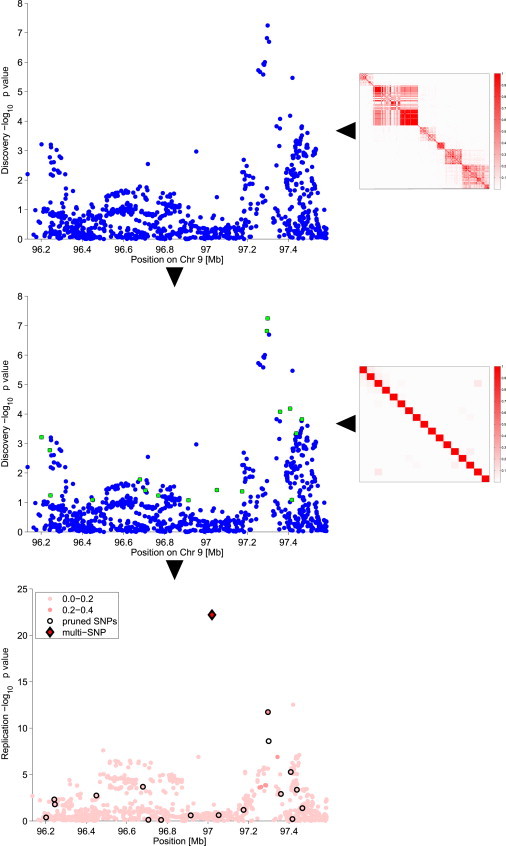
Brief Summary of the Multi-SNP Locus-Association Method First, SNPs at the locus were prioritized (on the basis of their discovery p values) and were LD pruned (on the basis of their pairwise LD). The emerging SNPs were taken to validation, where the multi-SNP was created as their optimal linear combination and was tested against the chi-square distribution for obtaining the multi-SNP association p value.
Figure 2
Figure 2
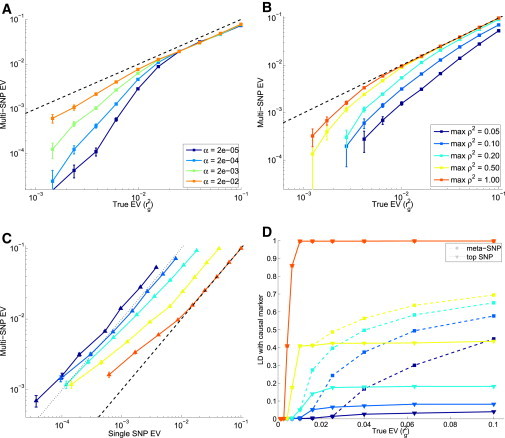
Properties of the Variance Explained by Multi-SNPs (A) The multi-SNP was generated for various EV values and SNP-selection thresholds (α), whereas all SNPs with an LD r2 ≥ 0.5 with the casual variant were set unobserved. (B) The multi-SNP was computed for various EV values (rg2) and for maximal LD (ρ2) between the observed SNPs and the causal variant. Here and for the rest of the experiment, we fixed α at 2 × 10−2. (C) The EV of the multi-SNP is plotted against that of the best associated observed SNP. The estimates were again generated for various EV values (rg2) and for maximal LD (ρ2) between the tagged SNPs and the causal variant. The dotted black line indicates a ten-fold increase. (D) LD (squared correlation) between the causal SNP and the derived multi-SNP (dashed line) and top associated SNP (solid line). The color coding for (C) and (D) agrees with that of (B).
Figure 3
Figure 3
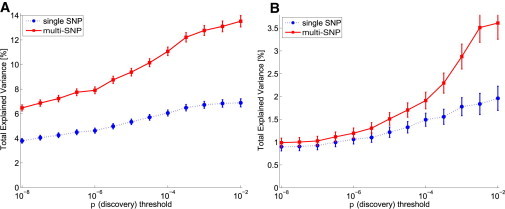
Gain in the TEV for Height and BMI The TEV of single SNPs and multi-SNPs is plotted as a function of the discovery-p-value cutoff. Although pronounced allelic heterogeneity can be observed throughout the whole p value spectrum for height (A), only SNPs with a smaller effect tend to harbor significant multi-SNPs for BMI (B).
Figure 4
Figure 4
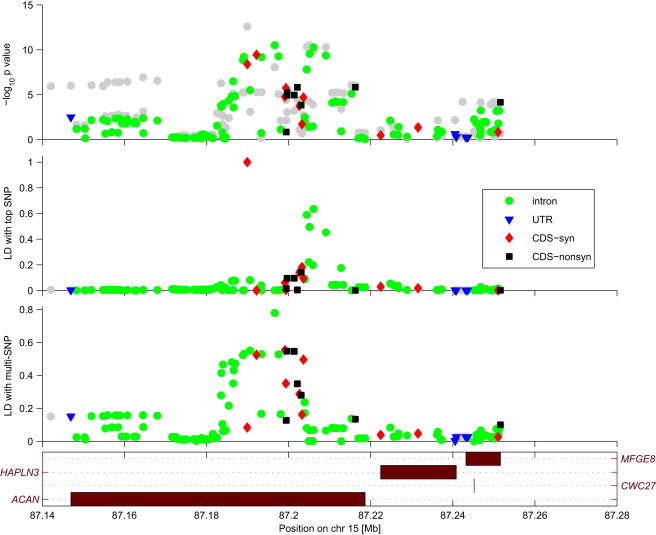
Example of a Height-Associated Locus with Strong Allelic Heterogeneity The top associated variant is in weak LD with all nonsynonymous markers in ACAN. However, the multi-SNP captures these SNPs.

References

    1. Hindorff L.A., Sethupathy P., Junkins H.A., Ramos E.M., Mehta J.P., Collins F.S., Manolio T.A. Potential etiologic and functional implications of genome-wide association loci for human diseases and traits. Proc. Natl. Acad. Sci. USA. 2009;106:9362–9367. - PMC - PubMed
    1. Maher B. Personal genomes: The case of the missing heritability. Nature. 2008;456:18–21. - PubMed
    1. Manolio T.A., Collins F.S., Cox N.J., Goldstein D.B., Hindorff L.A., Hunter D.J., McCarthy M.I., Ramos E.M., Cardon L.R., Chakravarti A. Finding the missing heritability of complex diseases. Nature. 2009;461:747–753. - PMC - PubMed
    1. Yang J., Benyamin B., McEvoy B.P., Gordon S., Henders A.K., Nyholt D.R., Madden P.A., Heath A.C., Martin N.G., Montgomery G.W. Common SNPs explain a large proportion of the heritability for human height. Nat. Genet. 2010;42:565–569. - PMC - PubMed
    1. Walters R.G., Jacquemont S., Valsesia A., de Smith A.J., Martinet D., Andersson J., Falchi M., Chen F., Andrieux J., Lobbens S. A new highly penetrant form of obesity due to deletions on chromosome 16p11.2. Nature. 2010;463:671–675. - PMC - PubMed

Publication types

LinkOut - more resources