. 2012 Dec 21;287(52):43876-83.
doi: 10.1074/jbc.M112.424879. Epub 2012 Nov 2.

Localization and substrate selectivity of sea urchin multidrug (MDR) efflux transporters

Affiliations

Localization and substrate selectivity of sea urchin multidrug (MDR) efflux transporters

Tufan Gökirmak et al. J Biol Chem. .

Abstract

In this study, we cloned, expressed and functionally characterized Stronglycentrotus purpuratus (Sp) ATP-binding cassette (ABC) transporters. This screen identified three multidrug resistance (MDR) transporters with functional homology to the major types of MDR transporters found in humans. When overexpressed in embryos, the apical transporters Sp-ABCB1a, ABCB4a, and ABCG2a can account for as much as 87% of the observed efflux activity, providing a robust assay for their substrate selectivity. Using this assay, we found that sea urchin MDR transporters export canonical MDR susbtrates such as calcein-AM, bodipy-verapamil, bodipy-vinblastine, and mitoxantrone. In addition, we characterized the impact of nonconservative substitutions in the primary sequences of drug binding domains of sea urchin versus murine ABCB1 by mutation of Sp-ABCB1a and treatment of embryos with stereoisomeric cyclic peptide inhibitors (QZ59 compounds). The results indicated that two substitutions in transmembrane helix 6 reverse stereoselectivity of Sp-ABCB1a for QZ59 enantiomers compared with mouse ABCB1a. This suggests that subtle changes in the primary sequence of transporter drug binding domains could fine-tune substrate specificity through evolution.


Figures
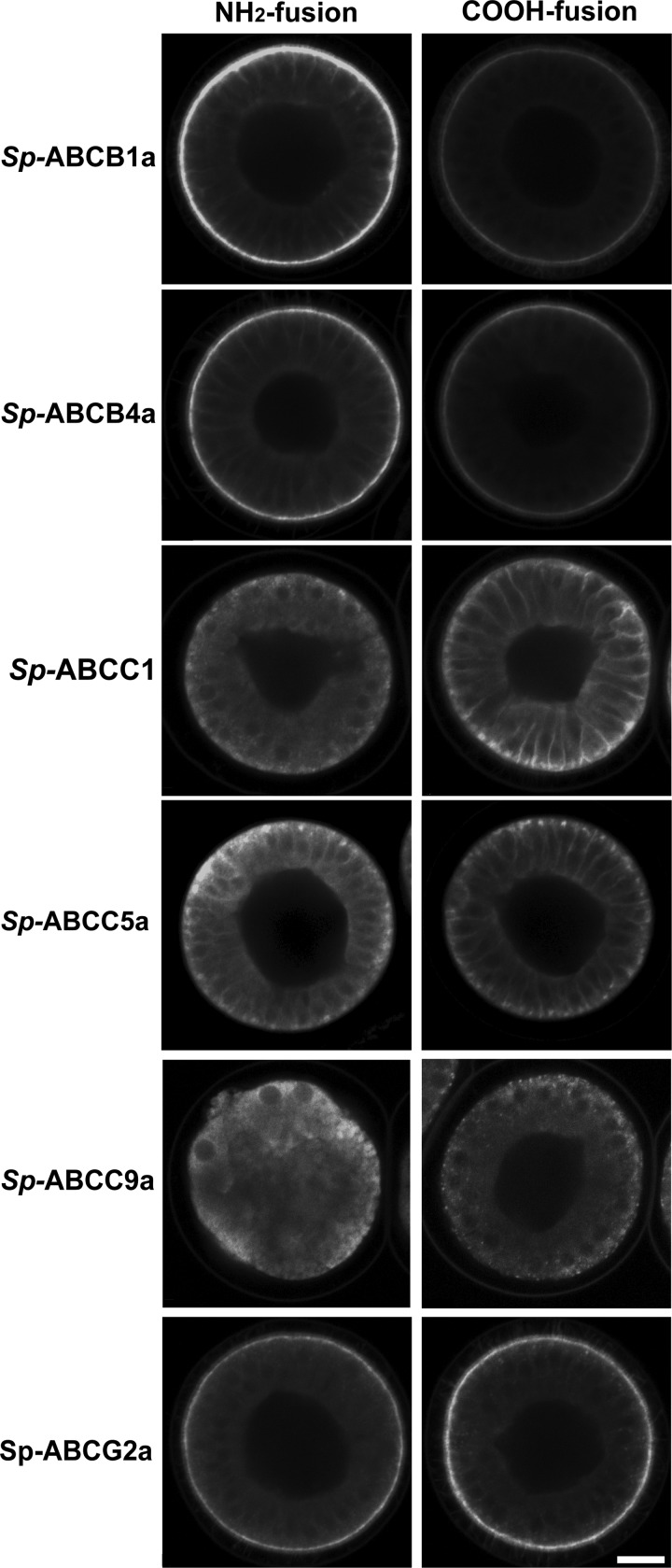
FIGURE 1.
FIGURE 1.
Fluorescent protein tag position influences the expression of sea urchin ABC transporters in blastulae. Both N- and C-terminal mCherry fusions of Sp-ABCB1a, ABCB4a, and ABCG2 localize to apical membranes. C-terminal Sp-ABCC1 and N-terminal and C-terminal fusions of Sp-ABCC5a localize to basolateral membranes. C-terminal fusion of Sp-ABCC9a localizes to apical vesicles. Scale bar, 20 μm.
FIGURE 2.
FIGURE 2.
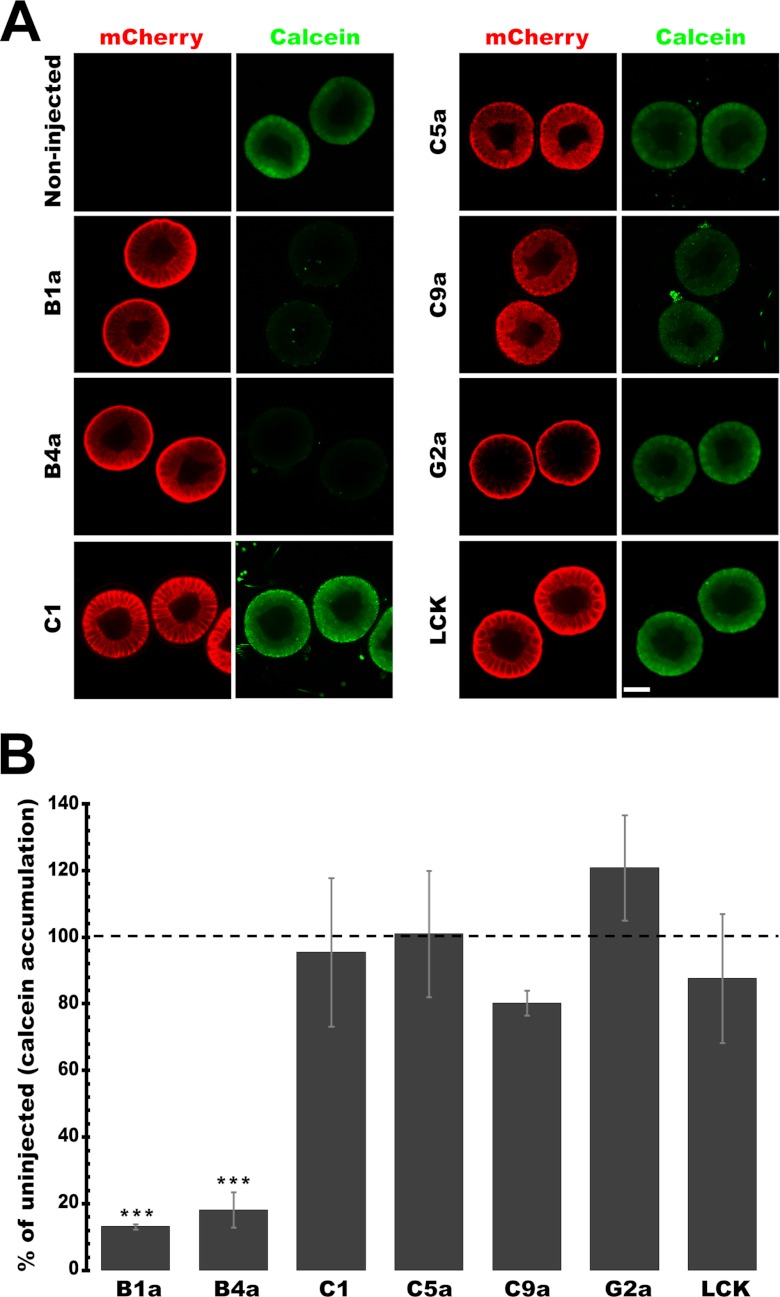
Recombinant sea urchin ABC transporters have CAM efflux activity. A, micrographs showing that overexpression of mCherry-tagged Sp-ABCB1a and ABCB4a reduces intracellular calcein accumulation significantly. Sp-ABCC1, ABCC5a, ABCC9, and ABCG2a, and LCK control have no effect on CAM accumulation. Scale bar, 35 μm. B, quantitative analysis of intracellular calcein accumulation in embryos expressing ABC transporters and LCK. ***, p < 0.0001 indicates the transporters significantly different from LCK. Error bars, S.D. n = 18–20 embryos from three separate experiments.
FIGURE 3.
FIGURE 3.
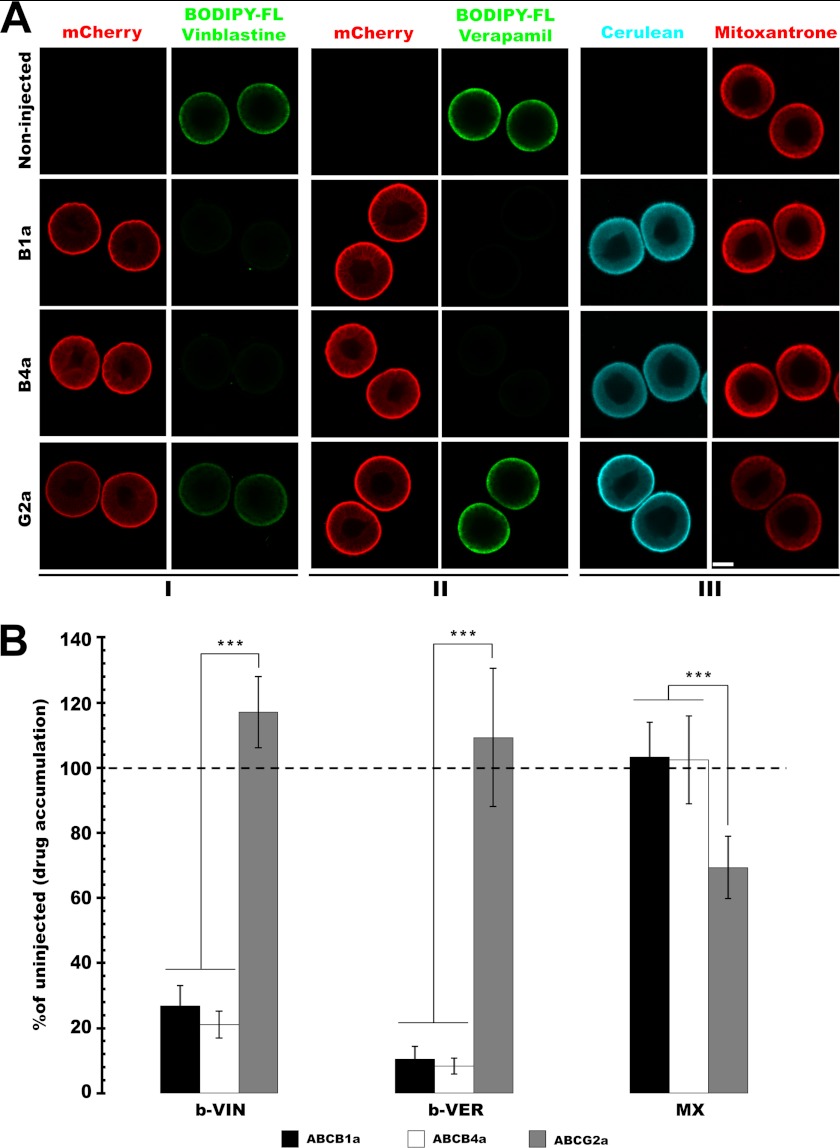
Sea urchin MDR proteins transport similar substrates to their mammalian homologs. A, micrographs showing that overexpression of Sp-ABCB1a and ABCB4a, but not ABCG2a, reduces intracellular b-VIN (I) and b-VER (II) accumulation significantly (***, p < 0.0001). Overexpression of cerulean (CFP)-tagged Sp-ABCG2a, but not ABCB1a or ABCB4, reduces intracellular MX (III) accumulation significantly (*, p < 0.01). Scale bar, 35 μm. B, quantitative analysis of intracellular b-VIN, b-VER, and MX accumulation in embryos expressing apical MDR transporters. n = 14–18 embryos from three separate experiments. Error bars, S.D.
FIGURE 4.
FIGURE 4.
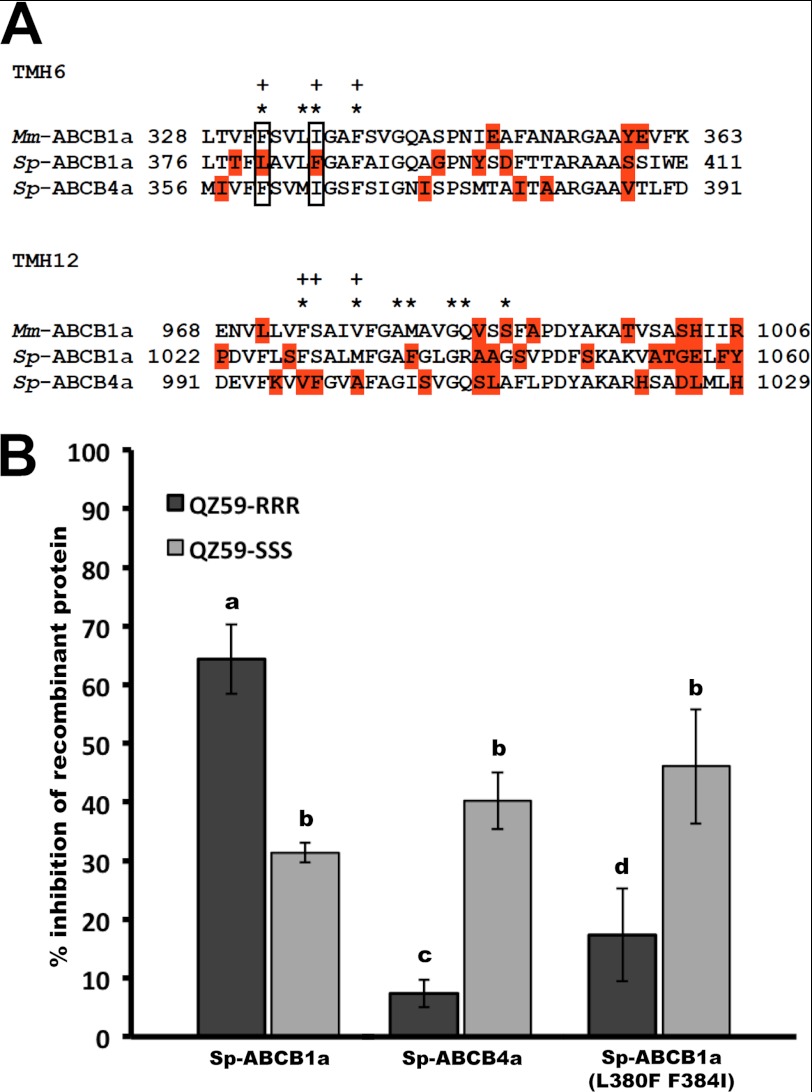
Differences in inhibition of sea urchin Sp-ABCB1a- and ABCB4a-mediated CAM efflux by QZ59 enantiomers. A, protein alignments of TMH6 and 12 of sea urchin Sp-ABCB1a and ABCB4a with mouse Mm-ABCB1a showing that Leu-380 and Phe-384 residues are unique nonconservative substitutions in Sp-ABCB1a drug binding domain. Residues in close proximity with QZ59-RRR (+) and QZ59-SSS (*) (30). Residues marked in red are nonconservative substitutions. B, quantitative analysis of the inhibition of intracellular calcein accumulation by QZ59 stereoisomers (10 μm) in embryos expressing mCherry-tagged Sp-ABCB1a, ABCB4, and ABCB1a (L380F, F384I) fusions. Bars with different letters are significantly different from each other (p ≤ 0.002). n = 18–20 embryos from three separate experiments. Error bars, S.D.

References

    1. Dean M., Hamon Y., Chimini G. (2001) The human ATP-binding cassette (ABC) transporter superfamily. J. Lipid Res. 42, 1007–1017 - PubMed
    1. Leslie E. M., Deeley R. G., Cole S. P. (2005) Multidrug resistance proteins: role of P-glycoprotein, MRP1, MRP2, and BCRP (ABCG2) in tissue defense. Toxicol. Appl. Pharmacol. 204, 216–237 - PubMed
    1. Gottesman M. M., Fojo T., Bates S. E. (2002) Multidrug resistance in cancer: role of ATP-dependent transporters. Nat. Rev. Cancer 2, 48–58 - PubMed
    1. Campanale J. P., Hamdoun A. (2012) Programmed reduction of ABC transporter activity in sea urchin germline progenitors. Development 139, 783–792 - PMC - PubMed
    1. Broeks A., Gerrard B., Allikmets R., Dean M., Plasterk R. H. (1996) Homologues of the human multidrug resistance genes MRP and MDR contribute to heavy metal resistance in the soil nematode Caenorhabditis elegans. EMBO J. 15, 6132–6143 - PMC - PubMed

Publication types

MeSH terms

Substances

LinkOut - more resources