


QTL mapping in three tropical maize populations reveals a set of constitutive and adaptive genomic regions for drought tolerance
- PMID: 23124431
- PMCID: PMC3579412
- DOI: 10.1007/s00122-012-2003-7
QTL mapping in three tropical maize populations reveals a set of constitutive and adaptive genomic regions for drought tolerance
Abstract
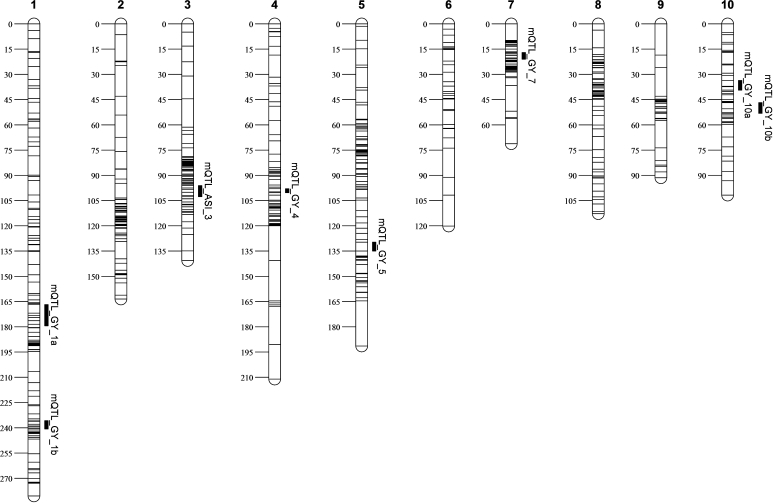
Despite numerous published reports of quantitative trait loci (QTL) for drought-related traits, practical applications of such QTL in maize improvement are scarce. Identifying QTL of sizeable effects that express more or less uniformly in diverse genetic backgrounds across contrasting water regimes could significantly complement conventional breeding efforts to improve drought tolerance. We evaluated three tropical bi-parental populations under water-stress (WS) and well-watered (WW) regimes in Mexico, Kenya and Zimbabwe to identify genomic regions responsible for grain yield (GY) and anthesis-silking interval (ASI) across multiple environments and diverse genetic backgrounds. Across the three populations, on average, drought stress reduced GY by more than 50 % and increased ASI by 3.2 days. We identified a total of 83 and 62 QTL through individual environment analyses for GY and ASI, respectively. In each population, most QTL consistently showed up in each water regime. Across the three populations, the phenotypic variance explained by various individual QTL ranged from 2.6 to 17.8 % for GY and 1.7 to 17.8 % for ASI under WS environments and from 5 to 19.5 % for GY under WW environments. Meta-QTL (mQTL) analysis across the three populations and multiple environments identified seven genomic regions for GY and one for ASI, of which six mQTL on chr.1, 4, 5 and 10 for GY were constitutively expressed across WS and WW environments. One mQTL on chr.7 for GY and one on chr.3 for ASI were found to be 'adaptive' to WS conditions. High throughput assays were developed for SNPs that delimit the physical intervals of these mQTL. At most of the QTL, almost equal number of favorable alleles was donated by either of the parents within each cross, thereby demonstrating the potential of drought tolerant × drought tolerant crosses to identify QTL under contrasting water regimes.
Figures
References
-
- Araus JL, Slafer GA, Royo C, Serret MD. Breeding for yield potential and stress adaptation in cereals. Crit Rev Plant Sci. 2008;27:377–412. doi: 10.1080/07352680802467736. - DOI
-
- Araus JL, Sanchez C, Edmeades G. Phenotyping maize for adaptation to drought. In: Monneveux P, Ribaut JM, editors. Drought phenotyping in crops: from theory to practice. 1. Texcoco: Generation Challenge Program (GCP); 2011. pp. 263–283.
-
- Bänziger M, Araus JL. Recent advances in breeding maize for drought and salinity stress tolerance. In: Jenks MA, editor. Advances in mol breeding toward drought and salt tolerant crops. Berlin: Springerlink; 2007. pp. 587–601.
-
- Bänziger M, Setimela PS, Hodson D, Vivek B. Breeding for improved abiotic stress tolerance in maize adapted to southern Africa. Agric Water Manag. 2006;80:212–224. doi: 10.1016/j.agwat.2005.07.014. - DOI
-
- Bänzinger M, Edmeads GO, Beck D, Bellon M. Breeding for drought and nitrogen stress tolerance in maize: from theory to practice. Mexico: CIMMYT; 2000.
Publication types
MeSH terms
Substances
LinkOut - more resources
Full Text Sources
