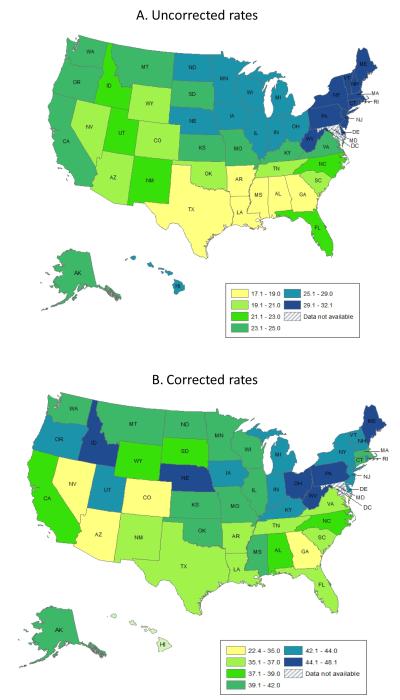
State-level uterine corpus cancer incidence rates corrected for hysterectomy prevalence, 2004 to 2008
- PMID: 23125334
- PMCID: PMC3538963
- DOI: 10.1158/1055-9965.EPI-12-0991
State-level uterine corpus cancer incidence rates corrected for hysterectomy prevalence, 2004 to 2008
Abstract
Background: The interpretation of uterine cancer rates is hindered by the inclusion of women whose uterus has been surgically removed in the population at risk. Hysterectomy prevalence varies widely by state and race/ethnicity, exacerbating this issue.
Methods: We estimated hysterectomy-corrected, age-adjusted uterine corpus cancer incidence rates by race/ethnicity for 49 states and the District of Columbia during 2004 to 2008 using case counts obtained from population-based cancer registries; population data from the U.S. Census Bureau; and hysterectomy prevalence data from the Behavioral Risk Factor Surveillance System. Corrected and uncorrected incidence rates were compared with regard to geographic and racial/ethnic disparity patterns and the association with obesity.
Results: Among non-Hispanic Whites, uterine cancer incidence rates (per 100,000 woman-years) uncorrected for hysterectomy prevalence ranged from 17.1 in Louisiana to 32.1 in New Jersey, mirrored regional hysterectomy patterns, and were not correlated with obesity prevalence (Pearson correlation coefficient, r = 0.06, two-sided P = 0.68). In comparison, hysterectomy-corrected rates were higher by a minimum of 30% (District of Columbia) to more than 100% (Mississippi, Louisiana, Alabama, and Oklahoma), displayed no discernible geographic pattern, and were moderately associated with obesity (r = 0.37, two-sided P = 0.009). For most states, hysterectomy correction diminished or reversed the Black/White deficit and accentuated the Hispanic/White deficit.
Conclusion: Failure to adjust uterine cancer incidence rates for hysterectomy prevalence distorts true geographic and racial patterns and substantially underestimates the disease burden, particularly for Southern states.
Impact: Correction for hysterectomy is necessary for the accurate evaluation of uterine cancer rates.
Figures
References
-
- Copeland G, Lake A, Firth R, Wohler B, Wu X, Stroup A, et al., editors. Cancer in North America: 2004-2008. Volume One: Combined Cancer Incidence for the United States and Canada. North American Association of Central Cancer Registries, Inc; Springfield, IL: 2011.
-
- Lyon JL, Gardner JW. The rising frequency of hysterectomy: its effect on uterine cancer rates. American journal of epidemiology. 1977;105:439–43. - PubMed
-
- Merrill RM, Feuer EJ. Risk-adjusted cancer-incidence rates (United States) Cancer causes & control : CCC. 1996;7:544–52. - PubMed
Publication types
MeSH terms
Grants and funding
LinkOut - more resources
Full Text Sources
Medical