Randomized Controlled Trial
. 2013 Jan 15;207(2):248-56.
doi: 10.1093/infdis/jis671. Epub 2012 Nov 2.

Characterization of humoral and cellular immune responses elicited by a recombinant adenovirus serotype 26 HIV-1 Env vaccine in healthy adults (IPCAVD 001)

Affiliations
Randomized Controlled Trial

Characterization of humoral and cellular immune responses elicited by a recombinant adenovirus serotype 26 HIV-1 Env vaccine in healthy adults (IPCAVD 001)

Dan H Barouch et al. J Infect Dis. .

Abstract

Background: Adenovirus serotype 26 (Ad26) has been developed as a novel candidate vaccine vector for human immunodeficiency virus type 1 (HIV-1) and other pathogens. The primary safety and immunogenicity data from the Integrated Preclinical/Clinical AIDS Vaccine Development Program (IPCAVD) 001 trial, the first-in-human evaluation of a prototype Ad26 vector-based vaccine expressing clade A HIV-1 Env (Ad26.ENVA.01), are reported concurrently with this article. Here, we characterize in greater detail the humoral and cellular immune responses elicited by Ad26.ENVA.01 in humans.

Methods: Samples from the IPCAVD 001 trial were used for humoral and cellular immunogenicity assays.

Results: We observed a dose-dependent expansion of the magnitude, breadth, and epitopic diversity of Env-specific binding antibody responses elicited by this vaccine. Antibody-dependent cell-mediated phagocytosis, virus inhibition, and degranulation functional activity were also observed. Env-specific cellular immune responses induced by the vaccine included multiple CD8(+) and CD4(+) T-lymphocyte memory subpopulations and cytokine secretion phenotypes, although cellular immune breadth was limited. Baseline vector-specific T-lymphocyte responses were common but did not impair Env-specific immune responses in this study.

Conclusion: Ad26.ENVA.01 elicited a broad diversity of humoral and cellular immune responses in humans. These data support the further clinical development of Ad26 as a candidate vaccine vector.

Clinical trials registration: NCT00618605.


Figures
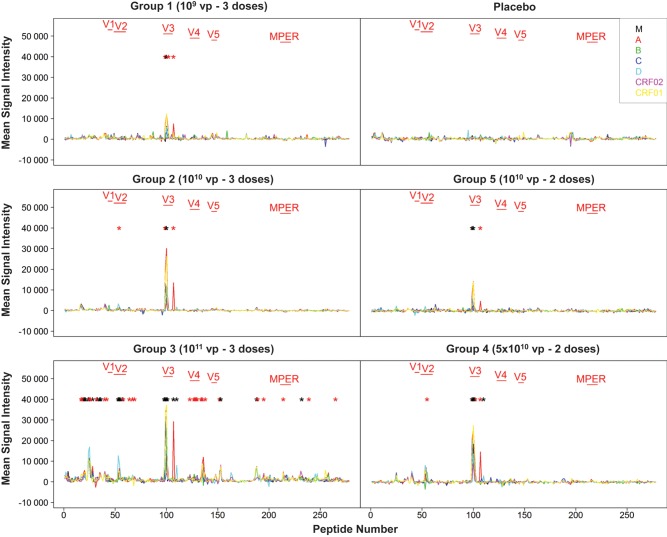
Figure 1.
Figure 1.
Env-specific binding antibody profiles by peptide arrays. Sera from baseline and week 28 were assessed using peptide arrays (JPT Peptide Technologies) to assess linear antibody responses to peptides spanning Env from clades M, A, B, C, D, CRF02, and CRF01. Mean signal intensity (week 28 with baselines subtracted) from all subjects in each group is depicted. Black asterisks denote peptides with significantly elevated mean signal intensity as compared with placebos (P < .05, by Wilcoxon Mann–Whitney U tests), and red asterisks denote trends (P < .10).
Figure 2.
Figure 2.
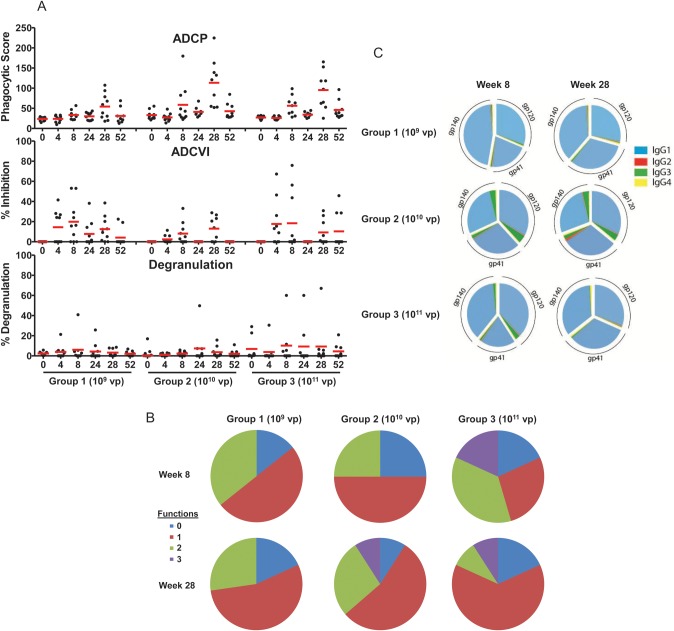
Env-specific functional nonneutralizing antibody binding responses and antibody isotypes. A, Serum from multiple time points from subjects who received 109 viral particles (vp), 1010 vp, and 1011 vp of the vaccine were assessed for antibody-dependent cellular phagocytosis (ADCP), cellular inhibition (ADCVI), and macrophage inflammatory protein 1β degranulation. Bars represent mean responses. B, Percentage of vaccinees in these groups at week 8 and week 28 that exhibit multiple antibody functions (ADCP/ADCVI/degranulation). C, Immunoglobulin G (IgG) isotypes of Env gp140-, gp120-, and gp41-specific binding antibodies from week 8 and week 28 from subjects who received 109 vp, 1010 vp, and 1011 vp of the vaccine are shown in pie charts. Mean proportional IgG1, IgG2, IgG3, and IgG4 responses are shown for each group.
Figure 3.
Figure 3.
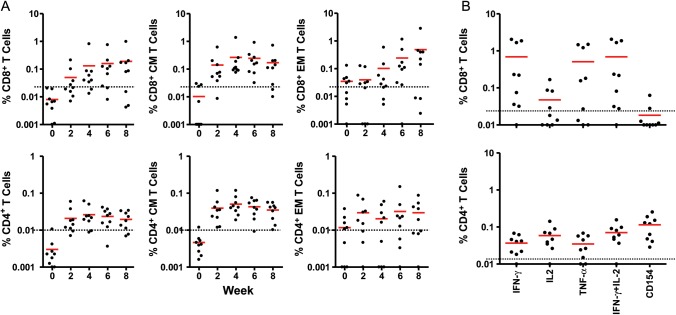
Env-specific CD8+ and CD4+ T-lymphocyte responses by intracellular cytokine staining assays. A, Peripheral blood mononuclear cells (PBMCs) from multiple time points from subjects who received 5 × 10¹⁰ viral particles (vp) of the vaccine were assessed for Env-specific interferon-γ (IFN-γ)–secreting CD8+ and CD4+ total, central memory (CM), and effector memory (EM) T-lymphocyte responses. Responses are depicted as percentage of IFN-γ–secreting cells divided by total, CM, or EM CD8+ or CD4+ T lymphocytes. B, PBMCs from these subjects at week 28 were assessed for secretion of multiple cytokines (IFN-γ, interleukin 2 [IL-2], and tumor necrosis factor-α [TNF-α]) and expression of CD154 from Env-specific CD8+ and CD4+ T-lymphocytes. T-lymphocyte responses were assessed following stimulation with pooled clade A Env peptides. Bars reflect mean responses. Average placebo assay backgrounds are shown as dotted lines.
Figure 4.
Figure 4.
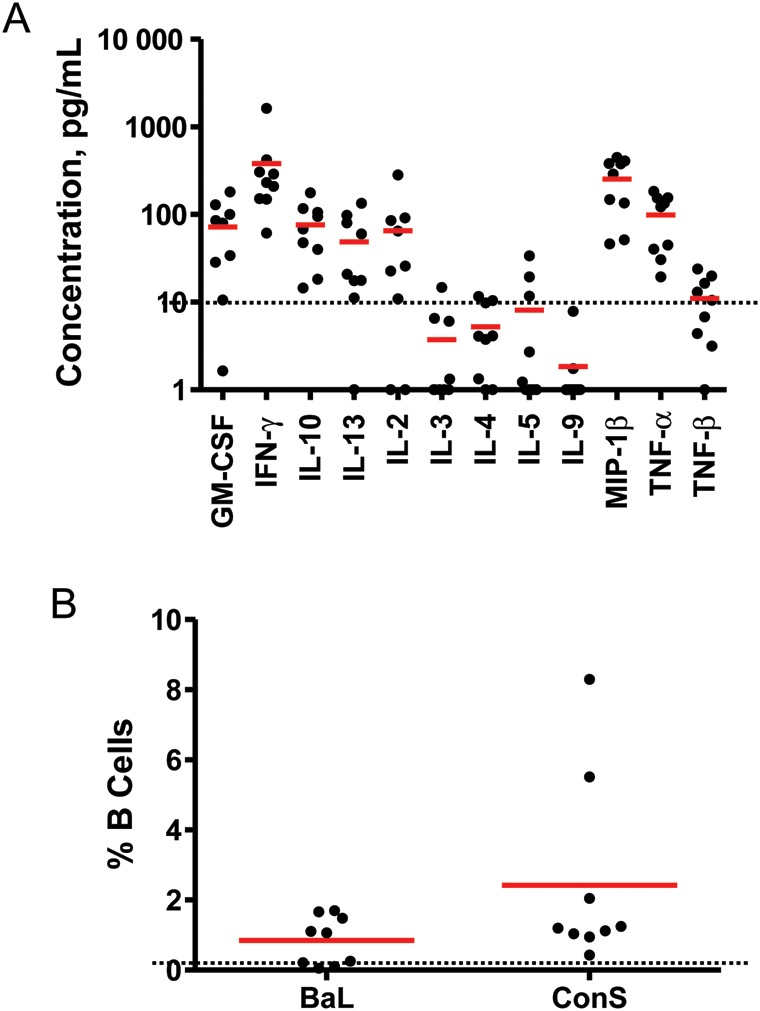
Env-specific cytokine secretion and B-lymphocyte enzyme-linked immuno spot (ELISPOT) assay responses. A, Peripheral blood mononuclear cells (PBMCs) from week 28 from subjects who received 5 × 10¹⁰ viral particles of the vaccine were assessed for secretion of multiple cytokines following stimulation with pooled clade A Env peptides by cytokine multiplex bead arrays. Concentrations of each cytokine are shown. Bars reflect mean responses. GM-CSF, granulocyte-macrophage colony-stimulating factor; IFN-γ, interferon γ; IL-2, interleukin 2; IL-3, interleukin 3; IL-4, interleukin 4; IL-5, interleukin 5; IL-9, interleukin 9; IL-10, interleukin 10; IL-13, interleukin 13; MIP-1β, macrophage inflammatory protein 1β; TNF-α, tumor necrosis factor α; TNF-β, tumor necrosis factor β. B, PBMCs from week 28 from subjects who received 5 × 10¹⁰ vp of the vaccine were assessed for memory B-lymphocyte responses following stimulation with purified BaL or ConS gp140 in B-lymphocyte ELISPOT assays. Bars reflect mean responses. Average placebo assay backgrounds are shown as dotted lines.
Figure 5.
Figure 5.
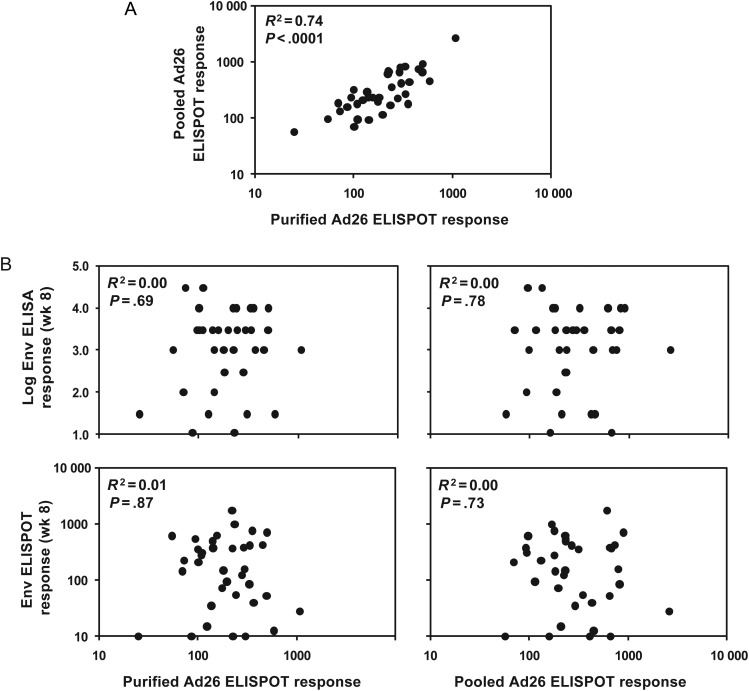
Adenovirus serotype 26 (Ad26)–specific T-lymphocyte responses by enzyme-linked immuno spot (ELISPOT) assays. A, Baseline Ad26-specific cellular immune responses were assessed by ELISPOT assays following stimulation with purified Ad26 virus or pooled Ad26 hexon peptides. B, Lack of correlation between baseline Ad26-specific cellular immune responses at week 0 and Env-specific humoral ELISA (top) and cellular ELISPOT assay (bottom) responses at week 8 from subjects who received 109 viral particles (vp), 1010 vp, and 1011 vp of the vaccine (Spearman rank-correlation tests).

References

    1. Flynn NM, Forthal DN, Harro CD, Judson FN, Mayer KH, Para MF. Placebo-controlled phase 3 trial of a recombinant glycoprotein 120 vaccine to prevent HIV-1 infection. J Infect Dis. 2005;191:654–65. - PubMed
    1. Pitisuttithum P, Gilbert P, Gurwith M, et al. Randomized, double-blind, placebo-controlled efficacy trial of a bivalent recombinant glycoprotein 120 HIV-1 vaccine among injection drug users in Bangkok, Thailand. J Infect Dis. 2006;194:1661–71. - PubMed
    1. Buchbinder SP, Mehrotra DV, Duerr A, et al. Efficacy assessment of a cell-mediated immunity HIV-1 vaccine (the Step Study): a double-blind, randomised, placebo-controlled, test-of-concept trial. Lancet. 2008;372:1881–93. - PMC - PubMed
    1. Rerks-Ngarm S, Pitisuttithum P, Nitayaphan S, et al. Vaccination with ALVAC and AIDSVAX to prevent HIV-1 infection in Thailand. N Engl J Med. 2009;361:2209–20. - PubMed
    1. Barouch DH. Challenges in the development of an HIV-1 vaccine. Nature. 2008;455:613–9. - PMC - PubMed

Publication types

MeSH terms

Associated data