. 2012 Nov 1:6:93.
doi: 10.3389/fncom.2012.00093. eCollection 2012.

The computational power of astrocyte mediated synaptic plasticity

Affiliations

The computational power of astrocyte mediated synaptic plasticity

Rogier Min et al. Front Comput Neurosci. .

Abstract

Research in the last two decades has made clear that astrocytes play a crucial role in the brain beyond their functions in energy metabolism and homeostasis. Many studies have shown that astrocytes can dynamically modulate neuronal excitability and synaptic plasticity, and might participate in higher brain functions like learning and memory. With the plethora of astrocyte mediated signaling processes described in the literature today, the current challenge is to identify, which of these processes happen under what physiological condition, and how this shapes information processing and, ultimately, behavior. To answer these questions will require a combination of advanced physiological, genetical, and behavioral experiments. Additionally, mathematical modeling will prove crucial for testing predictions on the possible functions of astrocytes in neuronal networks, and to generate novel ideas as to how astrocytes can contribute to the complexity of the brain. Here, we aim to provide an outline of how astrocytes can interact with neurons. We do this by reviewing recent experimental literature on astrocyte-neuron interactions, discussing the dynamic effects of astrocytes on neuronal excitability and short- and long-term synaptic plasticity. Finally, we will outline the potential computational functions that astrocyte-neuron interactions can serve in the brain. We will discuss how astrocytes could govern metaplasticity in the brain, how they might organize the clustering of synaptic inputs, and how they could function as memory elements for neuronal activity. We conclude that astrocytes can enhance the computational power of neuronal networks in previously unexpected ways.

Keywords: STDP; astrocytes; calcium; computation; heterosynaptic plasticity; metaplasticity; spike-timing-dependent plasticity; synaptic plasticity.


Figures
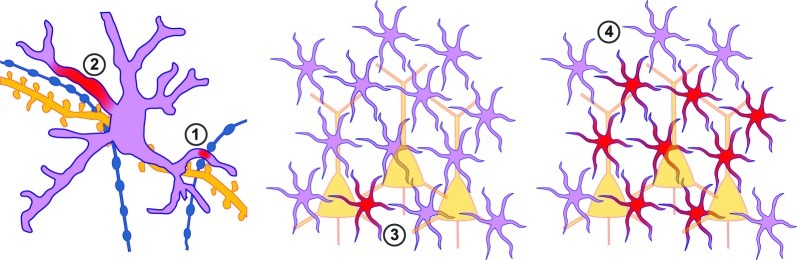
Figure 1
Figure 1
Spatial properties of astrocytic Ca2+ signals. Left: close-up view of a single astrocyte (pink) together with presynaptic (blue) and postsynaptic (yellow) neuronal elements. (1) Local Ca2+ signals (spread ~4 μm) can occur upon activity at a putative single neighboring synapse. (2) More robust regional events (spread ~12 μm) occur presumably when an astrocyte process senses release at several neighboring sites simultaneously. Middle, Right: zoomed out view of a network of astrocytes (pink) and neurons (yellow). Upon stronger stimulation an astrocyte Ca2+ signal can be generalized to the entire astrocyte (3), or spread through a network of neighboring astrocytes (4).
Figure 2
Figure 2
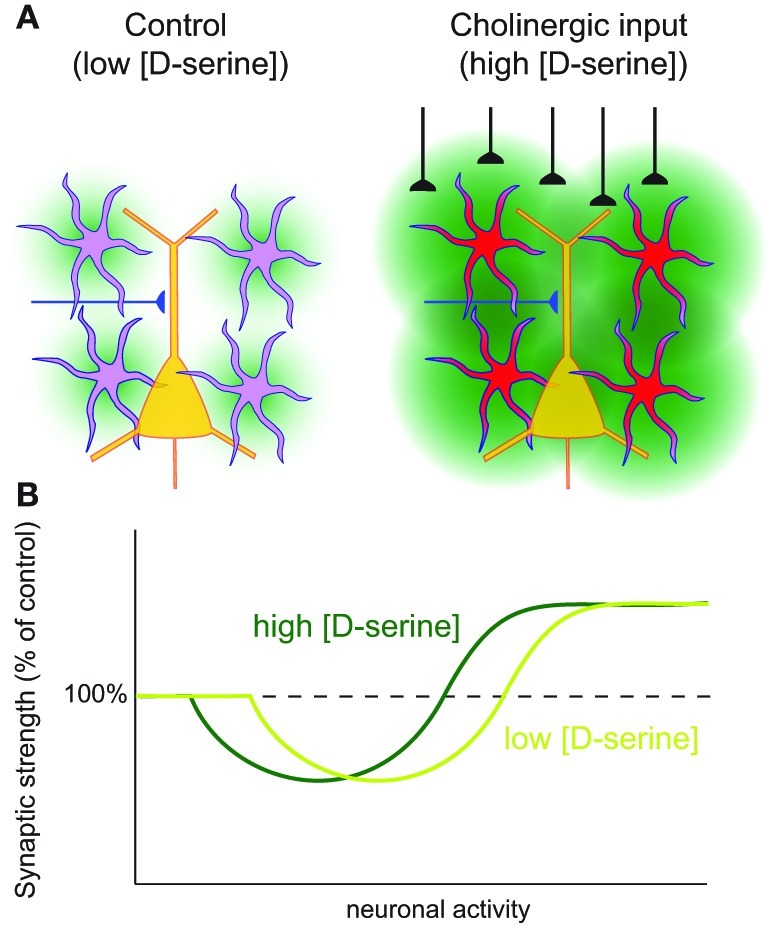
Astrocyte mediated metaplasticity. (A) Left: under basal conditions astrocytes release a basal tone of d-serine (green) which is sensed by neuronal NMDARs. Right: when astrocytes are stimulated, for example by the activation of cholinergic fibers, this leads to an increased release of d-serine from the astrocytes, which leads to an increased availability of neuronal NMDARs for activation. (B) Hypothetical BCM curve for the induction of LTP and LTD. Depending on the concentration of astrocyte-derived d-serine, the neuronal activity requirements for induction of LTP and LTD will shift.
Figure 3
Figure 3
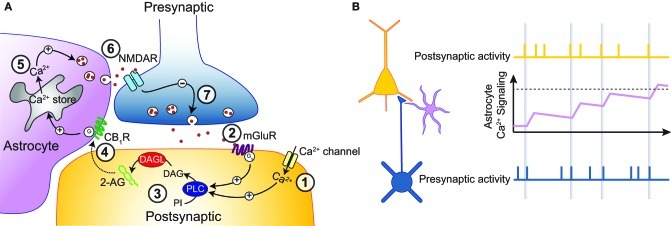
Astrocytes as memory elements. (A) Schematic representation of the pathway leading to t-LTD at developing neocortical synapses. A postsynaptic action potential leads to Ca2+ influx into the postsynaptic neuron (1). When this is followed by a presynaptic action potential, leading to activation of mGluRs (2), PLC is strongly activated (3), leading to the synthesis of endocannabinoids. These endocannabinoids leave the postsynaptic neuron to activate astrocytic CB1Rs (4), which cause release of Ca2+ from intracellular stores (5). The resultant Ca2+ transients trigger vesicular release of glutamate from the astrocyte, which in turn activates presynaptic NMDARs (6). This leads to a long-lasting depression in presynaptic release probability (7). (B) Astrocytes could act as memory elements. Schematic showing the action potential activity of a presynaptic (bottom, blue) and a postsynaptic (top, yellow) neuron, as well as the Ca2+ activity of a neighboring astrocyte (middle, pink). By sensing the buildup of endocannabinoids during subsequent pairings, astrocyte activity would gradually increase during the induction of t-LTD. t-LTD could then be induced only when astrocyte activity reaches a certain threshold (dotted line).

References

    1. Abbott L. F., Regehr W. G. (2004). Synaptic computation. Nature 431, 796–803 10.1038/nature03010 - DOI - PubMed
    1. Abraham W. C. (2008). Metaplasticity: tuning synapses and networks for plasticity. Nat. Rev. Neurosci. 9, 387 10.1038/nrn2356 - DOI - PubMed
    1. Abraham W. C., Bear M. F. (1996). Metaplasticity: the plasticity of synaptic plasticity. Trends Neurosci. 19, 126–130 10.1007/978-3-540-88955-7_6 - DOI - PubMed
    1. Agulhon C., Fiacco T. A., McCarthy K. D. (2010). Hippocampal short- and long-term plasticity are not modulated by astrocyte Ca2+ signaling. Science 327, 1250–1254 10.1126/science.1184821 - DOI - PubMed
    1. Alle H., Geiger J. R. P. (2006). Combined analog and action potential coding in hippocampal mossy fibers. Science 311, 1290–1293 10.1126/science.1119055 - DOI - PubMed

LinkOut - more resources