


Diagnostic accuracy of confocal laser endomicroscopy in diagnosing dysplasia in patients affected by long-standing ulcerative colitis
- PMID: 23125900
- PMCID: PMC3487190
- DOI: 10.4253/wjge.v4.i9.414
Diagnostic accuracy of confocal laser endomicroscopy in diagnosing dysplasia in patients affected by long-standing ulcerative colitis
Abstract
Aim: To evaluate the diagnostic accuracy of confocal laser endomicroscopy (CLE) for the detection of dysplasia in long-standing ulcerative colitis (UC).
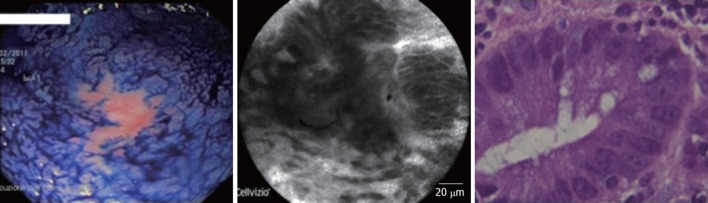
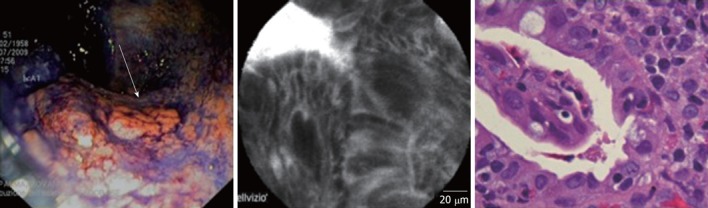
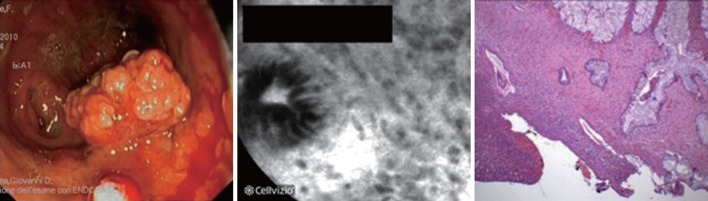
Methods: We prospectively performed a surveillance colonoscopy in 51 patients affected by long-standing UC. Also, in the presence of macroscopic areas with suspected dysplasia, both targeted contrasted indigo carmine endoscopic assessment and probe-based CLE were performed. Colic mucosal biopsies and histology, utilised as the gold standard, were assessed randomly and on visible lesions, in accordance with current guidelines.
Results: Fourteen of the 51 patients (27%) showed macroscopic mucosal alterations with the suspected presence of dysplasia, needing chromoendoscopic and CLE evaluation. In 5 macroscopically suspected cases, the presence of dysplasia was confirmed by histology (3 flat dysplasia; 2 DALMs). No dysplasia/cancer was found on any of the outstanding random biopsies. The diagnostic accuracy of CLE for the detection of dysplasia compared to standard histology was sensitivity 100%, specificity 90%, positive predictive value 83% and negative predictive value 100%.
Conclusion: CLE is an accurate tool for the detection of dysplasia in long-standing UC and shows optimal values of sensitivity and negative predictivity. The scheduled combined application of chromoendoscopy and CLE could maximize the endoscopic diagnostic accuracy for diagnosis of dysplasia in UC patients, thus limiting the need for biopsies.
Keywords: Cancer; Confocal; Surveillance; Ulcerative colitis.
Figures
References
-
- Lakatos L, Mester G, Erdelyi Z, David G, Pandur T, Balogh M, Fischer S, Vargha P, Lakatos PL. Risk factors for ulcerative colitis-associated colorectal cancer in a Hungarian cohort of patients with ulcerative colitis: results of a population-based study. Inflamm Bowel Dis. 2006;12:205–211. - PubMed
-
- Jess T, Winther KV, Munkholm P, Langholz E, Binder V. Intestinal and extra-intestinal cancer in Crohn’s disease: follow-up of a population-based cohort in Copenhagen County, Denmark. Aliment Pharmacol Ther. 2004;19:287–293. - PubMed
-
- Karlén P, Löfberg R, Broström O, Leijonmarck CE, Hellers G, Persson PG. Increased risk of cancer in ulcerative colitis: a population-based cohort study. Am J Gastroenterol. 1999;94:1047–1052. - PubMed
-
- Rex DK, Johnson DA, Anderson JC, Schoenfeld PS, Burke CA, Inadomi JM. American College of Gastroenterology guidelines for colorectal cancer screening 2009 [corrected] Am J Gastroenterol. 2009;104:739–750. - PubMed
LinkOut - more resources
Full Text Sources
