


Clostridium difficile infection in patients with chronic kidney disease
- PMID: 23127731
- PMCID: PMC3541867
- DOI: 10.1016/j.mayocp.2012.05.025
Clostridium difficile infection in patients with chronic kidney disease
Abstract
Objective: To examine the rate of Clostridium difficile infection (CDI) and hospital-associated outcomes in a national cohort of hospitalized patients with chronic kidney disease (CKD) and assess the impact of long-term dialysis on outcome in these patients.
Patients and methods: Data for January 1, 2005, through December 31, 2009 were obtained from the National Hospital Discharge Survey, which includes information on patient demographics, diagnoses, procedures, and discharge types. Data collected and analyzed for this study included age, sex, race, admission type (urgent or emergent combined vs elective), any colectomy diagnosis, length of stay, type of discharge, and mortality. International Classification of Diseases, Ninth Revision, Clinical Modification codes were utilized to identify CKD patients and CDI events. Weighted analysis was performed using JMP version 9.
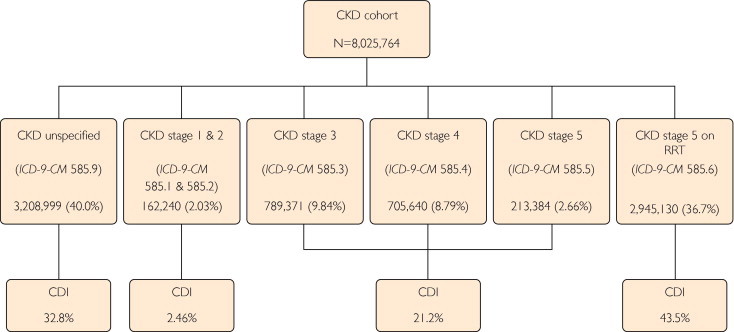
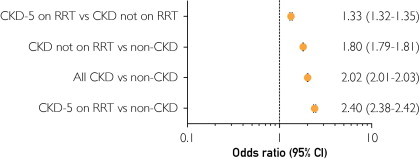
Results: An estimated 162 million adults were hospitalized during 2005-2009, and 8.03 million (5%) had CKD (median age, 71 years). The CDI rate in CKD patients was 1.49% (0.119 million) compared with 0.70% (1.14 million) in patients without CKD (P<.001). Patients with CKD who were undergoing long-term dialysis were more than 2 times as likely to develop CDI than non-CKD patients and 1.33 times more likely than CKD patients not undergoing dialysis (all P<.001). In a weighted multivariate analysis adjusting for sex and comorbidities, patients with CKD and CDI had longer hospitalization, higher colectomy rate (adjusted odds ratio [aOR], 2.30; 95% confidence interval [CI], 2.14-2.47), dismissal to a health care facility (aOR, 2.22; 95% CI, 2.19-2.25), and increased in-hospital mortality (aOR, 1.55; 95% CI, 1.52-1.59; all P<.001) as compared with CKD patients without CDI. Patients with CKD who were undergoing long-term dialysis did not have worse outcomes as compared with CKD patients who were not undergoing long-term dialysis.
Conclusion: These data suggest that patients with CKD have a higher risk of CDI and increased hospital-associated morbidity and mortality. Future prospective studies are needed to confirm these findings and to identify effective CDI prevention in CKD patients, who appear to have an increased risk of CDI acquisition.
Copyright © 2012 Mayo Foundation for Medical Education and Research. Published by Elsevier Inc. All rights reserved.
Figures
Comment in
-
Clostridium difficile: the emerging epidemic.Mayo Clin Proc. 2012 Nov;87(11):1037-9. doi: 10.1016/j.mayocp.2012.09.004. Mayo Clin Proc. 2012. PMID: 23127729 Free PMC article. No abstract available.
References
-
- Cohen D.N., Gerding S.H., Johnson S., Society for Healthcare Epidemiology of America; Infectious Diseases Society of America Clinical practice guidelines for Clostridium difficile infection in adults: 2010 update by the Society for Healthcare Epidemiology of America (SHEA) and the Infectious Diseases Society of America (IDSA) Infect Control Hosp Epidemiol. 2010;31(5):431–455. - PubMed
-
- Khanna S., Pardi D.S. The growing incidence and severity of Clostridium difficile infection in inpatient and outpatient settings. Expert Rev Gastroenterol Hepatol. 2010;4(4):409–416. - PubMed
MeSH terms
LinkOut - more resources
Full Text Sources
Medical
