


Branched-chain and aromatic amino acids are predictors of insulin resistance in young adults
- PMID: 23129134
- PMCID: PMC3579331
- DOI: 10.2337/dc12-0895
Branched-chain and aromatic amino acids are predictors of insulin resistance in young adults
Abstract
Objective: Branched-chain and aromatic amino acids are associated with the risk for future type 2 diabetes; however, the underlying mechanisms remain elusive. We tested whether amino acids predict insulin resistance index in healthy young adults.
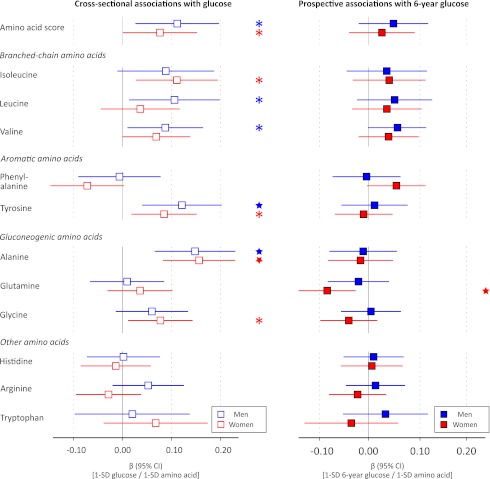
Research design and methods: Circulating isoleucine, leucine, valine, phenylalanine, tyrosine, and six additional amino acids were quantified in 1,680 individuals from the population-based Cardiovascular Risk in Young Finns Study (baseline age 32 ± 5 years; 54% women). Insulin resistance was estimated by homeostasis model assessment (HOMA) at baseline and 6-year follow-up. Amino acid associations with HOMA of insulin resistance (HOMA-IR) and glucose were assessed using regression models adjusted for established risk factors. We further examined whether amino acid profiling could augment risk assessment of insulin resistance (defined as 6-year HOMA-IR >90th percentile) in early adulthood.
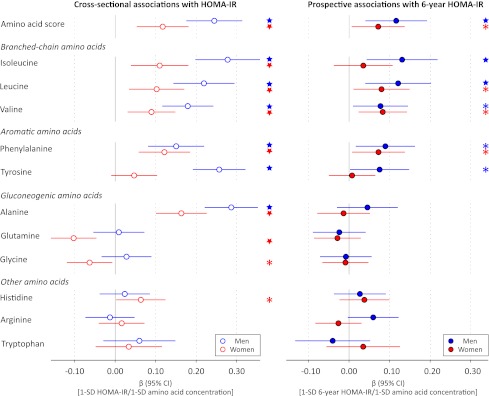
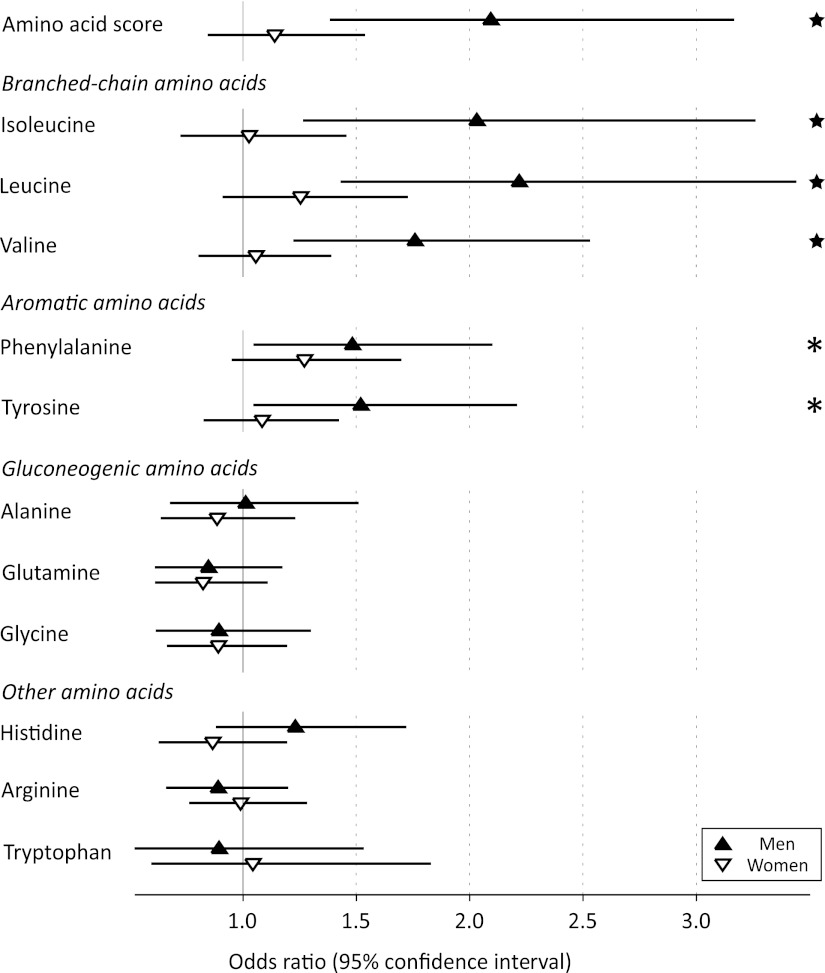
Results: Isoleucine, leucine, valine, phenylalanine, and tyrosine were associated with HOMA-IR at baseline and for men at 6-year follow-up, while for women only leucine, valine, and phenylalanine predicted 6-year HOMA-IR (P < 0.05). None of the other amino acids were prospectively associated with HOMA-IR. The sum of branched-chain and aromatic amino acid concentrations was associated with 6-year insulin resistance for men (odds ratio 2.09 [95% CI 1.38-3.17]; P = 0.0005); however, including the amino acid score in prediction models did not improve risk discrimination.
Conclusions: Branched-chain and aromatic amino acids are markers of the development of insulin resistance in young, normoglycemic adults, with most pronounced associations for men. These findings suggest that the association of branched-chain and aromatic amino acids with the risk for future diabetes is at least partly mediated through insulin resistance.
Figures
References
-
- Muoio DM, Newgard CB. Mechanisms of disease: molecular and metabolic mechanisms of insulin resistance and beta-cell failure in type 2 diabetes. Nat Rev Mol Cell Biol 2008;9:193–205 - PubMed
-
- Lillioja S, Mott DM, Spraul M, et al. Insulin resistance and insulin secretory dysfunction as precursors of non-insulin-dependent diabetes mellitus. Prospective studies of Pima Indians. N Engl J Med 1993;329:1988–1992 - PubMed
-
- Warram JH, Martin BC, Krolewski AS, Soeldner JS, Kahn CR. Slow glucose removal rate and hyperinsulinemia precede the development of type II diabetes in the offspring of diabetic parents. Ann Intern Med 1990;113:909–915 - PubMed
-
- Moran A, Jacobs DR, Jr, Steinberger J, et al. Changes in insulin resistance and cardiovascular risk during adolescence: establishment of differential risk in males and females. Circulation 2008;117:2361–2368 - PubMed
Publication types
MeSH terms
Substances
LinkOut - more resources
Full Text Sources
Other Literature Sources
