


Selenoprotein P genetic variants and mrna expression, circulating selenium, and prostate cancer risk and survival
- PMID: 23129481
- PMCID: PMC3640488
- DOI: 10.1002/pros.22611
Selenoprotein P genetic variants and mrna expression, circulating selenium, and prostate cancer risk and survival
Abstract
Background: Low levels of selenium have been associated with increased risk of prostate cancer (PCa). Selenoprotein P is the most abundant selenoprotein in serum and delivers ten selenocysteine residues to tissues. Variation in the selenoprotein P gene (SEPP1) may influence PCa development or modify the effects of selenium. We examined the association of SEPP1 single nucleotide polymorphisms (SNPs) with PCa risk and survival, and tested for interactions.
Methods: The Physicians' Health Study (PHS) is a prospective cohort of 22,071 US physicians; we utilized a nested case-control study of 1,352 PCa cases and 1,382 controls. We assessed four SNPs capturing common variation within the SEPP1 locus. In a subset of men (n = 80), we evaluated SEPP1 mRNA expression in tumors.
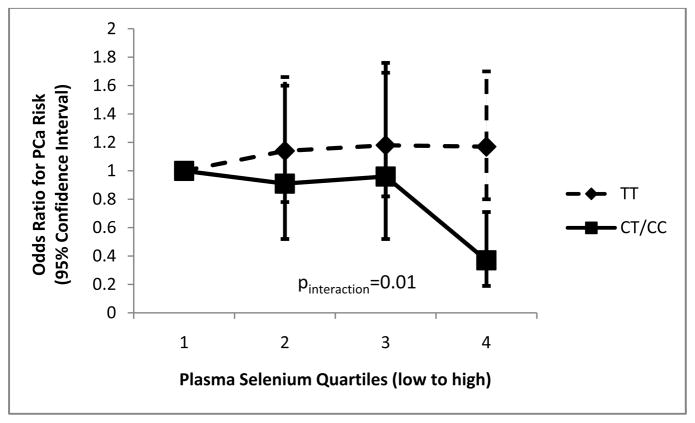
Results: Two SNPs were significantly associated with PCa risk. For rs11959466, each T allele increased risk (odds ratio (OR) = 1.31; 95% confidence interval (CI): 1.02,1.69; P(trend) = 0.03). For rs13168440, the rare homozygote genotype decreased risk compared to the common homozygote (OR = 0.56, 95% CI: 0.33, 0.96). Moreover, there was a significant interaction of rs13168440 with plasma selenium; increasing selenium levels were associated with decreased PCa risk only among men with the minor allele (P(interaction) = 0.01). SEPP1 expression was significantly lower in men with lethal PCa than long-term survivors.
Conclusions: SEPP1 genetic variation was associated with PCa incidence; replication of these results in an independent dataset is necessary. These findings further support a causal link between selenium and PCa, and suggest that the effect of selenium may differ by genetics.
Copyright © 2012 Wiley Periodicals, Inc.
Conflict of interest statement
None of the authors has a conflict of interest relevant to this study.
Figures
References
-
- Duffield-Lillico AJ, Dalkin BL, Reid ME, Turnbull BW, Slate EH, Jacobs ET, Marshall JR, Clark LC. Selenium supplementation, baseline plasma selenium status and incidence of prostate cancer: an analysis of the complete treatment period of the Nutritional Prevention of Cancer Trial. BJU Int. 2003;91(7):608–612. - PubMed
-
- Yoshizawa K, Willett WC, Morris SJ, Stampfer MJ, Spiegelman D, Rimm EB, Giovannucci E. Study of prediagnostic selenium level in toenails and the risk of advanced prostate cancer. J Natl Cancer Inst. 1998;90(16):1219–1224. - PubMed
-
- Li H, Stampfer MJ, Giovannucci EL, Morris JS, Willett WC, Gaziano JM, Ma J. A prospective study of plasma selenium levels and prostate cancer risk. J Natl Cancer Inst. 2004;96(9):696–703. - PubMed
-
- Clark LC, Combs GF, Jr, Turnbull BW, Slate EH, Chalker DK, Chow J, Davis LS, Glover RA, Graham GF, Gross EG, Krongrad A, Lesher JL, Jr, Park HK, Sanders BB, Jr, Smith CL, Taylor JR. Effects of selenium supplementation for cancer prevention in patients with carcinoma of the skin. A randomized controlled trial. Nutritional Prevention of Cancer Study Group. JAMA. 1996;276(24):1957–1963. - PubMed
-
- Lippman SM, Klein EA, Goodman PJ, Lucia MS, Thompson IM, Ford LG, Parnes HL, Minasian LM, Gaziano JM, Hartline JA, Parsons JK, Bearden JD, 3rd, Crawford ED, Goodman GE, Claudio J, Winquist E, Cook ED, Karp DD, Walther P, Lieber MM, Kristal AR, Darke AK, Arnold KB, Ganz PA, Santella RM, Albanes D, Taylor PR, Probstfield JL, Jagpal TJ, Crowley JJ, Meyskens FL, Jr, Baker LH, Coltman CA., Jr Effect of selenium and vitamin E on risk of prostate cancer and other cancers: the Selenium and Vitamin E Cancer Prevention Trial (SELECT) JAMA. 2009;301(1):39–51. - PMC - PubMed
Publication types
MeSH terms
Substances
Grants and funding
LinkOut - more resources
Full Text Sources
Medical
Miscellaneous
