


Measurement of reverse cholesterol transport pathways in humans: in vivo rates of free cholesterol efflux, esterification, and excretion
- PMID: 23130164
- PMCID: PMC3487360
- DOI: 10.1161/JAHA.112.001826
Measurement of reverse cholesterol transport pathways in humans: in vivo rates of free cholesterol efflux, esterification, and excretion
Abstract
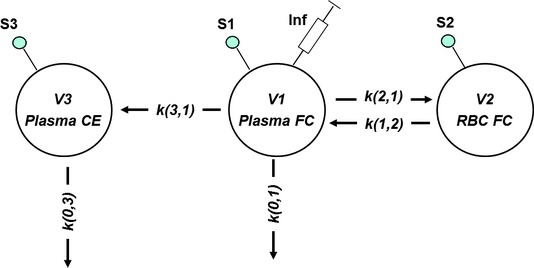
Background: Reverse cholesterol transport from peripheral tissues is considered the principal atheroprotective mechanism of high-density lipoprotein, but quantifying reverse cholesterol transport in humans in vivo remains a challenge. We describe here a method for measuring flux of cholesterol though 3 primary components of the reverse cholesterol transport pathway in vivo in humans: tissue free cholesterol (FC) efflux, esterification of FC in plasma, and fecal sterol excretion of plasma-derived FC.
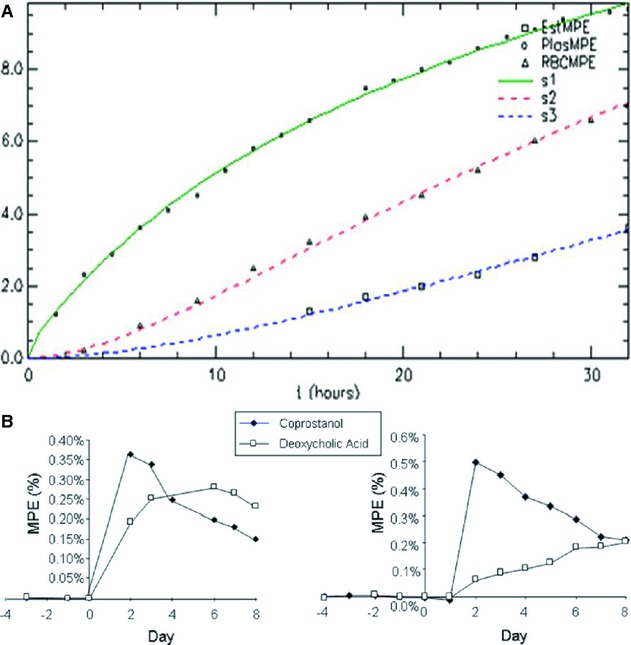
Methods and results: A constant infusion of [2,3-(13)C(2)]-cholesterol was administered to healthy volunteers. Three-compartment SAAM II (Simulation, Analysis, and Modeling software; SAAM Institute, University of Washington, WA) fits were applied to plasma FC, red blood cell FC, and plasma cholesterol ester (13)C-enrichment profiles. Fecal sterol excretion of plasma-derived FC was quantified from fractional recovery of intravenous [2,3-(13)C(2)]-cholesterol in feces over 7 days. We examined the key assumptions of the method and evaluated the optimal clinical protocol and approach to data analysis and modeling. A total of 17 subjects from 2 study sites (n=12 from first site, age 21 to 75 years, 2 women; n=5 from second site, age 18 to 70 years, 2 women) were studied. Tissue FC efflux was 3.79±0.88 mg/kg per hour (mean ± standard deviation), or ≍8 g/d. Red blood cell-derived flux into plasma FC was 3.38±1.10 mg/kg per hour. Esterification of plasma FC was ≍28% of tissue FC efflux (1.10±0.38 mg/kg per hour). Recoveries were 7% and 12% of administered [2,3-(13)C(2)]-cholesterol in fecal bile acids and neutral sterols, respectively.
Conclusions: Three components of systemic reverse cholesterol transport can be quantified, allowing dissection of this important function of high-density lipoprotein in vivo. Effects of lipoproteins, genetic mutations, lifestyle changes, and drugs on these components can be assessed in humans. (J Am Heart Assoc. 2012;1:e001826 doi: 10.1161/JAHA.112.001826.).
Keywords: cholesterol efflux; esterification; isotope labeling, stable; reverse cholesterol transport; sterol excretion.
Figures
References
-
- Goldstein JL, Brown MS. Regulation of the mevalonate pathway. Nature. 1990;343:425-430 - PubMed
-
- Dietschy JM, Turley SD, Spady DK. Role of liver in the maintenance of cholesterol and low density lipoprotein homeostasis in different animal species, including humans. J Lipid Res. 1993;34:1637-1659 - PubMed
-
- Phillips MC, Johnson WJ, Rothblat GH. Mechanisms and consequences of cellular cholesterol exchange and transfer. Biochim Biophys Acta. 1987;906:223-276 - PubMed
-
- Fielding CJ, Fielding PE. Cellular cholesterol efflux. Biochim Biophys Acta. 2001;1533:175-189 - PubMed
Grants and funding
LinkOut - more resources
Full Text Sources
Other Literature Sources
