Review
. 2012 Nov;142(5):1289-1299.
doi: 10.1378/chest.12-0809.

The emerging importance of autophagy in pulmonary diseases

Affiliations
Review

The emerging importance of autophagy in pulmonary diseases

Kenji Mizumura et al. Chest. 2012 Nov.

Abstract

Important cellular processes such as inflammation, apoptosis, differentiation, and proliferation confer critical roles in the pathogenesis of human diseases. In the past decade, an emerging process named "autophagy" has generated intense interest in both biomedical research and clinical medicine. Autophagy is a regulated cellular pathway for the turnover of organelles and proteins by lysosomal-dependent processing. Although autophagy was once considered a bulk degradation event, research shows that autophagy selectively degrades specific proteins, organelles, and invading bacteria, a process termed "selective autophagy." It is increasingly clear that autophagy is directly relevant to clinical disease, including pulmonary disease. This review outlines the principal components of the autophagic process and discusses the importance of autophagy and autophagic proteins in pulmonary diseases from COPD, α1-antitrypsin deficiency, pulmonary hypertension, acute lung injury, and cystic fibrosis to respiratory infection and sepsis. Finally, we examine the dual nature of autophagy in the lung, which has both protective and deleterious effects resulting from adaptive and maladaptive responses, and the challenge this duality poses for designing autophagy-based diagnostic and therapeutic targets in lung disease.


Figures
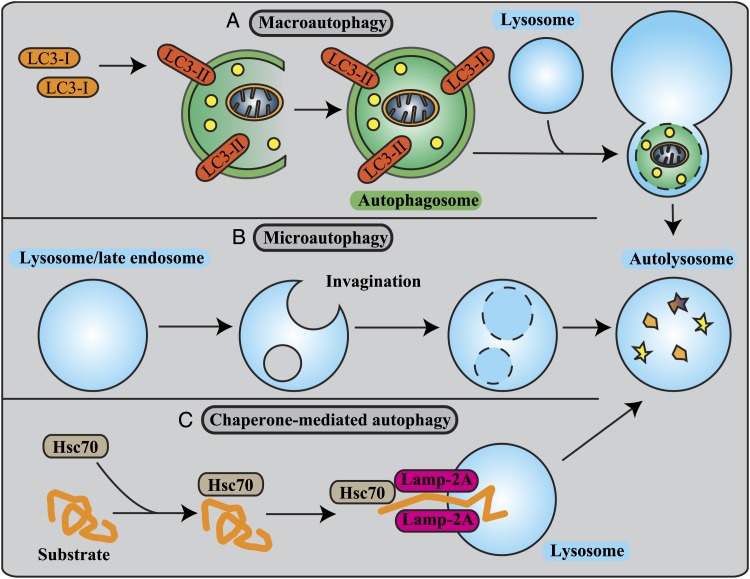
Figure 1.
Figure 1.
Three different types of autophagy. A, Macroautophagy is a dynamic process involving the rearrangement of subcellular membranes to sequester cytoplasm and organelles for delivery to the lysosome or vacuole where the sequestered cargo is degraded and recycled. LC3 is known to exist on autophagosomes, and hence, LC3 is a widely used marker for autophagosomes. B, In microautophagy, the lysosomal membrane is invaginated to sequester cytosolic constituents into intralysosomal vesicles. C, In chaperone-mediated autophagy, proteins containing the KFERQ motif bind to Hsc70 and cochaperones. These complexes are translocated across the lysosomal membrane after binding with Lamp-2A. Hsc70 = heat shock cognate 70; Lamp-2A = lysosome-associated membrane protein type 2a; LC3 = microtubule-associated protein light 1 chain 3.
Figure 2.
Figure 2.
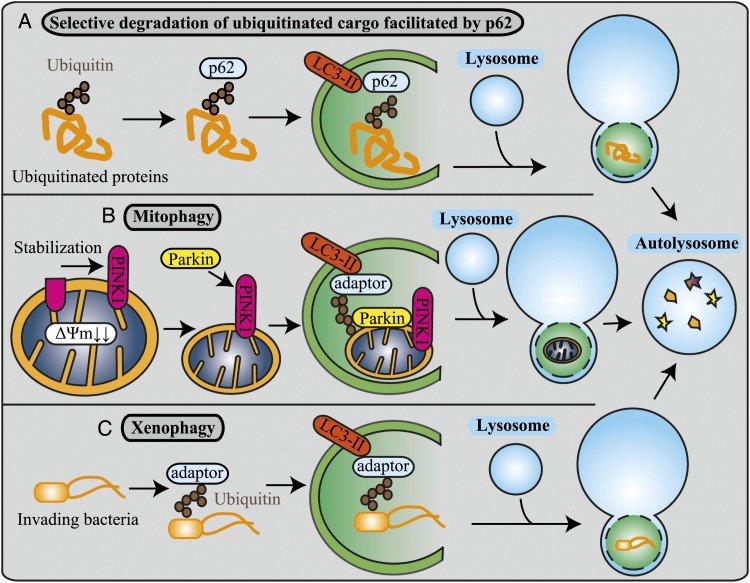
Selective autophagy. A, In the selective degradation of ubiquitinated cargo facilitated by p62, the p62 substrate interacts with monoubiquitinated or polyubiquitinated proteins through its ubiquitin-associated domain. This complex is selectively sequestered into autophagosomes. B, Mitophagy is the specific autophagic elimination of mitochondria. In response to the loss of the membrane potential, PINK1 accumulates, and parkin translocates to damaged mitochondria. Parkin ubiquitinates outer membrane proteins and induces mitophagy. C, In xenophagy, invading extracellular pathogens are recognized and captured by the autophagic machinery through ubiquitin-dependent and ubiquitin-independent mechanisms. Adaptors mediate autophagic sequestration of the pathogens to restrict their growth. PINK1 = PTEN (phosphatase and tensin homolog)-induced putative kinase 1. See Figure 1 legend for expansion of other abbreviation.

References

    1. Mizushima N, Komatsu M. Autophagy: renovation of cells and tissues. Cell. 2011;147(4):728-741 - PubMed
    1. Chen ZH, Kim HP, Sciurba FC, et al. Egr-1 regulates autophagy in cigarette smoke-induced chronic obstructive pulmonary disease. PLoS ONE. 2008;3(10):e3316. - PMC - PubMed
    1. Chen ZH, Lam HC, Jin Y, et al. Autophagy protein microtubule-associated protein 1 light chain-3B (LC3B) activates extrinsic apoptosis during cigarette smoke-induced emphysema. Proc Natl Acad Sci U S A. 2010;107(44):18880-18885 - PMC - PubMed
    1. Monick MM, Powers LS, Walters K, et al. Identification of an autophagy defect in smokers’ alveolar macrophages. J Immunol. 2010;185(9):5425-5435 - PMC - PubMed
    1. Granell S, Baldini G, Mohammad S, et al. Sequestration of mutated alpha1-antitrypsin into inclusion bodies is a cell-protective mechanism to maintain endoplasmic reticulum function. Mol Biol Cell. 2008;19(2):572-586 - PMC - PubMed

Publication types